

💥 Who Won the General Strike?
Plus: Vox's surprise hit on RTVE, a manhunt in Oviedo, and does Isa have a new boy?
Madrid | Issue #168 | The Bubble is Spain's #1 English-language newsletter. We offer paid and free subscriptions (which you can customize). For sponsorships, click here.
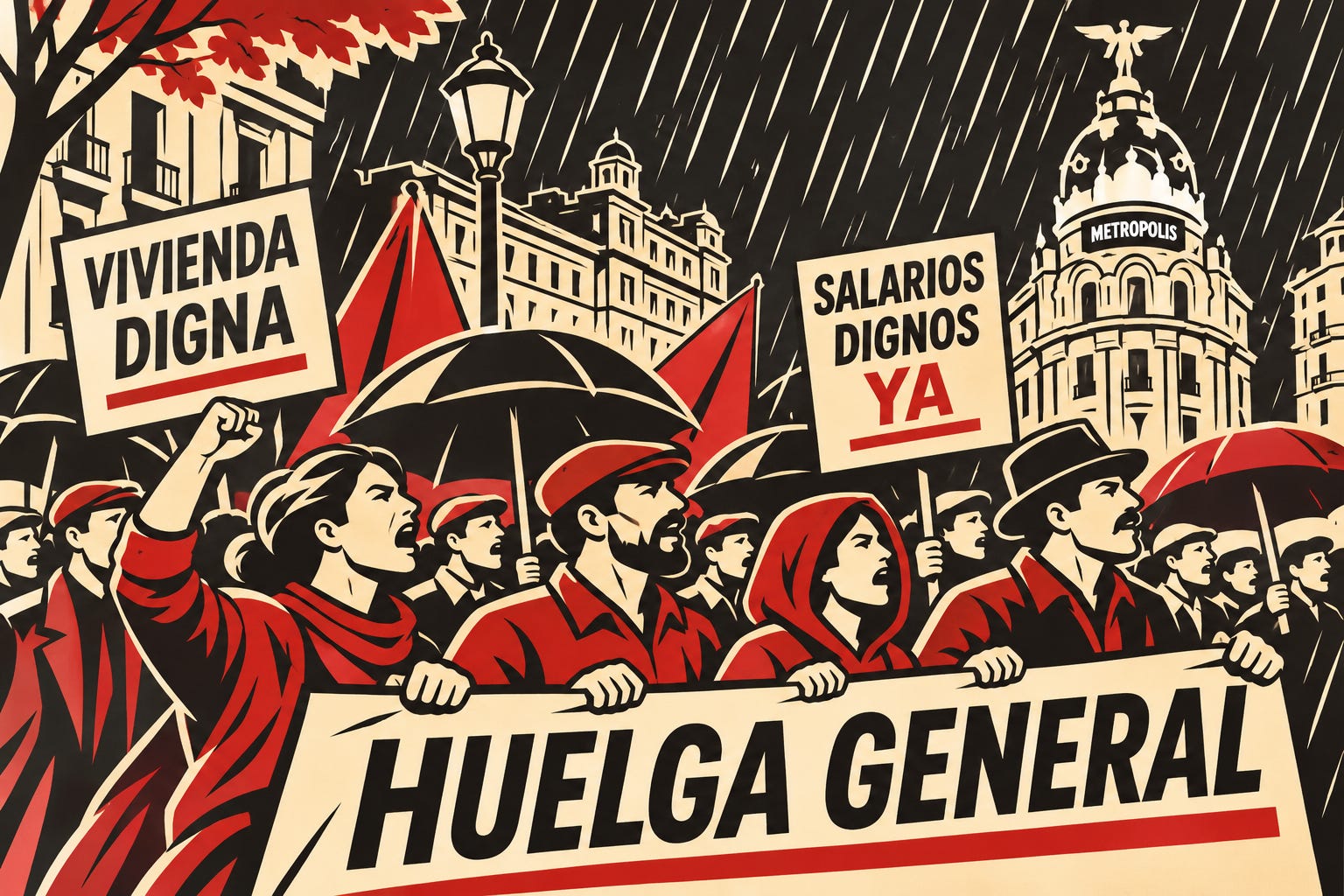
✊ An “atypical” general strike
Here's a story about a general strike. After an 87-year-old Madrid renter is evicted and then dies, a housing activist union calls for a general strike because housing in Spain is such a crisis (i.e., no one can afford it). And lots of people are super into the strike because…unhappy about housing and also low wages. But the activists can't legally hold a strike because they're not really a union. So the big unions say they'll hold it, because people don't care much about the unions anymore and they want attention they want to help. And they call one. But
But, but, but. It's not clear what exactly it's for — did strikers want a law, or more money, or…? — or who it's against (because normally it's against the government, but this one feels like it's not, and the government that's been in power for eight years says it's for the strike). Oh, and then it rains 🐱 and 🐶. And it's just before elections.
That's basically yesterday in a nutshell. The big UGT and CCOO umbrella unions, along with tenants’ groups, held the country's first national general strike in 14 years. People sat out work across the country, especially in factories and, to a lesser extent, in state jobs.
Well… Was it a success? Depends on who you ask. Organizers said 4m workers (maybe even 5m) joined and called it a “resounding success”, while the CEOE employers federation said only 5% of workers participated and called the strike a “failure.”
Minor disagreements. Madrid's Health Department estimated that participation barely exceeded 5%, while the CCOO union put the figure at 35%. In schools, the numbers also varied — ranging from 30% according to the government to 65% according to the unions. 🤷♀️
Even some health worker union organizers suggested the strike's “atypical” nature (as we noted above) may have put some workers off: “There is more work activity than we would have liked,” one said.
Canceled: 24% of AVE trains and 10% of Cercanías regional rail and more than 300 flights (about 7.3% of those scheduled).
The revolution will not be televised. In Andalucía, the local Canal Sur network went dark for hours, while in Catalonia, masked protesters forced the local RTVE network to stop broadcasting.
What's a protest without clashes with police? More than 74 people were detained by the police during the day, according to police and media reports.
Lots of people. The largest protest was in Madrid, where 120,000 workers marched on Gran Vía, according to the national government's delegate in the region (the tenants’ union said 400,000…500,000…750,000. It’s unclear. Counting is hard, apparently). Some protesters (including singer and content creator Samantha Hudson) said the police pepper-sprayed them “for no reason”.
Some people like masks. In Barcelona, after tens of thousands of people marched, people in hoods smashed shop windows and fired fireworks at the regional police force (Catalonia's presi, Salvador Illa, warned rioters on X that, “In Catalonia, you pay for what you do.").
And of course the politicians said stuff. In favor? The Socialist-led government and its left-wing allies. Against it? The conservative PP, far-right Vox, and Catalan separatist party Junts.
The center-right PP has been particularly aggressive. Party leader Alberto Núñez Feijóo called the strike “absurd,” while Madrid regional presi Isabel Díaz Ayuso described the unions as “garbage” (yikes) and urged Feijóo to curb their influence if he becomes prime minister.
Vox was also mad. Party leader Santiago Abascal argued that the strike “shouldn’t be legal,” and said that, “if the Spanish people give us their support [on Nov. 29], there will never again be ‘informational’ pickets in Spain shutting down businesses and preventing people from freely carrying out their full day’s work.”
On the left, politicians were for it. Government spokesperson Elma Saiz defended the constitutional right to strike and demanded respect for the unions — while largely avoiding questions about the government’s own responsibility for the problems being protested.
Podemos candidate Irene Montero joined picket lines in Madrid, while leftist separatist ERC’s Gabriel Rufián backed the mobilization but reminded Sánchez that his allies had been warning him about the housing crisis for months.
So, in the end, was the strike a success? Depends on your media diet. According to PSOE-friendly El País, more strikes may be coming after the elections, while according to PP-friendly El Mundo, “the politically motivated strike fell flat”. You choose.
More news below. 👇👇
🎙️ Listen to episode 8 of The Bubble Podcast!
Foreign policy and guiri confessions: former Foreign Minister Arancha González Laya joins our latest podcast to discuss Spain’s place in the world.
We also tackle the pension debate and hear American creator Danielle Grobman’s tips for escaping Madrid’s “expat” bubble. Escaping The Bubble remains discouraged.
🎧 Listen now. Spotify | Apple Podcasts | YouTube
💬 Five things to discuss at dinner parties
1. 🥊 Santiago Abascal vs. David Broncano in an interview that became the story of the week
We know you don’t really follow Spanish TV (shame on you), but if one story had everyone in this country talking this week, it was the spectacularly awkward interview on Monday night of Santiago Abascal, leader of far-right Vox, by the comedian David Broncano, host of La Revuelta, one of the country’s highest-rated TV shows.
Shiver with anticipation. The primetime show, on public broadcaster RTVE, has a humorous, progressive slant and a mostly lefty audience. Abascal’s politics are the opposite of that, so we knew his presence was going to be controversial. What nobody expected was just how badly it would go for Broncano.
Then why do it? Broncano argued that public TV should give different voices a chance, and La Revuelta had already hosted friendly interviews with PM Sánchez and left-wing candidates Irene Montero and Gabriel Rufián.
The problems started before the show. Vox demanded that its team be allowed to select the studio audience, fearing that the show’s regular crowd would boo its dear leader.
Not quite, but almost. The producers refused but, in an extraordinary concession, apparently outsourced the “casting” of the audience to entertainment agencies. The result? Abascal entered the studio to chants of “President! President!” and spent much of the interview receiving furious applause from some in the audience.
Abascal was unchained. He blamed Spain’s housing crisis partly on mass immigration, dismissed worries about climate change, and said PM Sánchez was a dictator. (When asked about Franco, an actual dictator, he claimed not to have a position.) 💀
Nervous host. Broncano was visibly nervous, stumbling over questions and struggling to respond to Abascal’s rehearsed talking points (and jokes).
Broncano attempted to push back on issues ranging from immigration and Gaza to feminism and gender violence, but repeatedly lost control of the conversation.
Abascal even joked that colleagues had suggested bringing Broncano cardboard boxes so he could “pack up his belongings”, implying that his television career would end if Vox came to power.
At the end of the interview, Broncano told him, “I can’t wish you luck.” Abascal replied, “I can wish you luck, because you’re going to need it”.
A ratings explosion…and a critical disaster. 4.8m tuned in ‼️, delivering a historic audience for La Revuelta, but the following morning Spain’s left-leaning newspapers, television panels, and social media (i.e. Broncano’s usual fans) were merciless.
Bad, bad, very bad. One El País columnist described it as probably “the worst interview in the history of Spanish television”.
Broncano apologized on TV the next night. Entering the studio to a funeral march, he admitted he was disappointed in himself: “I really fucked up here.”
He explained he’d agreed to change the audience because he didn’t want Vox to say public TV had silenced Abascal. And knowing he’d made a serious mistake distracted him throughout the interview, he said.
No planning. He also said he’d tried to conduct a conventional political interview without the necessary preparation. 🤦
Not everyone thought Broncano deserved a public flogging. Some media watchers argued that expecting a comedian to perform like a seasoned political journalist was unreasonable, even if accepting some of Vox’s conditions had been an error.
What’s next? Abascal walked away with enormous exposure and plenty of viral moments weeks before the election, but it wasn’t enough.
Never happy. Yesterday he canceled a scheduled appearance on The Wild Project, the hugely popular podcast hosted by Jordi Wild (aka Spain’s Joe Rogan), as Vox accused RTVE of withholding 40 minutes of footage from La Revuelta and complained that the party hadn’t been allowed to suggest which parts of the interview made it to air.
Wild (who is also interviewing Sánchez, PP’s Núñez Feijóo and Frente Amplio’s Ada Colau before the elections) is furious and released a 15-minute video rant saying Vox has “disrespected” his work, and he’s “disappointed” in them. (FYI, Wild is usually perceived as socially progressive but economically liberal).
The party now threatens to boycott interviews unless outlets agree to its conditions regarding the editing and publication of its candidates’ answers.
That’s not how journalism generally works, so maybe Vox shouldn’t hold its breath.
2. 🚨 Oviedo on lockdown: The hunt is on for a fugitive accused of killing a police officer
A massive manhunt was underway in the northern city of Oviedo yesterday after a suspected gunman allegedly shot a teenage girl and planted a bomb that killed a police officer and a police dog on Tuesday.
Flood the zone. More than 100 officers (including elite tactical units) are searching for a 64-year-old former soldier believed to be armed and potentially carrying additional explosives. The man is still at large, and authorities have established checkpoints across the city and its main exit routes.
It started with a feud between neighbors that apparently spiraled out of control. The suspect, identified as Manuel Ferrero Albares and nicknamed El Ruso (The Russian, because of his Russian wife), had apparently been involved in longstanding arguments with neighbors in his apartment building.
Knows his weapons. Ferrero is a former member of the Spanish Legion’s special operations forces and has experience handling explosives and a criminal record involving theft. Authorities are saying he wanted to blow up the building, although many details are still unclear.
Things escalated quickly. On Tuesday around 7 a.m., Ferrero apparently shot a 17-year-old neighbor five times (she’s been hospitalized but is apparently out of danger) and, before fleeing, warned that he had left a bomb inside the building.
Tragic consequences. Police officers tried to move and disarm the device, but it exploded and killed police subinspector Juan José Rodríguez and his three-year-old German shepherd Deny, who was trained to detect explosives. The bomb also injured another officer — amputating his leg and damaging his eye with shrapnel; he was in critical but stable condition.
Now Oviedo is on lockdown. Members of the GEO and GOES elite tactical units, riot police, and criminal investigators are searching for the suspect after establishing roadblocks on routes out of Oviedo.
Transit hubs. They have checked bus and railway stations in both Oviedo and nearby Gijón, and conducted numerous searches across the city.
Investigators say Ferrero is extremely dangerous and think he could be carrying a .22-caliber handgun and a long gun (and maybe even more explosives).
Fear has gripped the city. False reports of arrests spread through neighborhood WhatsApp groups, and locals are scared that he could return to the area.
Dealing with the death. Oviedo has declared two days of official mourning, and political parties in Asturias have suspended their election campaigning.
La Rusa. Ferrero's wife has been arrested for allegedly providing false information that helped him escape.
The authorities hadn’t found Ferrero as of the time of publication.
3. 🤦 Neo-nazis allegedly beat up students in Gijón, play soldier in Ukraine, get arrested across Spain
It’s easy to get wound up by neo-nazi nutters, especially around elections. They’re unpleasant, wear stupid uniforms, say stupid things and threaten violence. But we try not to overreact, because attention seems to be what they want. Still, the gentuza of Núcleo Nacional (National Nucleus…really?) have worked hard to earn some.
What’s up? On Friday, police arrested 14 Núcleo Nacional members across seven provinces, including spokesman Iván Rico, alleged ideologue Isabel Peralta and veteran far-right figure Enrique Lemus.
Why? They’re being investigated for hate crimes, illicit association and illegal weapons possession, in a case that began after a February rally in Gijón that left several students injured. The rally, outside a Jesuit school, protested the planned removal of a monument the regional government calls a symbol of fascism.
Not the first time. Peralta, 25, was earlier sentenced to a year for hate crimes after calling for “death” for Moroccan “invaders” at a 2021 rally.
Who are these people? The group grew out of late-2023 protests held outside the PSOE’s Madrid headquarters against the amnesty law for Catalan separatists. Its HQ is a big space in Madrid’s Fuencarral business zone, with a gym, called “El Nido” (the Nest).
Highlights: Ten people linked to the group were arrested in March for disrupting the Women’s Day march. An August trip to Ceuta to “defend” it from “invasion” ended when police escorted them to the port as locals chanted “This isn’t Torre Pacheco.” There’s also a Valencia branch in Torrent, with about 200 affiliates and plans for a merch shop.
Then there’s Ukraine. According to the court file, members trained in Ukraine in August with Azov’s 12th Special Forces Brigade (a unit with far-right roots), using body armor and AK-47s, and discussed learning to carry out an “armed uprising” back home. One called his wife from a battered town, sirens wailing, to report it was all “very interesting.” (Not exactly a gap year.)
Going home. A Gijón court released 10 of the 14 on Sunday, though they had to turn in their passports and check in weekly. Police seized brass knuckles and stun guns, but there were no firearms charges, since nearly all members hold gun licenses. The group calls it political persecution and the coup talk “ridiculous.”
So, wannabes playing soldier? Maybe. But wannabes who allegedly trained with AK-47s. So deserving of more than an eye-roll.
4. 😍 Does Isa (Madrid’s Presi) have a new boyfriend?
Elections. General strikes. Bombs. We know there are a lot more important things going on in the world. But, man, it’s all so heavy. We just need a break sometime. So that’s why we’re going to turn to the Most Important of All Things (not): Does Madrid regional presi Isabel Díaz Ayuso have a new boyfriend?
The 411: Ayuso and her boyfriend of five years, businessman Alberto González Amador, have officially split, El Mundo’s LOC supplement reports. “Officially” is a stretch because neither has commented, and LOC cites a source close to the couple….
But it was obvs… Isa moved out of their shared Chamberí place in August, and according to LOC’s source, she ended it after a summer of on-again, off-again (that’s the version going around, anyway).
Albert Gonzo Lover (as we know him) did come with baggage. There was a property saga around the renovation of their shared penthouse (no license!), plus accusations of tax fraud (kinda admitted, but not convicted…yet), which is not a great look for a regional leader. And her memoir, Íntimo, lands Dec. 2, so no distractions, please. (Plus he looked really funny when he cut his hair short — and looks kinda feral when it’s long.)
Inquiring minds want to know: who’s she dating now? The rumor mill has offered three suitors, and a few denials:
Juan Soto Ivars, writer. He denied it on YouTube: “It’s all lies.” They met once for a professional chat and again at an awards show, he says, and he’d stayed quiet at first because the rumor flattered him.
Miguel Lago, comedian. After a photo of the two surfaced, he told his Antena 3 show he’s not even a friend of hers.
Nacho Cano, ex-Mecano singer. Seen around her new neighborhood, but by most accounts it’s a friendship both have flaunted for years.
There’s evidence for singledom. Isa apparently runs every morning and recently posted a birthday photo of herself in shorts, looking fit, which LOC reads as a sign. So tough being single!

🦃 Who says you have to be in the US to celebrate Thanksgiving?
The American Club of Madrid is bringing Thanksgiving to the capital on Thursday, November 26, with a festive dinner at the Novotel Madrid Center.
You can be from the US or just love a good Thanksgiving feast. Everyone’s welcome!
Save your seat and get all the details here!
5. 🤑 A €1m+ prize for an archeological find!
You know how much we love a good archeological find, right? Well, what about one where the discoverer fights for years to receive a reward long denied, and wins in the end? We love that soooo much more!
The story: A man in Úbeda found a Renaissance church facade hiding in the old house he’d bought. Andalusia’s government refused the finder’s reward the law promises. A decade later, after a long court fight, he’s finally due more than €1m.
Juan Francisco León bought a crumbling house in Úbeda’s old town (a UNESCO World Heritage city in Jaén), planning to fix it up and live there. On Nov. 20, 2016, he and his father began knocking down walls and found a Renaissance facade, 15 meters wide and 11 meters high.
Experts identified it as the portal of a former hospital church, attributed to Andrés de Vandelvira, the architect behind Úbeda’s and Baeza’s greatest monuments. (Fun fact: the hilltown of Úbeda is also the birthplace of famous Spanish musician Joaquín Sabina — of “19 días y 500 noches” fame — and is surrounded by olive orchards.)
León reported it immediately, as the law requires. Spanish law also promises accidental finders a cash prize.
But, but, but… In 2018, Andalusia’s government refused to pay, claiming the facade supposedly bore a protected coat of arms (which for some reason would give it an out on the reward).
Well, screw you! León hired heritage lawyers and sued. In 2020, a regional court sided with him, finding the claim unproven. Under its formula, he’d get 50% of the value of the part in his house and 25% of the part next door.
Finally! The Supreme Court has now ended the fight, and the valuation puts the payout above €1m.
The facade itself? Frozen. Nothing has been touched since 2016, not even the rubble (click on the links for pictures). During lockdown, León worked out in the old ground floor beneath a Vandelvira portal, which is a flex.
For the peoples. León has offered to give up about 25 m² per floor to expose the facade to the street if the town hall pays for restoration. Talks continue, and a conservation report warns that leaks and rot threaten collapse if nothing is done. “Too much time has passed,” León says.
Fun fact #2: A 1906 local history says the old hospital once displayed the hide of a giant lizard, probably a caiman brought from the Indies. A nearby street is still called Lizard Street. 🦎
🔔 Don’t forget to follow us on Instagram!
If you’re not following us on Instagram yet, you’re missing out. We’re posting exclusive content with our collaborators across Spain, breaking news updates, and pop culture coverage. Click on the post above and come hang with us!
🙏 Once again, please remember to share this newsletter with your friends on social media. The more we grow, the more information we’ll be able to offer each week.