

🤔 What's next for Valencia?
Plus: The King Emeritus' memoirs stir the pot, Woody Allen comes to town and Forbes' rich people list.
Madrid | Issue #124
🇪🇸 The Bubble is Spain's #1 English-language, best-selling newsletter. We offer paid subscriptions, and we’d be thrilled to have your support!
🚨 Customize your subscription! You can personalize your Bubble experience so you only get the emails you want—and never the ones you don’t. Click here to learn how.
📺 Sponsorship opportunities. Want to get your brand in front of our engaged and influential audience of professionals, creatives, and government workers? We’re now offering a variety of ways to do so. Click here to find out how and book a spot.
One year after the deadly DANA storm
❌ Valencia’s regional leader Carlos Mazón has finally called it quits. What happens now?
Carlos Mazón, Valencia’s regional president, resigned Monday—one year after the DANA floods that killed more than 200 people—saying simply: “I can’t take it anymore.”
Mazón’s resignation closes a grim chapter for the Valencian Community, but it also opens a new one, full of political uncertainty and uneasy alliances.
First, a quick recap. Torrential rain caused by a DANA (in English, “Isolated Depression at High Levels”) on Oct. 29, 2024, turned highways into rivers and buried neighborhoods in mud. When waters receded, 229 were dead.
Many victims drowned at home or in their cars — not because the storm was a surprise, but because the state’s emergency SMS system went out hours after flooding began.
Public anger was immediate. Citizens accused local and national authorities (and even the King) of negligence, while politicians pointed fingers at each other. In the eye of the storm was the PP’s Mazón, who, despite mounting pressure from victims’ families to step down, refused to do so.
The key question that haunted Mazón was what exactly he was doing in the crucial early hours of the storm (and why it took so long to send the alerts). He’d been at a long lunch instead of governing for hours. Why didn’t he leave it?
Breaking point. It all came crashing down at last week’s state funeral, where relatives heckled Mazón as “asesino” (“murderer”). After a weekend of calls with PP leader Alberto Núñez Feijóo, Mazón—visibly exhausted—quit, calling the past year “unbearable” for him and his family.
He accepted no responsibility, blamed the national government for late information and unfinished flood-control works, hinted at medical leave, and kept his regional seat—preserving parliamentary immunity.
So what now? Mazón’s resignation triggers a complicated succession process. According to Valencian law, the regional parliament has 12 working days from the resignation to propose candidates for the regional presidency.
Mazón remains as acting regional president in the meantime, and the vice-president, Susana Camarero, will assume most of his day-to-day duties.
If no candidate is approved within two months, the parliament will dissolve automatically, and new elections will be called, likely in March 2026.
Approving a new president may be tricky. Everything depends on the fragile alliance between the center-right PP (40 seats) and far-right junior partner Vox (13), which together hold a slim majority in the Valencian parliament.
Feijóo’s team in Madrid wants to avoid early elections and has urged Vox to show “responsibility” and back a new PP candidate quickly (the PP’s preferred replacement is Juanfran Pérez Llorca, a loyal party insider and ally of Mazón).
But Vox sees Mazón’s fall as a bargaining opportunity. Party leader Santiago Abascal has already informed Feijóo that Vox will support a successor only if new “conditions” are met and has warned that his party will be “firmer and more demanding than ever” in negotiations.
Abascal said that his support will depend on the PP embracing Vox’s platform (which likely means scrapping environmental policies and taking a harder line on immigration), just as he demanded when approving the regional budget last March.
And Mazón is not off the hook. Judge Nuria Ruiz Tobarra is now zeroing in on what happened during the crucial hours of the DANA disaster. She’s called nearly all of Carlos Mazón’s closest aides who exchanged calls with him to testify.
The goal: to determine who knew what, and when, about the alert delay that cost more than 200 lives.
Pérez Llorca, the frontrunner to replace Mazón, has also been summoned, along with the restaurant owner from Mazón’s infamous lunch, as Ruiz Tobarra believes he may have overheard key conversations. These testimonies could finally clarify the chain of decisions and mistakes that turned a storm into a catastrophe.
More news below. 👇👇
🔔 But first, check out our new podcast!
That’s right, we have a podcast now! Groundbreaking, we know (everyone and their mom has a podcast these days). But ours is cool! We cover politics, social issues, and pop culture, and try to make it fun.
This week, we discuss Trump, NATO and Sánchez, the tragic reality of being an autónomo in Spain and why La Oreja de Van Gogh is such a beloved pop band.
Follow us on YouTube and don’t miss an episode!
💬 Five things to discuss at dinner parties
1. 🤑 ‘Spain’s richest’ list for 2025 is out…and we’re worried
The bad news for Inditex founder Amancio Ortega? He’s €10.3bn poorer than he was a year ago. But do not shed any tears for the man who brought you Zara: He is still worth €109.9bn, making him the richest Spaniard for the 11th year running, according to Forbes’ annual ranking.
The rich list, out Wednesday, is chock full of familiar names. After Ortega, you have his older daughter, Sandra, at #2 with €10bn; Ferrovial chair Rafael del Pino at #3 with €8bn (remember when he moved his company’s HQ to the Netherlands in 2023 because he thought it would get a higher value there? Apparently it worked); and Mercadona founder Juan Roig (god bless ‘em) holding steady at #4 with €7.9bn.
¡Hala Madrid! Florentino Pérez, the boss of Real Madrid (and the ACS construction giant), finally broke the top 10, pulling up the final spot with €3.1bn. We often worry he doesn’t get enough public praise 🤣.
But it’s what’s not in the list that worries us: A youth movement. The Spain 100 list is full of members of the Ortega, del Pino, Roig, and similar clans — families whose fortunes were forged in the late 20th century and are now being managed, not made.
More than half of Spain’s billionaire wealth — over €140bn — is held by just 28 octogenarians, Forbes España reports. Their average age? 84.5. Their average fortune? €5.3bn. Meanwhile, there are just seven people under 50 on the list, with a combined total smaller than a single Ortega daughter’s inheritance.
Even more telling. Not one on the list made their fortune in tech, software, or AI. No Spanish version of Bezos, Musk, or even a random Estonian with an app. The closest thing to “new economy” money comes from renewables and cybersecurity — and even those rich-listers barely crack the billion mark combined.
In other words, Spain’s wealth map still looks like 1985. Hotels, supermarkets, and construction firms that were built during Spain’s Transición from Franco to democracy. Compare that to the tech-heavy lists in the U.S. or China. As Forbes put it, “Spain operates a 20th-century economy in the 21st century.”
Maybe it’s time Spain tweaked the tax code to give people more incentives to take risk? Just saying — that’s exactly what our new Tax Guide (published two days ago 👀) is about.
2. Welcome to the AG’s trial, Spain’s Hollywood event of the season!
Attorney General Álvaro García Ortiz went on trial this week, on charges that he revealed a citizen’s secret personal information (a crime) by leaking details of a tax authority investigation into the boyfriend of Madrid governor Isabel Díaz Ayuso (we’ve written about this tons).
Now, García Ortíz was appointed by the PSOE, and Díaz Ayuso is all sorts of PP, so the media chatter is all left v. right. But we here at The Bubble have promised not to be dull. And so in the name of joy, we’ve been concentrating on the blockbuster movie potential of this trial.
Without further ado, here’s our Hollywood treatment. And the characters? They are big, they are bold, they are beautiful.
The protagonist…or villain?
Outside the prosecutor’s headquarters in Madrid on Monday, colleagues clapped as Álvaro García Ortiz stepped into his official car — a standing ovation fit for a leading man. Minutes later, at the Supreme Court, he arrived in full legal toga and black tie, choosing to sit beside the judges rather than in the defendants’ dock, a jurist’s privilege.
Inside, he uttered just one word — “no” — denying he leaked an email from the lawyer of Díaz Ayuso’s boyfriend admitting to tax crimes, a leak that detonated Spain’s latest political war. His lawyers blasted an “inquisitorial” investigation; opposition groups demanded his resignation. For eight hours, García Ortiz took notes in silence, as the country watched.
Is he a principled servant of justice, besieged by partisans — or a calculating insider, using the machinery of the state to shield his own?
The self-proclaimed Christ child.
Alberto González Amador — businessman, tax-fraud defendant, and long-suffering boyfriend of Madrid’s queen bee — took the stand on Tuesday and cast himself as Spain’s latest martyr. In the Supreme Court, he declared that the attorney general had “killed him publicly” by leaking an email in which his own lawyer admitted to two tax crimes, turning him overnight into “the confessed criminal of the Kingdom of Spain.”
Pale and indignant, González Amador told the judges he’d only wanted to settle his hidden income “quickly and quietly” to spare Ayuso embarrassment, but that a political vendetta had destroyed his life. “Either I leave Spain,” he said, “or I kill myself.” (To which the chief justice replied: “I don’t recommend either option. In any case, speak with your lawyer.”)
Is he a complex but unjustly punished figure trying to fix a wrong he committed — or is he just, ahem, full of 💩?
The blind chorus.
And then there are the bit players — the loyal apparatchiks who somehow saw everything and remember nothing. On the third day of the trial, the stage belonged to Juan Lobato, the ex-Madrid Socialist leader, and Pilar Sánchez Acera, an aide in Moncloa’s communications orbit, whose WhatsApp messages, conveniently erased, once ferried the infamous Ayuso-boyfriend email from government channels to the frontlines.
Lobato testified that Moncloa had “maximum interest” in the case but swore he never knew who leaked what; Sánchez Acera claimed a journalist (she can’t recall which one) sent her a “different” screenshot that she promptly forwarded up the chain. Both insisted they only wanted to keep the record straight — though the record now seems to have vanished along with their phones. And in the wings, Ayuso’s own bulldog spokesman, Miguel Ángel Rodríguez, blamed his “logical deductions” for spreading falsehoods (“I’m not a notary who needs any certification,” he explained).
Were they merely faithful soldiers caught in political crossfire — or the willing accomplices of a cover-up too clumsy to remember its own script?
The trial has three more court days next week, and in all, over 40 witnesses will be called — including García Ortíz. How will it end? When will we get a verdict? And where do we buy popcorn? 🍿
3. 🎬 Should Madrid fear being Woody Allen’s next muse?
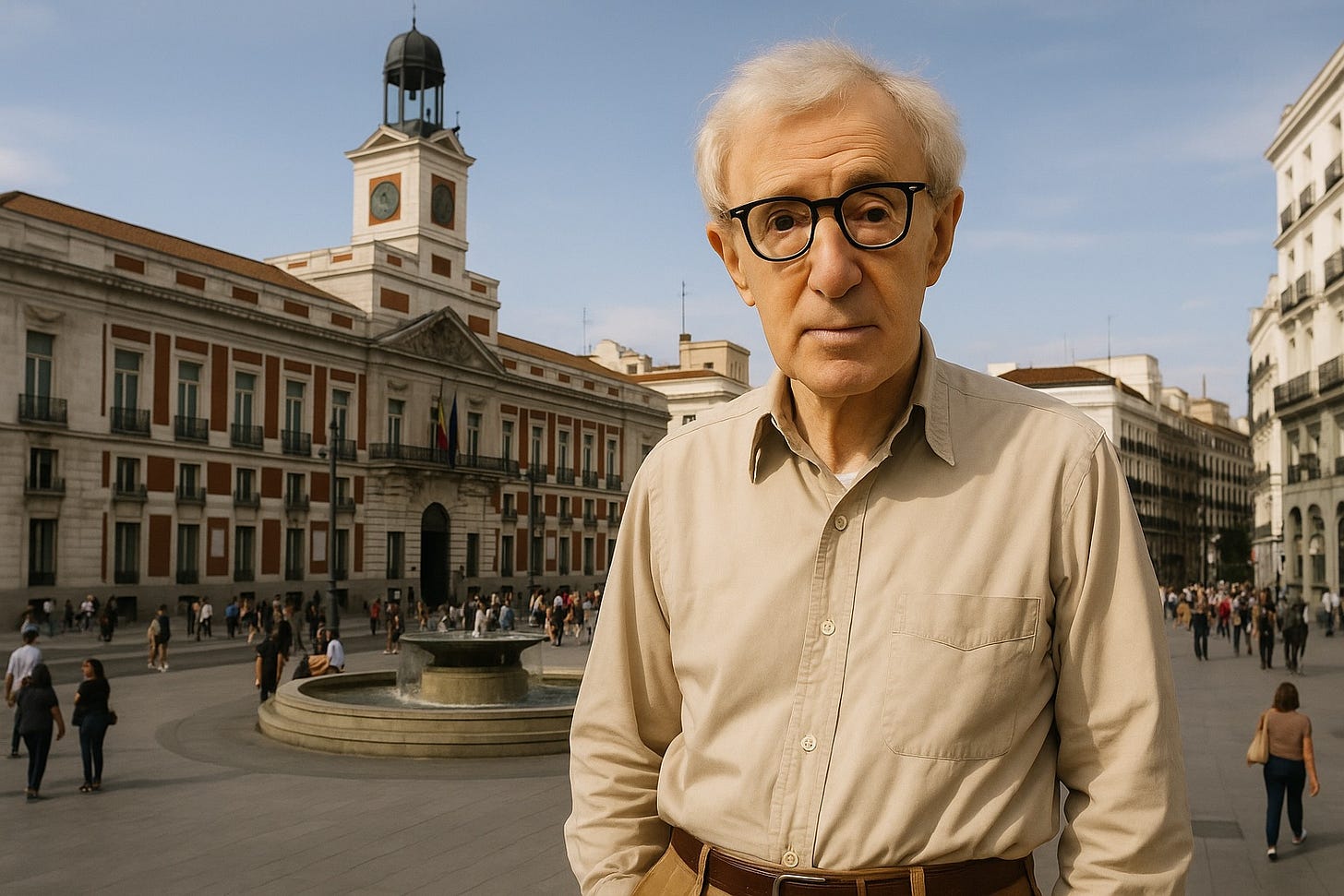
Woody Allen is coming to Madrid. Yes, that Woody Allen — the four-time Oscar winner, jazz clarinet enthusiast, and controversial director whose cities have always played as much of a role in his films as his quirky protagonists.
Eighteen years after shooting Vicky Cristina Barcelona in, well, Barcelona; 15 years after shooting Midnight in Paris in, well, Paris; and 14 years after shooting To Rome With Love in, well, Rome, the 89-year-old filmmaker will shoot a
two-hour clichémovie in Madrid for his next (and possibly final?) urban, cinematic love letter. Its title, for now? “WASP – Woody Allen Summer Project 2026.” Intrigued?
And there’s a catch. Just like the earlier European outings in Barcelona, Paris, and Rome, the movie will have the word “Madrid” in its title.
That’s not an artistic decision; it’s in the contract. The Community of Madrid is paying €1.5m for the privilege.
In exchange, the city will feature prominently on screen, the film must premiere at a major international festival (think Berlin or Venice), and audiences around the world will hopefully leave the cinema googling “cheap flights to Madrid.”
Why is this a big deal? For decades, Allen has turned cities into co-stars. New York is his eternal muse, and Paris and Barcelona have been his flings (btw, his Barcelona project was funded by a similar €1.5m public subsidy back in 2007).
The hope for the investment. Allen’s films don’t just boost tourism. They (at least in theory) help define how global audiences feel about these cities. Also, the Barcelona film helped define how people felt about a ménage à trois with Penélope Cruz and Scarlett Johansson, but that’s another story.
Why this isn’t a surprise. Madrid is having a moment. The city’s been popping up on every “best cities to live” list around the world, its cultural and nightlife scenes are booming, and post-pandemic tourism is off the charts.
Netflix shows like Valeria (Spain’s answer to Sex and the City) and Elite (young hot people having sex) have given international viewers a taste of Madrid’s streets and style, so a Woody Allen film could push the city’s global allure to another level. Like Emily in Paris, but with cocido. Or it could just be an embarrassing cliché 🤷.
Why it’s controversial. Well… not everyone’s excited about handing €1.5m in public funds to a filmmaker facing long-standing child sex abuse allegations (which he denies).
ROI? Some, like El Diario’s Elizabeth Duval, question whether the investment will deliver tangible returns or just be a vanity project for Isabel Ayuso’s regional government. (Note to self: El Diario is a very anti-PP publication, and Madrid is run by the PP. But that doesn’t mean it’s a bad question.)
Title bet. We suspect the movie will be named From Madrid to Heaven (as a translation of De Madrid al cielo) because Woody will think it’s tricky, but it’s really sorta obvs.
4. 👑 Ex-King Juan Carlos I has a story to tell (and it’s already causing trouble)
Oh boy. King Emeritus Juan Carlos I (aka JC1) just dropped his memoirs in France — and Reconciliation may be the most ironic title of the year.
Co-written with Franco-Venezuelan historian Laurence Debray, the 512-page tome is a bid to reclaim “his own history” after years of scandal, exile, and silence. But if the goal was reconciliation, early reviews suggest he may need another chapter. (Expect the uproar to only grow when the Spanish edition lands Dec. 3.)
What’s in the book? French media outlets received advance copies this week, and the excerpts quickly made their way into Spanish headlines. In Reconciliación, JC1 revisits nearly every chapter of his turbulent life:
His relationship with dictator Francisco Franco, whom he describes as a man with “a clear vision for Spain’s future.” 🤨
That (very public) love affair with Corinna Larsen, which he now calls “a mistake I bitterly regret.” 🫢
His abdication in 2014, and his eventual move to Abu Dhabi, “to make it easier” for his son, Felipe VI, to rule. 🫣
The strained relationship he has with Queen Letizia and the distance he feels from his granddaughters, Princess Leonor and Infanta Sofía. 🫥
Written in the tone of an 82-year-old seeking redemption, Reconciliación paints Juan Carlos as a misunderstood monarch — a man who helped deliver democracy to Spain but lost control of his image to scandal, gossip, and tabloid headlines.
Why controversy is brewing. The excerpts have been enough to reignite Spain’s favorite political pastime — debating whether tortilla should be made with onions the monarchy.
His positive description of Franco didn’t go down well. Spain’s culture minister Ernest Urtasun called the comments “repugnant,” noting that JC1 “owes his throne to the dictator.”
The timing didn’t help. His interview with Le Figaro appeared on the Day of Remembrance for the Victims of Francoism, prompting outrage across the spectrum.
What about his son, Felipe VI? While Juan Carlos reflects on his past, F6 is trying to keep his father’s ghost at arm’s length. The Royal Household is eager to draw a line between the two reigns, emphasizing a “renewed monarchy for a new era.”
Easier said than done. Later this month, Spain will commemorate the 50th anniversary of Juan Carlos’s accession to the throne — an event that will celebrate the country’s democratic transition, but notably won’t include him.
Officially, he’s no longer an “active member” of the Royal Family. Unofficially, his absence will be the most discussed presence of the day.
Someone call an exorcist. JC1 insists that Reconciliación is meant to “exorcise our demons.” But as the first reactions show, Spain’s demons aren’t so easily exorcised.
His supporters still hail him as the man who guided Spain from dictatorship to democracy; his critics see a disgraced monarch who fled to a tax haven, broke a hip on a luxury hunting trip with his lover during an economic crisis, and never quite said sorry.
Come to think of it, one royal dude’s redemption song may just reopen every wound Spain thought it had already healed.
5. 📸 ‘The white ghost of the Mediterranean forest’
We’d like to thank Ángel Hidalgo for giving us something to talk about that isn’t corruption. Because we don’t know how many more sleazy bribery stories we can handle — and what better palate cleanser than a mythical white lynx?
Spain (and the world) had never seen anything like it. As a gamer would say, it looks like an NPC in an RPG game with an important sidequest, telling you to take an object because it’s dangerous to go alone.
The ghost-pale Iberian lynx standing regally on a Jaén hillside was caught on camera by Hidalgo, a 29-year-old amateur wildlife photographer who’d spent months scouring the hills after spotting a strange blur on one of his motion-triggered cameras. On Oct. 22, after a rainstorm, he finally saw it — “a white shape that seemed to radiate its own light.” He called it, “The white ghost of the Mediterranean forest.”
Social media promptly lost its mind. (“It’s wonderful and at the same time it looks like a legendary Pokémon,” wrote one Insta commentator). Some doubted the photo’s authenticity — AI, amirite? — but biologists soon confirmed the lynx was real and even had a name: Satureja, a female born in 2021.
Turns out Satureja’s ghostly coat isn’t albinism or leucism, the two classic pigment disorders. Or proof she’s an actual ghost. She was born with normal coloring, so scientists suspect something rarer: a temporary loss of pheomelanin, the pigment that gives lynxes their orange-brown coat. One earlier female in the same region turned white the same way — then recovered her spots later. (No pictures of that one, though.)
So what’s happening? No one really knows. Stress, hormones, or even chemical exposure could be to blame. “It could be environmental,” said biologist Ismael Galván of Spain’s National Museum of Natural Sciences. “We don’t yet know what external agents trigger these changes. Pollution may play a role.”
But leave her alone. Others, like conservationist Astrid Vargas, urge restraint. As in, unless the animal shows signs of illness, better to leave her undisturbed. “Sometimes,” she said, “the best conservation act is simply to observe in silence.”
Whatever the cause, the sighting is another reminder of how far the Iberian lynx has come back from the brink. From barely 100 individuals in 2002, Spain and Portugal now host about 2,400 lynxes, thanks to decades of breeding and reintroduction work. When the population hits 3,500, the species will finally shed its “vulnerable” label.
Since Oct. 22, Hidalgo has become a minor celebrity. With articles in National Geographic and all the domestic TV and newspapers you can imagine. Not bad for a dude chasing ghosts in the hills of Jaén.
🙏 Once again, please remember to share this newsletter with your friends on social media. The more we grow, the more information we’ll be able to offer each week.
We’ll be back next week with more.