

Also: A regional president wears blackface and a streamer dies live doing a dare.
Madrid | Issue #131
🇪🇸 The Bubble isSpain's #1 English-language, best-selling newsletter. We offer paid subscriptions, and we’d be thrilled to have your support!
🚨 Customize your subscription! You can personalize your Bubble experience so you only get the emails you want—and never the ones you don’t. Click here to learn how.
📺 Sponsorship opportunities. Want to get your brand in front of our engaged and influential audience of professionals, creatives, and government workers? We’re now offering a variety of ways to do so. Click here to find out how and book a spot.
🇻🇪 The Spanish side of Trump's Venezuela adventure
The U.S. military’s capture/abduction of Venezuelan strongman Nicolás Maduro sent shock waves through Spain. And not just because the two countries share a language and a long colonial “relationship.”
Remember Delcygate? Delcy Rodríguez — Maduro’s VP and the woman now tapped (by Caracas…or by Trump?) to replace her arrested boss — has played a not-insignificant role in corruption scandals involving PSOE figures José Luis Ábalos, Koldo García, and Víctor de Aldama. Yes, that fun bunch. Now she’s the woman of the hour — and her success (or failure) may determine how much of the still-murky Venezuelan side of those scandals comes to light, and who gets hit.
More on that hot mess in a minute. First, how Spain handled the news from its former colony.
The news detonated straight down Madrid’s political fault line, instantly dividing the country into two camps (as per ush): those cheering the fall of a dictator, and those insisting that how it happened matters just as much.
PM Sánchez, unsurprisingly, chose Camp Two. After an initial call for “de-escalation,” his tone hardened quickly. Spain may not recognize Maduro’s regime, he said, but it will not endorse an intervention that violates international law or destabilizes the region.
Next stop: the international stage. Sánchez pushed the issue into the UN, warning that the operation set a dangerous precedent and violated Venezuela’s sovereignty. Foreign Minister José Manuel Albares argued that fighting organized crime can’t become a blank check for military action. “Force never brings more democracy,” he said.
Sánchez also pressed other European leaders to stop tiptoeing around Trump, warning that shrugging at a U.S. intervention in Latin America sends a signal. What happens, Madrid suggested pointedly, when that logic gets applied closer to home — in, say, Greenland?
On the right, the Popular Party sprinted into the story… and then slowed down. Party boss Alberto Núñez Feijóo initially hailed Maduro’s capture as unequivocally good news, while Madrid president Isabel Díaz Ayuso framed it as a historic act that could earn “years of gratitude.”
But once Trump floated a transition plan that sidelined María Corina Machado, the Venezuelan opposition leader and recent Nobel Peace Prize winner, apparently for being too into democracy, and kept Delcy Rodríguez in play, the PP began hedging: Venezuela’s future should be decided by Venezuelans, they said, and anyway, there are “doubts” about whether international law was breached.
To Sánchez’s left, the pressure ran the other way. Sumar denounced the intervention as imperial; Podemos went further, calling for Trump’s international isolation. And the far-righties of Vox predictably celebrated it as a triumph for “freedom”.
And public opinion? Classic Spain. A majority backs Maduro’s capture, but an even larger majority thinks the operation broke international law. In other words, Maduro is loathed, Trump is distrusted — and Spanish politics is fighting over which of those truths deserves the headline.
Now let’s get back to Delcy. She appears to have had close contact with Ábalos, Koldo and Aldama in the 2019-2021 period, when Ábalos was Sánchez’s infrastructure and transport minister and was apparently involved in commission schemes tied to public contracts. Aldama spoke regularly with Delcy ahead of a January 2020 meeting between her and Ábalos at Madrid’s Barajas Airport that Ábalos’s son claimed Sánchez had ordered his father to take (Delcy was banned from entering the EU because of her role in “human rights violations and for undermining democracy”).
The gold. Shortly before that meeting, Aldama apparently took part in the sale of 104 gold bars from Venezuela for $68.4m to a company called Bancasa S.A., and discussed it with Delcy; it is rumored that the bars were on Delcy’s flight and that they were moved into Spain in a money laundering or payoff scheme, though this has not been proven.
For now, the cases are winding their way slowly through the courts. And the courts may never get the whole story without the Venezuelan side. But if the Trump administration’s intervention takes another bizarre turn — an arrest of Delcy, for example — who knows what comes to light?
More news below. 👇👇
🔔 But first, check out our Instagram account
If you’re not following us on Instagram yet, you’re missing out. We’re posting exclusive content with our collaborators across Spain, breaking news updates, and pop culture coverage. Click on the post above and come hang with us!
💬 Five things to discuss at dinner parties
1. 🤑 A new sign that Madrid’s economy passed Catalonia’s
We live in Madrid, but this isn’t a Catalonia-bashing exercise. We love Catalonia — Barcelona, the Costa Brava, the Pyrenees, the whole schmear. But a new piece of economic data dropped this week that shows that Madrid’s sorpasso of Catalonia in economic terms isn’t slowing down. If anything, it’s hardening into a trend. Here’s what happened.
Social Security “affiliations.” For the first time since records have been kept (i.e. 1999), Madrid now has more people affiliated to Spain’s Social Security system than Catalonia — about 3.88 million, roughly 7,600 more than Catalonia, despite Madrid having around 1 million fewer residents. This number isn’t from a survey, but from a government register that tracks where people work, not where they live. It’s one of the cleanest proxies we have for where jobs are actually being created. (That said, if you have two part-time jobs, that counts as two affiliations 👀.)
That milestone didn’t come out of nowhere. Economists have been predicting it for years. Madrid’s regional GDP overtook Catalonia’s back in 2012, briefly flopped back, then pulled ahead again in 2017 during the height of the procés separatistcrisis — and has been widening the gap since. Today, Madrid accounts for nearly 20% of Spain’s total economic output, more than any other region. (Catalonia has been stuck around 19% for years.) So why is this happening?
First, Madrid has become Spain’s uncontested “global city.” According to Arturo Lahera, an academic cited in an analysis in El País, the capital now attracts close to a third of all foreign direct investment coming into Spain, particularly since the pandemic. Capital comes in, jobs follow. Economics 101, dude.
Second,economic sectors matter. As Spain’s longtime clothing and automotive factory center, Catalonia still has a powerful industrial base, but it’s heavily tied to exports to northern Europe — where growth has been sluggish for, like, years. Madrid, by contrast, is more diversified and increasingly heavy in high-value services: consulting, tech, finance, and corporate HQ activity. That’s where the job growth is.
Third, there’s a snowball effect. As one economist put it, Madrid benefits from a strong centripetal force: companies want to be near competitors, suppliers, regulators, and talent. The bigger it gets, the more gravity it has. That’s why so many graduates from elsewhere in Spain end up in a city with no access to the Med — if they want to or not.
Finally, there’s housing. Madrid concentrates the jobs, but it’s getting harder to live there. (If you read us regularly, you know we bang on about this. A lot.) Tens of thousands of people commute to work in Madrid from Toledo or Guadalajara. Those workers still count as Madrid “affiliations,” reinforcing the capital’s economic weight even as the population spills outward. (When you look at where workers live, more still reside in Catalonia than Madrid.)
The downside? Winning can come with the risk of death by success. As in, if it becomes absolutely impossible to attract talent to Madrid because of housing prices, businesses will look elsewhere.
2. 📺A death is live-streamed Black Mirror-style
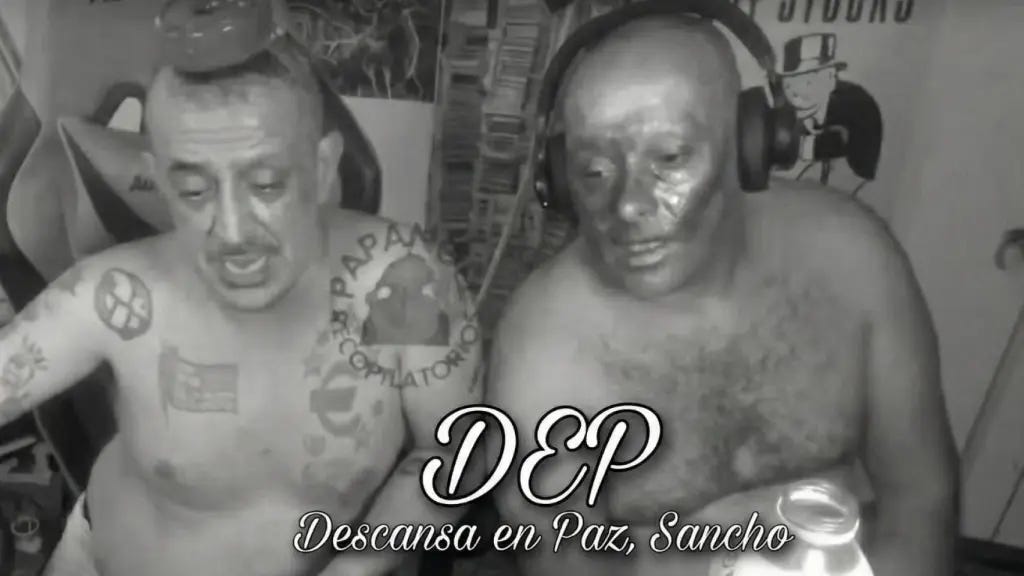
Simón Pérez (left) and Sergio Jiménez (right), in an image shared on Telegram.
Sergio Jiménez Ramos’s death was a Black Mirror episode nobody asked for. When his brother Dani managed to push open the door to Sergio’s room at the house of their mother in Vilanova i la Geltrú (Barcelona) in the early hours of New Year’s Day, he found Sergio on his knees on his bed, his head to his mattress “as if he were praying.”
Sergio’s computer and webcam were on, and the table held an almost-empty bottle of whiskey and a pile of cocaine. Voices from his computer were asking if he was sleeping off a hangover, but Sergio’s rigid body and cold hand, still holding his phone, told another story. “Mamá,” Dani said. “Sergio is dead.”
Sergio died livestreaming a “dare.” The 37-year-old was a Trash Streamer, a member of an underground society of hosts who engage in shocking, degrading, violent, or humiliating activities to attract viewers — and donations. In this case, a small group of fans had ponied up the money to buy the whiskey and cocaine — reportedly six grams — and pay him to livestream himself while ingesting it all in three hours.
This is not the first Spanish trash stream. If the reference to “a Black Mirror episode nobody asked for” gave you a sense of déjà vu, that’s because we used it before — when we wrote about Simón Pérez and Silvia Charro, the real estate experts who lost their careers after recording a video about mortgages while high, and turned to trash streaming to make money. We wrote about them in August, when their Kick channel, SS Conexión, was shut after French streamer Raphaël Graven (aka Jean Pormanove) died during a 12-day trash stream that featured him being physically abused.
Local connection. Well, it appears that Simón is from Vilanova i la Geltrú, and served as a kind of manager and guru for Sergio; Sergio started trash-streaming in October when Simón invited him onto his livestreams to build his audience, and Simón apparently took something like a 20% cut.
Sergio was a vulnerable man with mental problems — he had a kind of schizophrenia, a friend told El Español — who took to drugs after his father died, a brother died in a motorcycle accident, and two friends died in the crash of a car he was driving.
Which is why some blame Simón for Sergio’s death. “For me, Simón Pérez is responsible,” the YouTuber Pablo_Xtrm, a commentator on the trash stream world, told El Español. “This is a murder committed by psychopaths. They took a disabled person and encouraged him to do these kinds of challenges. It was like shooting him: they killed him.”
Simón’s reaction has not been exemplary. “I told him not to do live streams, to get off Telegram because it was crap, that it was going to end badly,” he said in a live stream. “It’s not my fault.”
TikTok has since closed Simón’s account. Which is good. But it feels like it will “end badly” for him as well. Both El Españoland El País have written articles about his slow online “suicide” in recent months.
3. 🗳️ Alvise never stops surprising — now he’s taking “The Party’s Over” to Spain’s Ohio
Just when you thought Luis “Alvise” Pérez has finally run out of plot twists, he’s dropped another one. Fresh off the whole “yes, I took €100,000 in cash from a crypto guy, no I won’t be taking questions” era — and with multiple legal cases still simmering — Alvise now has announced that his non-party party, Se Acabó la Fiesta (SALF), will run in the Aragón regional elections on Feb. 8.
Why Aragón? Because it’s basically Spain’s Ohio: mid-sized, swingy, and just close enough to normal politics that any new populist gets stress-tested there first. Also, the math is friendly. Aragón’s electoral law has a 3% threshold, and in Zaragoza province, that can translate to about 15,000 votes for a seat, which SALF has gotten before.
Wait, who’s Alvise and SALF again? In the June 2024 elections, the unhinged professional agitator and far, far-right social media troll astonishingly managed to get 800,763 votes and three seats in the European Parliament for his electoral group while promising to end “corruption, crime, and pedophilia” in the government. Because…lots of pedophilia?
A 34-year-old Sevillano college dropout who calls himself “academically illiterate”, Alvise had brief stints as a member of Unión Progreso y Democracia (UPyD) first and later of the now-defunct centrist party Ciudadanos (he was chief of staff in the Valencian Parliament but quit after a year). He also tried Vox, but apparently it didn’t take.
That’s when he decided to build his community on Telegram by bombarding people with misleading and fake stories, (aka “real news”) as part of his crusade against “corrupt politicians and criminals”. Think of his politics as a guy on a street corner screaming “freedom!”, “anti-dictatorship!”, “anti-taxes!” and “anti-feminism!” Oh, he’s also anti-vax and a climate change denier. We hear he likes cats, however.
Aragón’s election list dump Wednesday confirms SALF is running in all three provinces.
The faces. In Zaragoza, the list is headed by Cristina Falcón, a public-school director in Utebo; in Huesca, Jorge Falcó (a University of Zaragoza professor); and in Teruel, Carlos Aranda, a former Ciudadanos councillor whose past includes a sexual assault complaint that was later archived.
And yes, the timing is exquisite. While SALF tries to look like a “serious” regional option, Alvise is still dealing with the aftershocks of his European-election breakout — including a rupture with his two MEP colleagues and ongoing court drama.
Never, ever boring.
4.🦴A discovery in Morocco may force Spain to rethink one of its biggest prehistoric claims
Attention, fossil nerds! We have a story for you.
Spain has occupied a privileged place in the story of human origins for decades. The fossils found at Atapuerca, near Burgos, helped shape the idea that Europe, rather than Africa alone, may have played a central role in the emergence of modern humans.
New facts! Now, a new discovery just across the Mediterranean is challenging that narrative and forcing Spanish paleoanthropology to revisit some of its boldest assumptions.
Researchers have uncovered 770,000-year-old human remains in a quarry near Casablanca, Morocco, including three jawbones, teeth, and vertebrae that appear to belong to a population closely linked to the lineage that led to Homo sapiens.
Ours weren't so smart. The findings, published in Nature, suggest that these North African hominins were already on the evolutionary path toward modern humans, while European populations such as Homo antecessor, discovered at Atapuerca, may instead belong to the branch that led to Neanderthals. (Ugh.)
This distinction matters enormously for Spain. Since the late 1990s, Homo antecessor has been one of the country’s most significant scientific exports, placing Atapuerca at the center of global debates about where and how modern humans originated.
The new Moroccan fossils resemble antecessor in some ways, but their dental and mandibular features align more closely with later Homo sapiens. If confirmed, this would mean that Atapuerca represents not the cradle of our species, but a parallel evolutionary experiment on the European side of the Mediterranean. They kinda lead to a dead end.
Spanish scientists are deeply engaged in the debate. Some members of the Atapuerca team have pushed back, arguing that key Asian fossils were not fully considered and that the evolutionary picture remains incomplete.
Fine, you're right. Others acknowledge that the discovery strengthens the classic “Out of Africa” model, placing the deepest roots of Homo sapiens firmly in Africa while redefining Europe’s role as secondary rather than central.
What this discovery does is reframe Spain’s place in the human story. Atapuerca remains one of the most important archaeological sites on the planet, but its significance may lie less in being our point of origin and more in showing how fragmented human evolution really was.
5.🫅🏿 A regional president in blackface and a bait-and-switch sort of harsh our mellow during Epiphany
Here we go again. What should have been a night of magic and excitement for thousands of children across Sevilla instead became a national controversy after Andalucía’s regional president, Juan Manuel Moreno Bonilla, from the center-right PP, appeared wearing blackface while portraying King Baltasar during the city’s traditional Three Kings parade. Whoopsie! 🤭
It’s all about joy and nothing else. Moreno himself amplified the moment by sharing images on his official X account, celebrating the “illusion, magic, and hope” filling the streets of Sevilla and describing his role as an honor.
No happy faces. The reaction was immediate and, um, overwhelmingly negative. Spain has a long, uncomfortable history with blackface, and critics argued that whatever meaning it may once have had, it is now globally recognized as a racist practice rooted in colonial caricature.
TheCabalgata de Reyes (aka the Cavalcade of Magi) is one of Spain’s most beloved traditions, held on Jan. 5 (aka Epiphany Eve), and for many children it’s even more important than Christmas. The Three Wise Men — Melchior, Gaspar, and Baltasar (you should know that!) — parade through cities throwing candy and gifts, pitting children against one another in a sugar-fueled Battle Royale.
But Sevilla is different. Its parade has been organized since 1918 by the Ateneo de Sevilla, a private cultural institution. There, the Three Kings aren’t actors but prominent members of the city’s elite, who are expected to make large donations in exchange for the role.
That structure has allowed Sevilla to cling to practices other cities have dropped — Málaga, for example, has explicitly moved away from blackface — despite growing criticism from civil society groups.
And they knew the drama was coming. Back in October, the PP and far-right Vox blocked a parliamentary debate on whether the president should appear in blackface, dismissing the issue as “absurd”.
Just when you thought the night couldn’t disappoint further, Madrid viewers faced another blow: the loss of hot Gaspar.
Wait, who? The city’s Three Kings parade sparked unexpected outrage this year when people realized that the hot zaddy actor playing King Gaspar was not the same one they had grown used to drooling over seeing.
This may sound trivial, but Gaspar had become very popular. Since 2022, the role had been played by Beltrán Iraburu, whose, ahem, “striking good looks” turned him into an unlikely cult figure with moms and the gays.
Bible gets some sexing up. Parents joked about “the hot Gaspar,” memes circulated every January, and his appearances became part of the parade’s modern identity. (Because fantasizing about a biblical figure is a thing these days).
The hot man speaks. Iraburu himself addressed the situation shortly after the parade, explaining that the magic of the Three Kings relies on mystery. Once that mystery fades (by his identity becoming widely known, which could undermine the illusion for children), he suggested it is time to step aside.
Sorry, moms and gays!
🙏 Once again, please remember to share this newsletter with your friends on social media. The more we grow, the more information we’ll be able to offer each week.