

🏠 This Week in Spain: 'Xenophobic' Housing Reform
Also: more dumb religion-related controversies and a Spanish eagle handler gets fired.
By @IanMount and @AdrianBono | January 16, 2025 | Madrid | Issue #85
🎉 Welcome to The Tapa, an English-language, weekly newsletter about all things Spain!
🥜 This Week in a Nutshell: It’s a bad week for non-EU foreigners aiming to buy property in Spain because, if a new bill proposed by the government is passed, they will be imposed a tax of up to 100% on homes they buy. Will it, though? Read more to find out!
🙏 Remember that if this email gets truncated at the bottom because it’s too long, just click here to read the rest on Substack.
🙌 One more thing for new subscribers: we are offering paid subscriptions, and we’d be thrilled if you purchased one to help build this enterprise we’ve had so much fun creating. (And to those of you who have already subscribed, thanks for the love 🥰.)
🕺If you haven’t subscribed yet, please do so by clicking on the button below.
🫶 And if you already have, please send this newsletter around to your friends and family and help us keep growing.
No Costa del Sol for you!
Sánchez’s New Housing Reform Has British Buyers—or at Least Their Tabloids—Seeing Red 😡
Time to start considering Bristol as an option for your second home, eh?
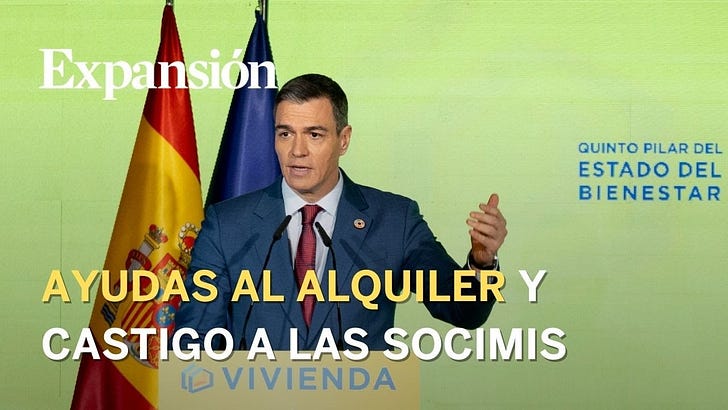
This week, Prime Minister Pedro Sánchez announced a 12-point housing reform with the aim of addressing Spain’s society-breaking housing crisis (as in, Spaniards can’t afford to buy or rent houses)—and saving his popularity, and government, in the process. “The West faces a decisive challenge: to not become a society divided into two classes, the rich landlords and poor tenants,” Sánchez told an economic forum in Madrid.
Spain’s lack of accessible housing is a massive issue. As we’ve noted before, 66% of young people 18-34 in Spain live in their parental home, compared to 50% in 2010. Salaries have gone up less than 20% since 2015 while home prices have gone up over 50% in Madrid, Catalonia and the Balearic Islands. Spain’s central bank says that the country faces a 600,000 housing unit deficit. But barely 90,000 new units are being built yearly, less than half the numbers in the 1990s.
So, like many reforms, it’s a noble idea—the question is whether Sánchez’s plan would work, and whether it’s politically possible.
Now that we got that out of the way, what does Sánchez wanna do? Many of the 12 points the PM announced Monday are versions of previous ideas, made more urgent by recent protests demanding 50% rent cuts and threatening rent strikes. Here are a few:
New public housing company. The transfer of more than 3,300 homes and almost 2 million m2 of residential land to the newly created Public Housing Company, for the construction of protected housing, and the incorporation of more than 30,000 homes held in Spain’s “bad bank” (SAREB), 13,000 of them during this first half of 2025.
Tax break on cheap rent. A 100% tax break on income from apartments that landlords rent at the government’s suggested reference level (way below market). We wrote about this quasi-rent-control scheme before.
Punishment for tourist rentals. Tourist flat owners would pay VAT (up to 21%) on income from their rentals. The government would also tighten regulations around fraud in seasonal rentals and create a fund for regional and municipal governments to increase inspections of illegal tourist housing.
But, but, but… Those weren’t the headline news. The point that set the fires burning (and got all the headlines), dear reader, was Sánchez’s plan to levy a tax of up to 100% on property purchases by non-residents from countries outside the EU. The reason? According to Sánchez, such people bought 27,000 of the 600,000 or so sold in 2024, "not to live in [but] to make money from, which, in the context we are in, we obviously cannot allow.”
And the British tabloidosphere exploded. Brits are major buyers in Andalucía and with, um, Brexit, they are no longer EU residents. So the sharp end of this proposal felt like it was pointed directly at them (or at least Daily Mail editors felt so).
The entire paper? Almost. For a while it felt that the Mail was only publishing outraged Spanish real estate stories—or maybe Sánchez had killed someone’s mum: “Spain moves to STOP Brits from buying homes in the country…”; “End of the Spanish relocation dream? The devastated Brits who face a 100% tax raid on their house in the sun…”; “Britons will invest their money in places such as Greece and Cyprus instead of Spain, experts warn…”; and (for variety) “Spanish fury over bid to stop Brits buying holiday homes: Politicians slam 'xenophobic' 100% tax plan and say they will REFUSE to enforce it - as estate agents dismiss the idea as 'silly'“.
But seriously, will the proposal help Spain beat its housing crisis? Honestly, probably not—for a variety of reasons. The construction and real estate industry, as well as right-of-center parties, are complaining, as would be expected, but they do agree on one point worth making: that the reforms focus on regulating prices on the little available housing there is, but do very little to address the housing deficit by building or attracting new units to the market.
Too small. Referring to the proposal as “nonsense”, Colliers’s Spain and Portugal CEO Mikel Echavarren calls going after the 27,000 properties bought by foreigners "a drop in the ocean” compared to the 600,000 sold each year.
Wrong target—and too slow. For Francisco Iñareta of the real estate portal Idealista, the proposals follow the same path that has led to Spain’s housing emergency: “tax increases for international investors, increased sanctions for property owners, and plans that won’t offer new housing for another 3-4 years. “The worrying lack of supply in the market requires incentives to bring back as many properties as possible,” he added. “And it seems that this objective has become secondary in the government's attempt to set prices.”
That may not even matter. The usual fight between the property industry (which wants lower taxes and easier permitting) and left-of-center politicians (who want to appease public anger by forcing greedy landlords to cut rents) is to be expected—and a good argument to have. But the outcome of that argument may not even matter here.
Why? Because almost half the proposals will need to go through parliament, where Sánchez struggles mightily to build a majority for even the least divisive bills. A 100% tax on sales to non-EU foreigners or IVA on tourist rentals? Probably not anytime soon.
More news below. 👇👇
🔔 But First, A Message From Our Sponsor

Bucólico Café is a project of connection that was born as a specialty coffee shop.
We value time and understand that it represents both a cycle and an instant—chronology and nostalgia. Bucólico is a space that connects one’s soul with the purity, lightness and beauty of the countryside—while being in the city. Via a cup of coffee, a piece of cake or a song…
Located on Calle de Barbieri 4 — a few blocks from Plaza Chueca — Bucólico reassures the soul with a feeling of home.
Follow Bucólico Café on Instagram.
💬 Five things to discuss at dinner parties this week
1. ⚖️ Sánchez judicial reform isn’t about his family. Honestly
PM Sánchez proposed a pretty major judicial reform at the end of last week that would, if passed, likely benefit his family and government. Actually, he didn’t present it. Patxi López, his PSOE party’s parliamentary speaker, presented the bill on a Friday, alone, without any support from the parties it would need to pass. Which gives you an idea how it went over: badly.
But before we explain what the PSOE wants and why, let’s explain what’s behind the bill.
Freelance accusations. One of the great oddities of Spain’s justice system, in our view, is the “popular accusation” (acusacion popular) recognized in Article 125 of the Spanish constitution. In simple terms, it allows a private person or group to make legal accusations in cases in which they are not directly involved or affected (unlike in the U.S., for example, where the plaintiff must have “standing”). The concept is pretty (or maybe totally) unique to Spain.
Nuisances—but not always. Because most anyone can file a lawsuit this way using things like newspaper articles for evidence, many are nuisance suits that are quickly dismissed (the group Manos Limpias — Clean Hands — has made a kind of career of getting its suits dismissed). Which explains why both the PSOE and PP have tried to regulate them at various times. But proponents of the acusación popular say it's a vital tool in calling out government corruption (which Spain has had plenty of). If a newspaper uncovers wrongdoing but prosecutors don’t follow up on the news (out of being politically compromised, for example), shouldn’t we let “the people” bring suit?
PSOE reform to stop ‘harassment through abusive judicial actions.’ The reform proposed by the PSOE would prohibit political parties and groups linked to them from bringing acusación popular suits (to harass their opponents); prohibit suits based on newspaper clippings; recuse judges who make statements in favor of a political party; and eliminate the crime of insulting religious sentiments.
Yes, but… In a calm political situation, most parties could agree to limit the most frivolous suits (judge speech limits are trickier). But there’s something else going on here. Besides the last bit—which basically decriminalizes critical religious speech—the other three parts have one thing in common: they would help Sánchez’s family and government disentangle themselves from the legal difficulties they face.
Which are… Sánchez’s wife Begoña faces an influence-peddling investigation: his brother David is facing something similar; and his attorney general, Álvaro García Ortíz faces a Supreme Court investigation into his possible revelation of confidential citizen data. All based on acusaciones populares.
That’s why they’re calling it the Ley Begoña. Because it could end all these suits retroactively, the bill was attacked by anyone who’s not in the PSOE. We won’t bore you with a list (here’s one), but let’s just say those on the right called it “an outrage,” “a first step towards a silent dictatorship,” “an attack on the legal system”. Madrid Presi (and Spain’s Troll Queen) Isabel Diaz Ayuso said, “The Ley Begoña is a preventative amnesty for Sánchez’s family and the attorney general.” Judge and prosecutor groups didn’t like it either. Even parties allied to Sánchez didn’t offer support (they weren’t even consulted, after all).
Un-like-ly. The broad rejection suggests this bill just won’t see the light of day.
2. 🗳️ Could Vox and Junts join forces to oust Sánchez?
PP leader Alberto Nuñez Feijóo got so wound up by the Ley Begoña (see #1 👆) he compared Sánchez to former dictator Francisco Franco (who doesn’t like a little overstatement?) and said he was open to promoting a motion of censure to remove Sánchez from office and call for general elections if far-right Vox and Catalan separatist Junts decided to join him.
Ridiculous, right? Vox wouldn’t normally be caught dead
datingvoting with Junts because they consider the Catalan separatists the literal devil, and while the PP is center-right like Junts (whose predecessor CIU was basically the PP in Catalonia) it would almost never be caught voting with them because while they don’t think Junts are the devil, they do think they are very, very bad.
But strange times make for strange bedfellows. That’s a cliché, but also true here. As in, reacting to Feijóo’s offer, Vox party leader Santiago Abascal has said he’d be open to voting with the PP and Junts due to the “gravity” of the situation—and as long as they don’t make any concessions to the pro-independence bloc (of course).
Phew! At least Junts kept their head about them. Their party secretary general said voting together with Vox would be akin to a “sick joke”. So no cats lying with dogs (for now).

