

👋🏻 This Week in Spain: We're Back!
Oh, and August was the opposite of chill. Get ready, we have a lot of catching up to do.
By @IanMount and @AdrianBono | September 7, 2023 | Madrid | Issue #27
🎉 Welcome to The Tapa, an English-language, weekly newsletter about all things Spain!
🥜 This Week Month in a Nutshell: Oh, boy. Where do we even start. Puigdemontgate? Kissgate? People claiming PTSD after receiving a severe weather alert text message on their phones? And, of course, the fact we still have no idea who will become the next prime minister of Spain. Also, we’re happy to be back! Be kind with us this week, though: We’re still getting back up to speed (a like to this page would be nice).
🙏 Remember that if this email gets truncated at the bottom because it’s too long, just click here to read the rest on Substack.
🙌 But wait, there’s more! The Tapa now has its very own LinkedIn page to grow a new community. Please check it out and, if you’re so inclined, follow us here.
🕺If you haven’t subscribed yet, please do so by clicking on the button below.
🫶 And if you already have, please send this newsletter around to your friends and family and help us keep growing.
Here’s what you missed
Cruel Summer: August Was All About Politics
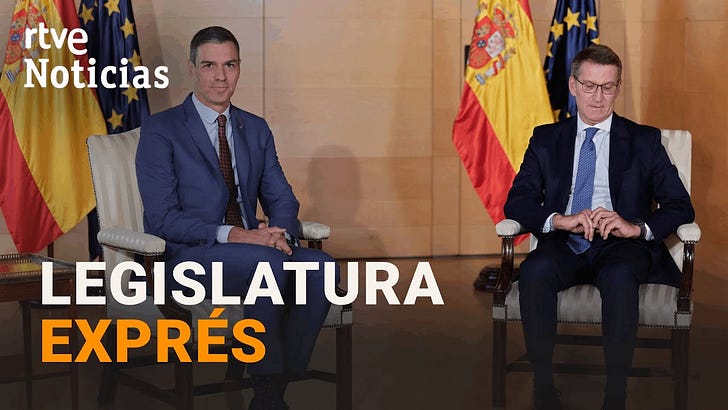
Yup, that video above is from a pretty awkward meeting that took place between caretaker Prime Minister Pedro Sánchez and center-right PP leader Alberto Núñez Feijóo last week. Why did they meet? What did they talk about? We explain it all below. Here’s what happened in the last 30 days while we were off:
We still don’t know who won the national elections. Right before our break a month ago, we told you that once the expat vote was counted, the election results left the Feijóo-led right wing coalition of PP, Vox and UPN with 171 votes, virtually tied to the likely left wing coalition led by Sánchez that includes PSOE, Sumar and a small number of nationalist regional parties such as EH Bildu and ERC. So now the only way for Sánchez to get the 176 votes he needs to be elected the next Prime Minister of Spain is to get Catalan separatist party Junts, led by self-exiled former Catalan leader Carles Puigdemont, to vote in favor of his appointment (not just abstain). More on that below.
King Felipe VI asked Núñez Feijóo to try to form a government on Aug. 22, after meeting with all the leading candidates (as is customary), This wasn’t the King playing politics, he was just picking the PP candidate because he is the one that got the largest number of parliamentary seats in the elections (also customary).
Unfortunately for the conservative candidate, this won’t lead to anything and on Sept. 26/27, the voting session scheduled to take place in Parliament will end in a defeat for Feijóo because, again, he doesn’t have the 176 votes (unless some sort of miracle happens).
What happens then? Then it’s Pedro Sánchez’s turn and he will have two months to negotiate and get to the 176 he needs in order to be appointed Prime Minister. If that vote (scheduled for Nov. 26/27) also fails because he couldn’t get Junts to support him, then (you guessed it!) Spain is having a second general election this year, right in time for Christmas. Thematic elections are all the rage this year.🧑🎄
Batet Out, Armengol In. On Aug. 17, former Balearic Islands president Francina Armengol (from the socialist party) was elected president of Parliament, replacing Catalonian Meritxell Batet (from the same party).
Armengol obtained 178 votes in Parliament, in what seemed to be the first sign of fruitful negotiations between the PSOE-led leftist coalition and Junts (the separatist party agreed to vote in favor of her).
Of course, Junts will not agree to voting with PSOE in exchange for nothing. In a historic first, it was announced that this grand leftist-coalition would introduce a new law so that regional languages (or “co-official languages”) like Catalan, Basque or Galician would now be allowed on the floor of Parliament (only Spanish was accepted).
This has expectedly angered conservative leaders. Feijóo complained about the fact MPs would now “have to wear an earpiece” during parliamentary debate, and Madrid regional president Isabel Díaz Ayuso called it “nonsense” and “an aberration”.
The Feijóo-Sánchez Summit: The strangest moment of the month was perhaps a meeting between both candidates, in which Feijóo presented the socialist leader with an 11-point proposal that included getting him to support the King’s decision and vote for the PP leader to become Prime Minister (!) and letting him run the country for just two years instead of four (!!).
The goal, Feijóo explained, was to find a way that helped both sides move forward without having to depend on separatist parties such as Junts and EH Bildu. But despite his big smile at the beginning of the meeting, Sánchez said no (shocker).
The meeting proved to be a nothing burger and they both quickly went back to attacking each other.
Vox MP Iván Espinosa de los Monteros, the party’s spokesperson and one of its most visible faces, resigned from his seat in parliament and announced he was quitting politics altogether. While he cited “personal reasons”, local media indicated that he was disappointed with Vox’s results after the 23J elections and that he felt increasingly sidelined by party leaders, who seemed to leaning more towards Vox’s Catholic wing.
Feel all caught up (sorta)?
🔔 A Message From Our Sponsor

Secret Kingdoms is your English bookstore in Madrid. It specializes in Spanish history and literature, contemporary and classic novels, books for children and young adults of all ages, history and historical fiction, thrillers, science fiction, fantasy, poetry, biographies and much more.
Located on Calle de Moratín 7 — a few blocks away from the Prado Museum — and with over 20,000 new and used books, Secret Kingdoms has something for everyone.
Find out more at www.thesecretkingdoms.com
💬 Five Four things to discuss at dinner parties this week
1. ⚖️ Puigdemont has a Christmas list
Catalan separatist leader and former regional president Carles Puigdemont, who moved to Brussels to avoid prosecution after 2017’s unconstitutional independence referendum ended in the takeover of the region by Spain’s central government, was perhaps the biggest winner in Spain’s inconclusive 23J elections.
His party (Junts) lost a quarter of its votes and one of its eight seats, compared to 2019, but a “Sí” vote from some of its remaining seven MPs will be absolutely necessary for Pedro Sánchez to repeat as prime minister.
As the leader of a small party with outsized power, Puigdemont played his hand hard after the elections.
Puigdemont’s party demanded full amnesty for those involved in the independence referendum and a real referendum on the region breaking off from Spain.
Analysts speculated at the time that Puigdemont might back down from some of the more extreme demands (like the referendum). And he has—to a point.
Leaders of Sumar—the further-left party that would form a coalition with Sánchez’s PSOE if he returns as prime minister—visited Puigdemont in Brussels this week. Second Deputy Prime Minister (and Labor Minister) Yolanda Díaz, as well as MP Jaume Asens, held talks with Puigdemont on Monday,
The meeting was meant to be “unofficial” and not sanctioned by Sánchez… but it felt a lot like the first step of negotiations to get the Junts votes.
Puigdemont did not push an immediate referendum, but he did demand amnesty for all those involved in the 2017 referendum (like fugitives such as himself), an international mediator, and “complete and effective abandonment of judicial action against independence”.
