

Skip to content
Madrid

đŸ«” This Week in Spain: Valencia DANA Tragedy Goes International

Also: A lefty pol pens a spicy revenge book and 'Bitcoin Jesus' hits the Balearics.
By @IanMount and @AdrianBono | November 14, 2024 | Madrid | Issue #78

🎉 Welcome to The Tapa, an English-language, weekly newsletter about all things Spain!

đŸ„œ This Week in a Nutshell: We’re still not done figuring out who’s to blame for the tragedy that hit Valencia two weeks ago when another storm has hit MĂĄlaga this week—floods included.

🙏 Remember that if this email gets truncated at the bottom because it’s too long, just click here to read the rest on Substack.

🙌 One more thing for new subscribers: we are offering paid subscriptions, and we’d be thrilled if you purchased one to help build this enterprise we’ve had so much fun creating. (And to those of you who have already subscribed, thanks for the love đŸ„°.)

đŸ•șIf you haven’t subscribed yet, please do so by clicking on the button below.

Subscribe now

đŸ«¶ And if you already have, please send this newsletter around to your friends and family and help us keep growing.

Share


Here comes the flood (again)

Another storm hits Spain as we’re still figuring out who to blame for the last one

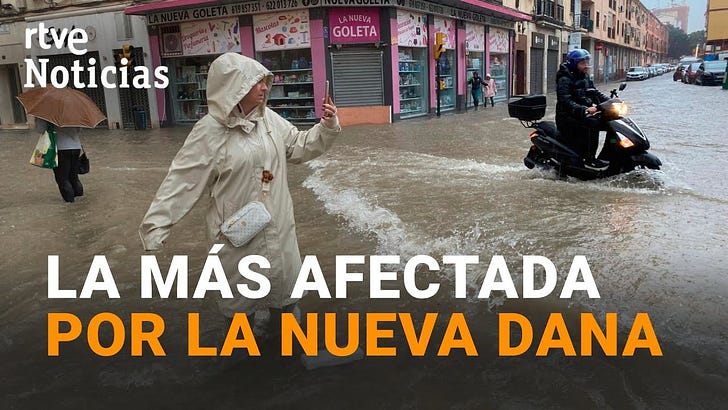
The rains are back (and as you’ll see they never left). Yesterday, a severe DANA storm caused the worst flooding in 35 years in Málaga, forcing the evacuation of over 4,000 people and halting transportation, including trains, buses and flights.

  • Shut everything down. Torrential rain led to the closure of schools, businesses, and non-urgent hospital services, while several rivers overflowed, inundating key areas and infrastructure.

  • Good news, though. Fortunately, this time the Andalusian government sent mobile phone red alerts to warn residents to stay at home (and away from likely floods). This significantly reduced road traffic and people on the streets, which may have avoided casualties. Despite the widespread flooding and formation of multiple tornadoes, no fatalities have been reported so far.

Meanwhile, in Valencia the fallout from the floods goes on


Who’s to blame for Valencia’s horror? The baffling inability of Valencia president Carlos Mazón (PP) and his administration to send a timely red alert (while ‘Dead Man Walking’ Mazón was at a three-hour lunch with a local journo) is by far the clearest example of the government's failure. But it is not the only one. And of the many others—including the inability to send timely aid afterwards, which set off the anger that culminated in people in Paiporta tossing mud at the royals, Sánchez, and Mazón—one stands out for both being a political football used to deflect attention and also for being very real. 

  • Infrastructure. That is, the decisions made over many years not to invest in infrastructures that could have stopped suddenly full waterways from overflowing their banks and causing the tragic urban floods that killed over 200 people.

  • Let us count the ways. El Español reports that since 1994, nine projects that were meant to protect residents of the Huerta Sur area (where the recent flooding occurred) have failed to be executed for various reasons.

  • The projects. The infrastructure itself is a bit beyond our ability to explain in detail (not being hydrological engineers and all) but in broad strokes, the projects aimed at increasing the capacity of the Barrancos of the Poyo and the Saleta, which are kind of seasonal waterway gulches that run through the zone (these are the dry riverbeds you see coursing through many cities and towns in Spain). That in turn would allow them to drain better and carry more water without bursting their banks and, well, killing people.

Blame shift. In the days since the recent tragedy, the PP and right-leaning media have been eager to focus blame away from MazĂłn. And they found a way: a series of decisions by the PSOE in 2020 and 2021 not to invest in these projects.

  • Let’s focus on 2021. In the decision not to invest in the Barranco del Poyo, Environment Minister Teresa Ribera’s ministry apparently rejected the work for “environmental” and “cost-benefit” issues—not for technical ones.

  • But really all her fault? While Ribera may now wish her department had approved the project, it’s clear that governments of all colors have failed Valencia over the years—just ask the mayor of the town of Aldaia, who’s been begging for the completion of a waterway detour begun in 2006. Or ask CompromĂ­s, a lefty Valencia party that in recent days hit out at both PP and PSOE governments for ignoring requests for a budget to fix the waterways.

  • Still, the PP went bananas. 🍌 For those on the right, the denied project was evidence that Ribera put her hardcore environmentalism over human safety. “Teresa Ribera halted the channelling and drainage works of the Barranco del Poyo in 2021 due to her ideological sectarianism,” PP parliament spokesman Miguel Tellado said on Twitter/X. “This information is further proof of her negligence and why she hid and did not show her face after the terrible DANA.”

  • And that means this isn’t local many more. This thing is, Ribera is SĂĄnchez’s nominee to take a powerful executive VP role in the new EU executive, and her hearings were this week. So the PP pushed its larger European party (the EPP) to turn those hearings into a referendum on Ribera’s “failures” in Spain, with PP boss Alberto Nuñez FeijĂło demanding that SĂĄnchez pull her name and choose a new nominee. 

  • In fact, it’s paralyzing Europe. Because EU leadership elections are huge exercises in horse-trading where each country and each party makes complex give-and-take deals, the PP (or EPP) can’t force SĂĄnchez to dump Ribera without the whole Jenga-like structure falling down and forcing everyone to start again (which noooobody wants). So for now EU elections are, like, kinda paralyzed as everyone waits to see who blinks. A bureaucratic thriller!

  • Not to get on our high horse, or even our pigmy horse, but while the PP may have some kind of point here, letting your hatred of SĂĄnchez lead you to cause a Europe car wreck that you’ll prolly lose? Bad strategy

Finally, storm aftermath on the ground.

Things in Valencia were slowly going back to normal this week. Schools were reopening, the AVE high-speed train was supposed to resume its regular service between Madrid and Valencia today, and even King Felipe VI was able to return to the area to survey the progress in military fatigues. Without getting hit with mud.

  • Not leaving. Even though MazĂłn has admitted “mistakes were made”, he.has said he will not resign. He is scheduled to testify to the regional parliament tomorrow about what happened with the DANA.

PS. On a separate note—but still related—Prime Minister Pedro Sánchez attended this week’s COP29 climate change conference in Baku, Azerbaijan, where he said that what happened in Valencia was not an isolated incident.

More news below. 👇👇


🔔 But First, A Message From Our Sponsor

Bucólico Café is a project of connection that was born as a specialty coffee shop.

We value time and understand that it represents both a cycle and an instant—chronology and nostalgia. Bucólico is a space that connects one’s soul with the purity, lightness and beauty of the countryside—while being in the city. Via a cup of coffee, a piece of cake or a song


Located on Calle de Barbieri 4 — a few blocks from Plaza Chueca — Bucólico reassures the soul with a feeling of home.

Follow Bucólico Café on Instagram.


💬 Five things to discuss at dinner parties this week

1. 📕 Irene Montero published a book—and it’s a hot one

Remember Shakira’s “diss track” for Gerard PiquĂ© (in which she compared Piqué’s new girlfriend to a Twingo and said real women don’t cry, they make bank)? Well, Irene Montero wrote a political diss book that dropped this week, and it’s already ruffling mad feathers (though as far as we know she compares no one to a Twingo).

  • Algo habremos hecho (We must have done something), is ostensibly a half-like political autobiography of the 36-year-old pol, covering the rise of university-born far-left Unidos Podemos (led by her hubby Pablo Iglesias), the party’s years in government with the PSOE and its more recent fall into irrelevance.

But no
there’s more! Some people (okay, who?) like to read dry political tomes, but pretty much everybody likes to watch people hang out their dirty laundry. And in that sense, in this book, there’s something for everybody. 

  • Irene does not like Sumar boss Yolanda DĂ­az. (Is she a Twingo? đŸ€«) It all started about 18 months ago, after Pablo Iglesias anointed DĂ­az as his successor atop Podemos but then, because of a certain scandal inside Podemos (more in a sec), DĂ­az decided to start her own party to run in the 2023 elections and basically told Podemos, “You can be part of my party if you sit in the way back and shut up.” 

And the scandal was
 Irene Montero led the writing of the “Only yes means yes” law, which was meant to update Spain’s sexual assault statutes to remove the requirement for a woman to fight back for rape to be considered rape. But the law was a complete clusterfuck problematic, and the loopholes it unwittingly introduced led judges to reduce the sentences of or free over 700 convicted sex offenders. Which is bad.

  • Dirty laundry #1; The Yell. Because of the f-ed up law, DĂ­az held meetings to “discuss” the resignation of Montero and several of her allies. “In one of those meetings, she shouted at Isa Serra (current MEP for Podemos) on several occasions, ‘When is Irene Montero going to resign,” Montero writes. “I still cry with rage when I remember it. Yolanda was acting to force my resignation.” (Well, yeah, but you wrote that law, right?)

  • Dirty laundry #2: The Bribe. In the book presentation (video above), Montero also confirms that, through a third party, DĂ­az offered her the job of ambassador to Chile to get her out of everyone’s hair—and, hey, it would pay a good salary. Montero calls the offer a “humiliation” because “they thought we could be bought.”

The diss. To put the cherry on top, Montero notes that Díaz—who was forced upon Podemos to broaden the left coalition—utterly failed to do so. And she’s right—under Díaz’s leadership, polls find Sumar dropping from the 31 seats it has in parliament to some 15 if elections were held today. So Montero said that choosing Díaz to replace Pablo Iglesias “is the biggest political mistake [Podemos] ever made.” OUCH!

  • At least there’s a happy ending. Risto Mejide, who helms the news/humor show Todo es mentira (It’s all a lie) on channel Cuatro has hired Montero as a contributor for the show. Her predecessor? Scandal-plagued former Public Works Minister JosĂ© Luis Ábalos. đŸ€Ł

2.đŸ‘šđŸ»â€âš–ïž ErrejĂłn’s court debut has been suspended

You may have forgotten the Iñigo Errejón case with Valencia taking up most of the news space. However, things are still very much happening.

  • Wrap up. The huge political scandal blew up a few weeks ago when the leftist MP, who was Sumar’s spokesperson in Parliament, surprisingly announced he was quitting politics. Hours later various accusations of sexual harassment and violence against him came to light.

  • Court filing. One of those accusations came from actress Elisa MouliaĂĄ, who filed a report with the Family and Women’s Unit (UFAM) of the National Police at a central station in Madrid.

  • Not a great look. Mouliaá’s statement said that, while attending a party at a friend’s house, ErrejĂłn took her by the arm, led her into a room, and locked the door. Then, he allegedly began to touch and kiss her without her consent. She also claims he pushed her onto a bed and “exposed himself”. MouliaĂĄ says all of this happened without her consent.

Day in court thwarted. This week, the judge in the case, Adolfo Carretero, was supposed to listen to the testimonies of both her and Errejón at the Plaza de Castilla courts. However, he decided to suspend them at the request of Mouliaá’s lawyer, who is in an advanced stage of pregnancy.

  • New lawyer? Carretero apparently offered MouliaĂĄ the option to testify with a different lawyer, but she refused. Since this was the second time her statement had to be postponed (the first time was Nov. 7), the judge then decided to “provisionally dismiss the case and suspend all procedural actions until the lawyer provides a medical clearance”.

Unhappy. Errejón is not happy about this. As El País explains, the former MP believes that the temporary incapacity of the lawyer is a “delaying tactic by the prosecution” and is looking to appeal the suspension.

  • ErrejĂłn clearly wants to get this done with. He has avoided making public statements since his resignation, and this was to be his first public appearance. Now, while the case is suspended, all procedural actions are paused—which means, for example, that the case’s statute of limitations can’t run out. So this will go on. And on.

3.👀 More legal headaches for PM Pedro Sánchez

Prime Minister Pedro SĂĄnchez can’t catch a (legal) break. Besides dealing with the deadly Valencia floods, he still needs to deal with the legal cases that affect the people around him (or who used to be around him) — mainly, the cases involving his wife Begoña GĂłmez, and former socialist Transportation Minister JosĂ© Luis Ábalos.

Caso Gómez. Sánchez’s wife is under investigation for alleged influence peddling and now also for misappropriation for her alleged private use of software from the Complutense University (the accusations suggest that she may have used it without proper authorization or for purposes outside of the scope of her role).

  • New summons. GĂłmez was summoned to appear before Judge Juan Carlos Peinado on Nov. 18 so she could be personally notified that the lawsuit had been admitted in court. Her questioning would come at a later date.

  • Rain check. But it turns out that GĂłmez already has plans that day, as she’s supposed to be attending the G-20 summit in Brazil with her husband, so she notified the court that she can’t make it on that date (this is what happens when you don’t use Calendly). You see, Brazilian President Luiz InĂĄcio Lula da Silva has formally invited her to the summit, and she’s already confirmed she’s going.

  • Already knew that. GĂłmez’s attorney, former socialist minister Antonio Camacho, explained to the judge that GĂłmez already considers herself notified and so there’s no need to appear in court for this.

đŸ€Ż Gasket blown. This, of course, infuriated the accusers in the case (mostly far-right organizations such as Vox, Hazte OĂ­r and Manos LĂ­mpias), who were horrified about the defendant "unilaterally deciding not to appear” and assuming that she could just leave Spain that day like it’s no big deal.

  • No respect. In a response to her filing, they say GĂłmez “demonstrates not only a lack of respect and consideration for the judiciary but also an assumption that she deserves different treatment from any other citizen before the law.”

  • Bit extreme, no? All amped us as they were, they asked the judge to take away her passport. While we find this excessive, we love the idea of the first lady going on the lam to Brazil. We’ve seen the movie: Blame It on Rio.

Cooler heads and all. Peinado decided yesterday that taking her passport away would be “disproportionate and unnecessary”, and agreed to Gómez’s request because, considering she’s the PM’s wife, she’s probably not going to move to another country.

  • But
 Still, he summoned her to testify in court on Dec. 18. Hopefully she doesn’t have plans to spend Christmas abroad.

Caso Ábalos. On top of this, Sánchez and the Socialist party are facing another legal headache: the one surrounding former minister Ábalos and his involvement in the so-called “Koldo Case”, which we covered many times here.

  • Let the investigation begin. Last week, the Criminal Chamber of the Supreme Court agreed to investigate Ábalos citing evidence of influence peddling, criminal organization, bribery, and embezzlement. The Court attributes a “leading role” in the corruption scheme to the former minister and former PSOE organization secretary.

  • Not a good look. The Court believes there is evidence that the then-minister “benefited financially” from a scheme that involved his advisor Koldo GarcĂ­a and businessman VĂ­ctor de Aldama, and sought to secure public contracts for COVID-19 supplies (and get paid for arranging them).

  • Home, sweat home. It also cites evidence about the acquisition and use of a property in the La Alcaidesa development (CĂĄdiz), allegedly enjoyed by Ábalos as “financial compensation” for his actions within the organization, as well as the payment of rent in Madrid for a woman with whom he was reportedly involved.

Pay us a visit? Ábalos will now likely be asked to (voluntarily) testify in court. He may have been suspended as a member of the PSOE party but he’s still an MP (which means he can only be summoned to testify if Parliament approves it first).

4. đŸ›¶ 2,000+ year-old Phoenician boat recovered in Murcia

Tired of sad water stories? So are we. You’re in luck, though—we found a happy one!

  • Some 2,600 years ago an 8m-long wooden boat sank not far off the MazarrĂłn coast of Murcia. This is not terribly exciting. You know what is exciting? That in 1995 it was found, largely intact
and now it’s been recovered and brought to land.

The story of the wreck of the Mazarrón II is one of accident and amazement. A pair of divers came across the wreck in 1995, in two meters of water just 60m off La Isla beach, after the construction of a marina in the 1970s (along with changing currents and the like) caused the seafloor to shift and uncovered the boat. 

  • Ancient beach and anchorage. According to Carlos de Juan, the Universidad de Valencia researcher who led the recovery, the area was an ancient Phoenician anchorage in the 6th or 7th century BC. The boat had been “anchored on what was the paleocostada, that is, the old beach
that no longer exists today.”

  • Think of it as an Amazon van. De Juan calls it a small boat used for local navigation and trade that worked with “the long-distance vessels that the Phoenicians had to connect the western Mediterranean with the central and eastern Mediterranean.”

  • Emptied and protected. The boat’s cargo—two tons of lead ingots—was removed in 2000 and the site was protected with a metal box. At that time, researchers also recovered an amphora jug, a hand mill, various navigation tools and what was considered to be the complete anchor—which is currently on display at the National Museum of Underwater Archaeology in Cartagena (ARQUA​​). 

But in recent years the tides began to further erode the wood. So an extraction effort was designed—and that’s what was carried out over 40 days beginning on Sept. 13. The boat was split into 22 pieces, and each element will now be treated in ArquaTec, ARQUA's laboratory specializing in underwater archaeology, in a process that will last at least four years (and sounds a lot like preserving ham). 

  • First, desalting. The process begins by desalting each of the 22 pieces, which can take about six months, and then treating them with resins to fill the cavities where the wood has lost its cellulose structure. 

  • Second, freeze-drying. Then each piece will be freeze-dried, which consists of freezing the wood to make the water go from a solid to a gaseous state without passing through liquid, which avoids breakages and deformations. It will take about three weeks to dry each piece, so this part will take about a year and a half.

  • Bonus: The researchers also found something that could be pieces of the anchor. "The surprise was that half of the anchor was still in the site, with the trap, part of the shank and even fragments of the rope that connected it to the ship,” De Juan told El PaĂ­s. This anchor, he said, is very unique; only two similar ones from the period have been found.

Yes, you can see it
in a while. When the recovery efforts are done, the boat will be on display at ARQUA. The recovery cost an estimated €350,000.

5. ✝ Who is ‘Bitcoin Jesus’ and why is he living in Mallorca?

We knew there were a lot of guys named JesĂșs in Mallorca, but Bitcoin Jesus? Nope, not him. So who is this dude—and why does the U.S. IRS want him so badly?

It turns out that ‘Bitcoin Jesus’ is just an American crypto investor named Roger Ver who’s been profiled this week by Bloomberg because he’s laying low(ish) in Mallorca as he fights against extradition to the U.S. to face tax fraud and evasion charges. So who is this dude?

  • Born and raised in Silicon Valley. Ver was an early tech entrepreneur, though he did get arrested for dealing explosives—he said he was just selling firecrackers on eBay, thus proving that one man’s M80 is another man’s artillery shell. He spent 10 months in jail so it seems like maybe there was a big bang there? đŸ’„

  • Early crypto bro. Ver was an early crypto evangelist too (hence the name!) and started buying Bitcoin in 2011. He quickly became one of those annoying guys who wouldn’t talk about anything else at BBQs (and later, wouldn’t talk about anything else while on stage at crypto events). đŸȘ™

  • No, of course that won’t raise a red flag. Bitcoin Jesus then renounced his U.S. citizenship in 2014 and became a citizen of St. Kitts and Nevis, which is a move no one ever uses to dodge taxes. No, not at all.

Then the trouble started. The U.S. taxman (aka the IRS) makes people who renounce their citizenship do a kind of exit interview to declare all their property in the world, to ensure that they don’t avoid taxes owed from when they were American. And it seems like Bitcoin Jesus might have lied to the IRS or his tax preparers.

  • Made some bank! Bitcoin Jesus had a fallout with others in the Bitcoin community (Bitcoin Dalai Lama? Bitcoin Mohamed? Inquiring minds want to know) and sold his pile, then worth some $240m, in 2017. 

The IRS is like a shark. It quietly collected info on Ver’s assets and actions and then, silently, filed a sealed indictment against him in February 2024, accusing him of tax fraud. 

  • Surprise! So you can imagine his, um, excitement when a Spanish policeman came up to him in the lobby of the W Hotel in April, while he was attending a Bitcoin conference in Barcelona, said, “You’re Roger Ver, right?” and arrested him. 

  • Bitcoin Jesus on lockdown. His Holiness had to spend a month in jail before he got provisionally released while he fights his extradition. The U.S. says he “fraudulently misrepresented and concealed” the Bitcoin he possessed and sold, and owes some $48m to the IRS.

And that’s why he’s in Mallorca. Preparing his case with his lawyers, apparently practicing jiu jitsu, and hopefully not getting plutocratically drunk in the bars of Magaluf. These days, he’s just one of those slightly dodgy guys on the peripheries of Spanish life, but at least he chose Mallorca, which is a lovely place to live, right? 


🙏 Before you go, please remember to share this newsletter with your friends on social media. The more we grow, the more information we’ll be able to offer each week.