

🤴🏻This Week in Spain: The King's Speech
Also: Puigdemont is already making threats and Netflix doesn't know what Rio looks like.
By @IanMount and @AdrianBono | November 30, 2023 | Madrid | Issue #35
🎉 Welcome to The Tapa, an English-language, weekly newsletter about all things Spain!
🥜 This Week in a Nutshell: King Felipe VI officially opened the 15th Parliament yesterday and, in case you’re wondering, of course there was drama. Also, the bilateral relations between Spain and Israel are going through a really, really rough time.
Oh, and another tiny, minor thing: WE REACHED 1,000 SUBSCRIBERS!
Thank you for choosing us every week and for trusting our voice.It’s only been nine months since we started this beautiful journalistic adventure and we hope you keep reading us for a long, long time. Some changes coming soon, so get ready!
🙏 Remember that if this email gets truncated at the bottom because it’s too long, just click here to read the rest on Substack.
🙌 But wait, there’s more! The Tapa has its very own LinkedIn page to grow a new community. Please check it out and, if you’re so inclined, follow us here.
🕺If you haven’t subscribed yet, please do so by clicking on the button below.
🫶 And if you already have, please send this newsletter around to your friends and family and help us keep growing.
So very solemn
King Felipe VI Makes Strong Defense of the Constitution at Tense Opening Day
Alright, it’s been two weeks since Pedro Sánchez was appointed Prime Minister of Spain—or a century in geological time—which means yesterday it was time for the ceremony known as the Solemn Opening of Parliament. That is, when the Speaker and the King deliver speeches to the new cabinet and MPs present along with senators and members of the judiciary. Oh, and it’s solemn.
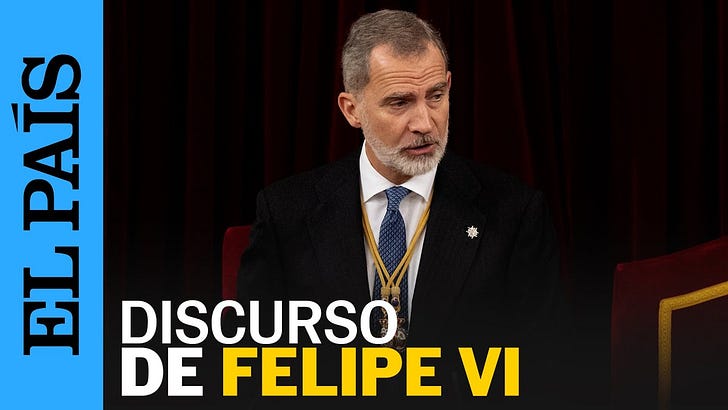
The King delivered a 12-minute speech (see above) that focused on defending the 1978 Constitution and how it exists as a legacy of democratic culture for the younger generations (those kids!) who may not have a clear idea of the state Spanish society was in 45 years ago.
This comes as some parties that support this new coalition government are calling for a revision of what they refer to as “the 78 regime” (these parties claim that the Monarchy was “imposed” on society by dictator Francisco Franco).
The King said that “to reclaim the profound significance of that great pact among Spaniards that is at the origin of our democracy is not, in any way, looking back with nostalgia. It is, however, a proud and conscious reaffirmation of our capabilities as a country."
Separatist parties EH Bildu (Basque Country), ERC (Catalonia) and BNG (Galicia) decided to skip the ceremony (just like last month during Princess Leonor’s swearing-in) and issued a joint statement saying: “We don’t have a king”.
The King also dedicated large parts of his speech to young people (like his daughter and heir to the throne Princess Leonor), explaining that the Constitution provides Spain with the democratic framework needed to form the “cohesive and united” country that the younger generations need to “develop their ideas and project their illusions”.
He reminded them that "democracy is not an aspiration, but a reality" stemming from the "great collective success of our democracy, supported by the Constitution," whose values "must be projected into the future."
Addressing the members of the Spanish parliament, he insisted that their obligation is “to pass on to the younger Spaniards a solid, united Spain, without divisions or confrontations." Like, don’t screw this up.
He also seemed to speak as a father (don’t forget Princess Leonor, a future queen, is meant to be a role model for the youths). Young people “have the moral duty to protect and preserve what has been achieved,” he said. Like, you kids don’t screw this up either.
The King also congratulated Pedro Sánchez on being reelected and called for the “respect”, “mutual understanding” and acknowledgement of political differences, especially at such polarized times (not that anyone listened to him—more on that below).
Oh boy. Right before the King’s speech, Parliament Speaker Francina Armengol (from Sánchez’s center-left PSOE) had also been tasked with delivering a few words, as protocol dictates.
This normally isn’t controversial, as speakers are expected to make non-partisan comments about the importance of Parliament and making Spain a better place.
Today this wasn’t the case, and a certain progressive leaning made the conservatives go nutty-pants.
Armengol used her time to say that the new coalition government is legitimate as it is the result of a deal between multiple parties that helped them obtain parliamentary majority (which is true). Considering that far-right Vox is not only calling this new government “illegitimate” but also “illegal” that didn’t go well with them.
Then she criticized those MPs who “distort reality or question important democratic values from the opacity of dispute” because this only “increases society's alienation from institutions” and asked everyone to “exercise coexistence” against “tension, polarization and noise”.
Finally, she decided to highlight the many laws that “expanded rights and improved people's lives” since the return of democracy (such as the minimum wage law, the divorce law, the same-sex marriage law and the suspension of mandatory military service). But note: of all the laws she mentioned, this last one was the only one passed by a conservative government (the center-right PP in 2001).
Both the PP and Vox were angry. So angry that they refused to applaud when she was done, something that hadn’t happened since, well, who knows. Maybe their hands hurt from so much clapping. But we think they were angry.
“When the Speaker behaves like a party representative, she doesn’t deserve applause,” said PP leader Alberto Núñez Feijóo (see video above). “We’ve been respectful but applauding this provocation is inappropriate. This is the worst speech from a Speaker I’ve ever heard in my life.” But really, Alberto, what do you think?
Meanwhile, when Vox leader Santiago Abascal was asked about his refusal to applause, he responded that “the only political rallies we applaud are our own”. Ooh, snap!
So much for “coexistence”. But there’s more!
Yes, it’s true. There were also intra-family roces (friction) between members of PM Sánchez’s cabinet: Economy Minister (and first Deputy Prime Minister) Nadia Calviño, and Labor Minister (and Second Deputy Prime Minister) Yolanda Díaz.
Fight, fight! When Díaz arrived at the ever-so-solemn opening of parliament, she was asked what she thought about some suggested edits Calviño’s ministry made to her proposal to expand unemployment benefits. Her answer? She didn’t think much of them at all.
Díaz, who heads the hard-left Sumar coalition member, marked her territory, saying that “unemployment reform was the purview of Labor” and her team was in “absolute disagreement” with the Calviño team’s suggestions: “We don't share their ideas at all."
So what’s the problem? Díaz wants to lower the age of eligibility and increase the amount given for extended unemployment benefits. Calviño, who’s of the center-left PSOE and is trying to get a big job in Brussels, seemed to suggest some limits—that people on this unemployment should only be able to turn down a certain number of jobs while collecting it, and that the benefits should shrink over time (both to encourage people to work).
Díaz felt this questioned the “honor” of those on unemployment, and would turn her benefit expansion into a cut. “The government is not going to cut unemployment benefits; it’s going to expand them,” she said.
And this is only the first day of the legislature! Much more fun to come.
🔔 A Message From Our Sponsor

Bucólico Café is a project of connection that was born as a specialty coffee shop.
We value time and understand that it represents both a cycle and an instant—chronology and nostalgia. Bucólico is a space that connects one’s soul with the purity, lightness and beauty of the countryside—while being in the city. Via a cup of coffee, a piece of cake or a song…
Located on Calle de Barbieri 4 — a few blocks from Plaza Chueca — Bucólico reassures the soul with a feeling of home.
Follow Bucólico Café on Instagram.
💬 Five things to discuss at dinner parties this week
1. 🐴 The strangest of bedfellows
Self-exiled Catalan separatist leader Carles Puigdemont was full of ideas—and a threat or two—this week, according to an eye-opening Politico report.
So why the horse’s head above? We’ll get to that in a minute.
The excitement began Tuesday evening, when Puigdemont and his political sidekick Antoní Comín arrived at the POLITICO 28 gala dinner in Brussels.
Comín and Puigdemont (who’s been dubbed “Puchi” by everyone from the La Sexta left to the Esperanza Aguirre right) ran into Manfred Weber, the head of the center-right European People’s Party (EPP)—the umbrella group to which Spain’s PP belongs.
Puigdemont and Comin tried to convince Weber that a “consultative referendum” on Catalan independence was possible constitutionally, and that Weber’s criticism of the deal between Spanish PM Sánchez and Puigdemont’s Junts party was off base. (Weber had said Sánchez had placed “personal egoism” ahead of national interests by signing a “legally unthinkable” deal.)
Weber, um, politely disagreed, and said that the deal and the Junts indy push would only serve to inflame the far-right Vox and its supporters. “In fact, you are both feeding each other,” he said, according to Politico. So far, all according to (ideologically expected) plan.
But then it got interesting. Puigdemont said to Weber—shocking the guy in the process—that he could imagine doing a deal with Spain’s PP to bring down the Sánchez government halfway through the term.
What? Yup, you heard that right. Politico apparently asked Puigdemont to repeat this, and he did.
You’re gonna have to explain this. Puigdemont’s idea, as whacky as this sounds, is that if Sánchez’s gov didn’t make the proverbial “sufficient process” towards recognition of Catalonia as a nation, they could team up with the PP, file a motion of no confidence, and dump Sánchez.
Junts was actually more aligned with the PP than with the PSOE on issues like Israel, Puigdemont claimed (we didn’t know that Junts has any policies beyond separatism, but you learn something new every day…).
Magical thinking: Spanish politics being what they are right now, that Puigdemont would float this suggests he’s been away for too long. Because the PP and Feijóo (or whoever is in charge of the party in two years) would have to give him more than the PSOE, which isn’t likely.
Still, Puigdemont’s got ideas. Junts and the PP would just have to agree on an independent replacement PM, and, Puigdemont said, the PP would have to stop “treating me like a terrorist.”
Shockingly, Feijóo said thanks, but no thanks. Actually, he just said no, or rather, that he hadn’t accepted Junts’ conditions to form a government because “they are illegal and violate the Constitution and the equality of Spaniards.”
Ultimately, there is little to no chance of this happening. But it shows the (relative) leverage Puigdemont has. He can (and likely will) continue to push Sánchez and irritate the PSOE via such statements as the legislature goes on, to prove he’s indispensable and because, presumably, it’s fun
Now, about that horse’s head. Politico also asked Puigdemont about the inclusion in the agreement with the PSOE of “lawfare”—the theory that the courts use the law to attack political opponents and should have government oversight because of this, which has led to massive criticism by judges’ groups of all colors.
Puigdemont said its inclusion was meant as a warning to judges and others who promoted “lawfare” with his group (i.e. those who didn’t act like he wanted). Politico reports he said it was meant to be like the horse’s head in The Godfather — where the severed animal noggin is placed in Jack Woltz’s bed to show the Corleone family means business. “It’s a warning that we’re serious,” Puigdemont was quoted as saying.
Somebody seriously needs a beach vacation. Maybe that’s why Puchi seems so desperate to get back to Spain. Just an idea.
2. 🇮🇱 The Spain-Israel diplomatic mess goes on
Prime Minister Pedro Sánchez’s fist overseas trip after being reelected was to Israel last week. He was joined by his Belgian counterpart Alexander de Croo, as Belgium is set to take over the presidency of the Council of the European Union in January (Spain currently holds it). There, they both met with Israeli Prime Minister Benjamin Netanyahu and, well, things didn’t go well.
In fact, the whole thing ended in a pretty bad diplomatic conflict, as Israel accused Spain of supporting Hamas’ terrorism.

