🎉 Welcome to The Tapa, an English-language, weekly newsletter about all things Spain!
🥜 This Week in a Nutshell: The first general election in Spain to ever be held in the middle of summer is finally here. Hold on to your butts.
🙏 Remember that if this email gets truncated at the bottom because it’s too long, just click here to read the rest on Substack.
🙌 But wait, there’s more! The Tapa now has its very own LinkedIn page to grow a new community. Please check it out and, if you’re so inclined, follow us here.
🕺If you haven’t subscribed yet, please do so by clicking on the button below.
The moment we’ve all been waiting for/hoping to be done with is finally here. Millions of Spanish voters will head to the polls on Sunday to decide whether they want center-left Pedro Sánchez (PSOE) to continue to be Prime Minister or they prefer center-right PP boss Alberto Núñez Feijóo to take the reins.
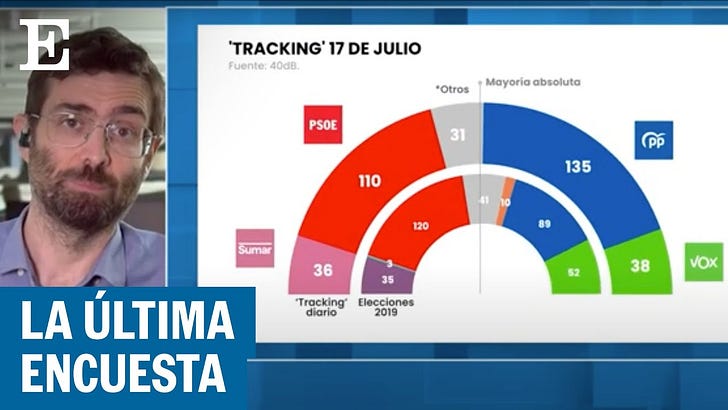
Most polls (in fact, all except one*) predict that Feijóo will win and likely form a coalition government with far-right Vox, led by Santiago Abascal.
One poll* by the Center for Sociological Investigations (CIS) predicts Sánchez will win and form a coalition government with left-of-PSOE Sumar, led by the charismatic Yolanda Díaz. Then again, the person who runs the CIS poll was appointed by the current government and has been wrong. A lot.
So, with three days to 23J, here’s what’s happened this week and what we can expect to see this Sunday.
Last night, three of the four major PM candidates (all those above minus the PP’s Feijóo) clashed in a live televised debate on TVE.
Feijóo decided not to participate because he claims the public network lacks objectivity (something the network has denied) and criticized that the PNV, ERC, and Bildu (regional parties from the Basque Country and Catalonia) had been “vetoed” from the debate. He said they should have been included because they were “crucial” for governance, in reference to how all three have repeatedly sided with Sánchez’s coalition government.
Pundits also believe that after his relatively good performance during his one-on-one debate with Sánchez last week, Feijóo simply wants to avoid having to deal with three attackers at the same time.
The debate was largely a clash between potential deputy prime ministers Díaz and Abascal. While Sánchez remained calm, Díaz was energetic and confrontational toward the Vox leader. She repeatedly said the PP and Vox were the same, criticized his stance towards what he calls “gender ideology” and his climate change doubts. She also asked him to “stop laughing” at women several times. Pundits agreed she was the clear winner of the debate.
Núñez Feijóo has been laying low this final week, which in many ways hasn’t gone as planned. The PP leader participated in an interview on TVE public TV on Monday that was arguably disastrous—or at least didn’t really go as expected.
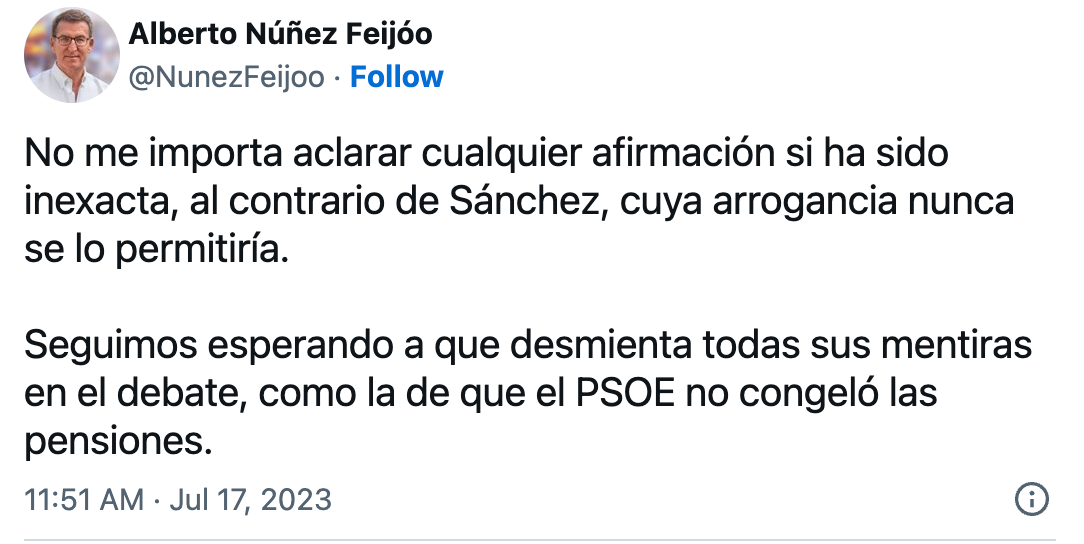
The PP boss stated during the interview that his party had "always" revalued pensions "in line with the CPI [inflation rate]," despite the fact that in 2012, 2013, and 2017, under Mariano Rajoy’s PP government, pensioners lost purchasing power because the increase in retirement benefits was lower than the CPI rate.
When RTVE journalist Silvia Intxaurrondo claimed his statement wasn’t true, Feijóo demanded an on-air correction from her, questioning her data. (Ahem, he was wrong.)
He later said on Twitter that his intention was to point out that the PP "had never frozen pensions" and downplayed his incorrect statements calling them “inaccurate information”.
Núñez Feijóo announced Wednesday he was suspending his campaign due to lower back pain, a result of intensely hitting the campaign trail. He was also scheduled to speak at a rally in the Canary Islands, but decided to cancel it out of respect for the people of La Palma who were still fighting a massive fire.
El País data journalist Kiko Llaneras, who’ve we mentioned before and who does a generally excellent job crunching the data, finds that the elections have a 55% chance of leading to a PP+Vox majority, with the PSOE+Sumar (and regional nationalist parties) having a 16% likelihood. Exciting times!
🔔 A Message From Our Sponsor
Secret Kingdoms is your English bookstore in Madrid. It specializes in Spanish history and literature, contemporary and classic novels, books for children and young adults of all ages, history and historical fiction, thrillers, science fiction, fantasy, poetry, biographies and much more.
Located on Calle de Moratín 7 — a few blocks away from the Prado Museum — and with over 20,000 new and used books, Secret Kingdoms has something for everyone.
💬 Five things to discuss at dinner parties this week
1. 🔥 Charon heatwave: Is it hot in here?
If you’re reading this, it means you survived the Great Heatwave of This Week.Congrats! We usually like to complain about having to stay in the city while fortunate others get to spend the summer months by the Med, but this time there was nowhere to run.
From Malaga to Sicily, the extreme weather has affected us all and there’s only one culprit: the anticyclone Charon, named after the Greek mythological boatman who ferries souls to the underworld (note: it’s not the Greek spelling of Karen). So yes, in case it wasn’t clear, this heatwave is named after a guy who literally takes you to hell.
Monday and Tuesday were the worst days, with places like Figueres, in Catalonia, recording 45.4°C, the highest temperature ever registered in the region. On Monday, monthly records were broken in Toledo (maximum of 42.9°C) and Teruel (minimum of 20.6°C), while on Tuesday, in addition to the Figueres record, monthly maximum records were also shattered in Lleida (43.2°C), Teruel (40.6°C), Albacete (41.5°C), and Daroca in Zaragoza (40.5°C).
If that were not enough, three absolute minimum records were set in Cuenca (24.7°C), Calamocha in Teruel (22.2°C), and Daroca (25.3°C).Oh, and over 140 stations from Spain’s AEMET state meteorological agency reached or surpassed 40°C, and in more than 45, temperatures did not drop below 25°C. Which is…pretty crazy.
Fortunately, things started to cool down yesterday, but not enough to spare us from the heat. Murcia and the southernmost parts of Valencia and Andalucía were set to burn in the afternoon. The worst conditions were experienced in Murcia, where a red alert was issued due to temperatures reaching 44°C, as well as in Alicante and Málaga, with alerts for 42ºC.
The heatwave is officially over today, according to AEMET, with a "general drop in temperatures," followed by a second decrease on Friday. But we still don’t recommend you leave the house. Charon never rests, so stay alert.
2. 🪦 A shipwrecked dinghy and death on a Tarragona beach
The tragic discovery of a baby’s corpse on a beach in Roda de Berà (Tarragona, Catalonia) a week ago left many questions unanswered. Who was it? How did it get there? And was it a crime?
Several grim aspects of the cadaver offered clues. The small body was heavily dressed—not in beachwear—and very decomposed, which suggested death far from the beach. Also, the diaper it wore was a brand popular in northern Africa.
"At first, it looked like a doll, but it is a decapitated corpse, which had been in the water for a long time. Here we can make hypotheses… and it could be another person who died at sea,” the mayor of Roda de Berà, Pere Virgili, said at the time.
The police investigating the death took a DNA sample and sent it to the Guardia Civil labs, where it was crossed with the genetic profile of others on file. And it came back with a family match.
With this grim conclusion, the story came into focus. The small child was the 8-month-old daughter of a couple who had traveled on a boat with 12 others that had departed from Cherchel, Algeria on March 21, and sunk 16 days later near the Balearic Islands. All aboard died (the father’s body was found near Alicante). Eight of the bodies, including the baby, have been recovered.
The tragedy of the family losing their lives on a boat to Spain is only multiplied by how common an occurrence it is.
The UN High Commissioner for Refugees (UNHCR) says more than 13,000 refugees have arrived in Spain by sea in 2023, compared to 30,000 in 2022 and more than 40,000 each in 2020 and 2021. During that period, over 3,600 died trying.
The NGO Caminando Fronteras offers a far higher number: 11,286 died between 2018 and 2022. The most dangerous routes? The one across the Atlantic to the Canary Islands, followed by the trip from Algeria to the Balearics.
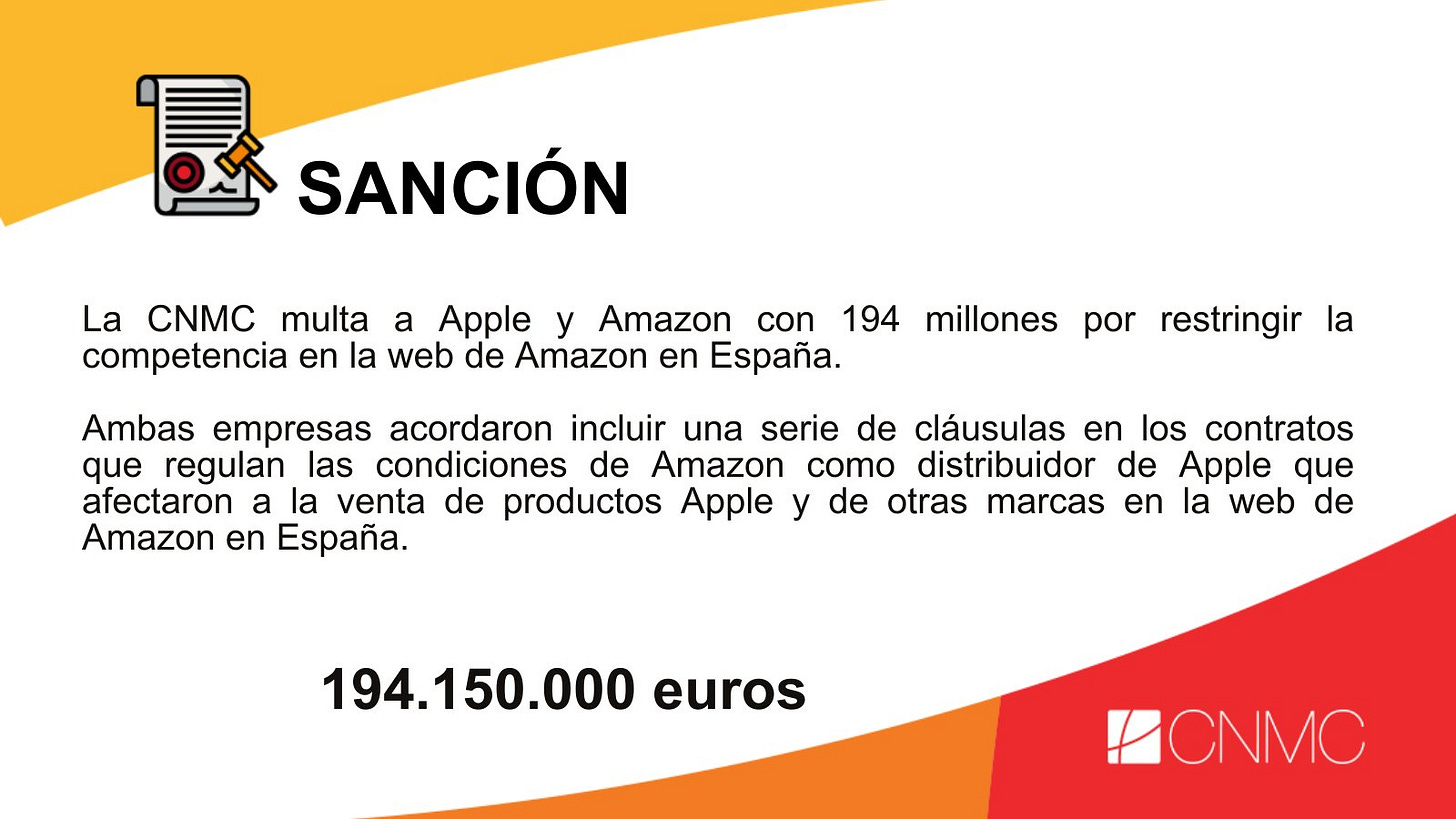
Apple and Amazon got hit with €194m in fines this week. Spain’s CNMC antitrust and markets regulator wrapped up a two-year investigation into a deal between the two companies over how Apple products were presented on Amazon’s marketplace with the decision that, yeah, it was anticompetitive.
The investigation stems from two contracts the companies inked on Oct. 31, 2018 (Halloween!), which gave Amazon the status of authorized Apple dealer.
The CMNC contends that the companies “unjustifiably restricted” the number of resellers of Apple products on Amazon in Spain and “limited the advertising spaces” where competing Apple products could be advertised on Amazon.
The results? More than 90% of the retailers that were using Amazon’s marketplace to sell Apple products were blocked, causing the prices of Apple products sold on Amazon to rise in Spain, according to the CNMC. The markets regulator said this especially hurt Non-Authorized Resellers—generally small businesses.
The fines: €143,6m to Apple and €50,5m to Amazon.
But before you get too excited about finding cut-priced Apple gear on Amazon, a few things to know.
The companies will appeal—and have a good chance of winning. A similar case in Italy saw the two tech giants hit with €200m in fines in November 2021. But it was thrown out late last year by an Italian court.
€194m is pocket change to these guys. Apple’s profit was $100bn last year, to give ya a comparison.
Amazon says Apple product buyers won from the deal as discounts on iPads and iPhones increased (by 6% and 7-8% on the respective products), while Apple said the agreement was meant to limit the number of counterfeits sold online.
Expect months if not years of back and forth and the distinct possibility that nothing will come of it.
4.🫅 Snazzy royals
Royalty are, by definition, meant to look rather swanky. Considering they no longer really have political power (at least in Europe), their main job is to offer some positive symbolism—that is, dress very well and look really good (and not embarrass the country—note to JC1).
On that last point, the Spanish royals (i.e. Felipe VI and Queen Latifah Letizia) have received a surprising amount of praise recently. The occasion? Wimbledon.
It started with 20-year-old Spanish No. 1 Carlos Alcaraz winning the tournament in an epic five-set battle with Novak Djokovic, the winningest of all major winners. (Insert passing of the generational torch commentary here.)
Let’s just say the fashion police noticed F6’s presence—and his snazz. Fashion writer Derek Guy began with a dissertation on how fantástico F6’s tailoring was at the Wimbledon final—and then dove into a wormhole of the king’s historic fashion wins (fascinating and, we must say, a bit much).
This kicked off a frenzy of coverage, as The Daily Mail ran a long piece on how absolutely fab both King F6 and Queen L looked at the ABC journalism awards. What great and daring outfits they wore! What sculpted arms she has! And wow that ‘Look of Love’ she gave him! Again…a bit much.
Question: Has Spain hit peak royal? Is it all downhill from here? And who’s his tailor? (Not that we could afford it.)
An activist group going by the name of VIOLETAS modified the banner that’s been hanging in the Madrid neighborhood of Chamberí since last week and changed the words to hit back at the far-right party.
The banner, which shows a hooded male figure with his hand covering a scared woman’s mouth, originally read “Sánchez put hundreds of these monsters on the street”, in reference to the 1,000+ sex offenders who saw their sentences reduced or were released because of botched writing of his government’s “Solo sí es sí” sexual crime law.
But the message has now been modified by this group to read “(Party leader) Abascal has put hundreds of these monsters in his ranks”. The organization released a statement on Wednesday accusing the party of including in its lists some candidates who have been accused of machista violence.
The VIOLETAS statement also denounced the "fascist, homophobic, patriarchal, and denialist policies defended by the political party led by Santiago Abascal" and specifically mentions the case of Carlos Flores, a Vox candidate for Congress in Valencia who "was convicted of habitual psychological violence against his ex-wife and 21 counts of coercion, slander, and unjust vexation."
The attacks against Vox over the group’s denial of the existence of machista violence have continued as the party tries to reframe such violent acts as a generic “intra-family” violence that does not have machismo as its root causes.
The statement also points out to other less prominent Vox members accused of sexist behavior, such as Carlos Aurelio Caldito, Juan Carlos Cuello Fernández, José Antonio Ortiz Cambray, David Pérez Brígido and Ricardo Ibáñez. According to El País, a VIOLETAS spokesperson said the group prefers to remain anonymous for security reasons.
If you’re wondering what next week’s banner will be, that makes two of us.
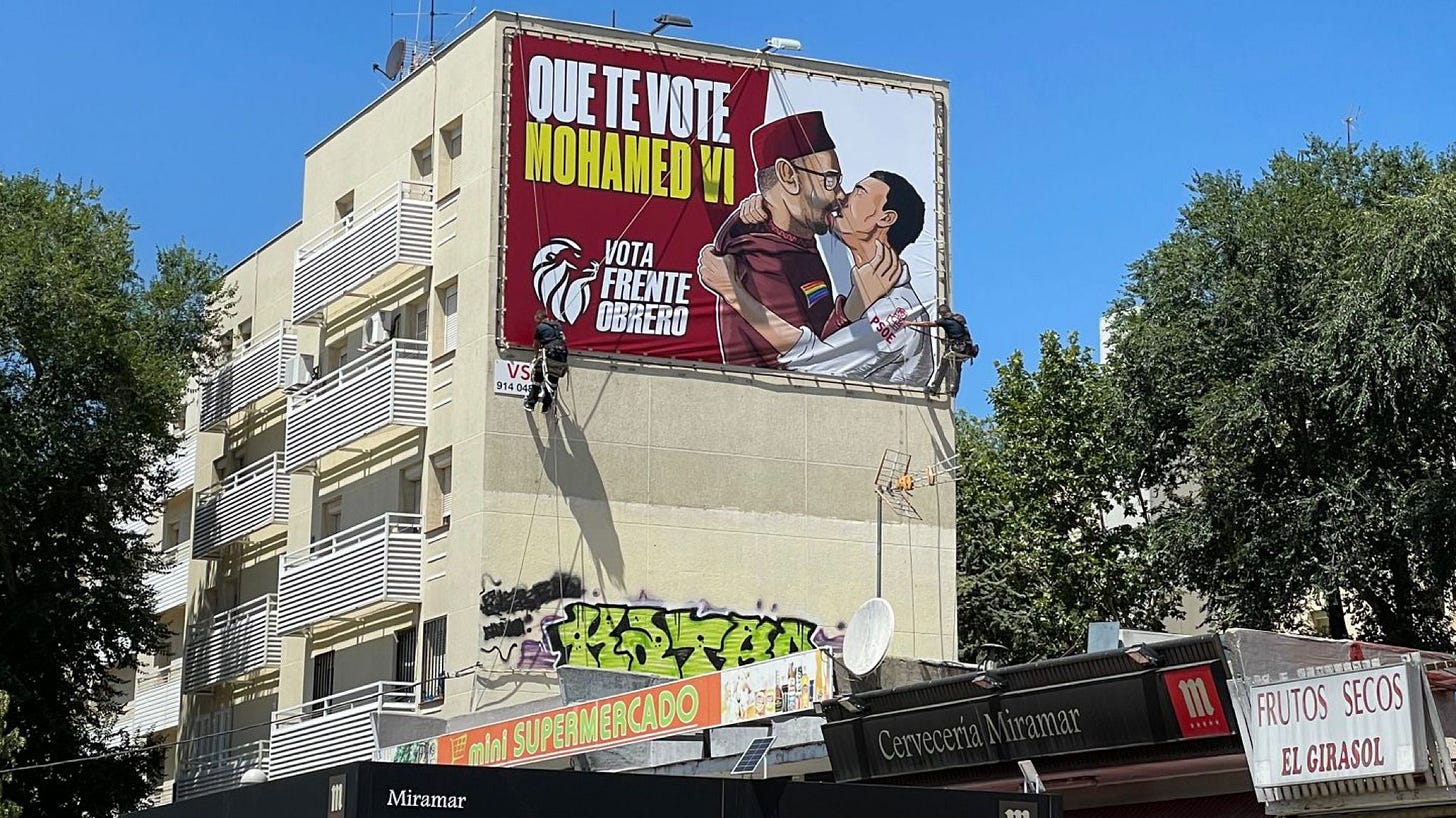
Yup, that banner shows the King of Morocco, Mohamed VI, and Pedro Sánchez sharing a passionate kiss on the mouth. It’s also too small to see but the Moroccan monarch is shown wearing an LGBT patch on his traditional clothing.
The banner reads “Let Mohamed VI vote for you" while asking voters to cast their ballot for the Frente Obrero (Workers' Front), a relatively new and small political party that, while seemingly associated to communist ideology, says it doesn’t “believe in left or right”. Instead, they call themselves “revolutionary patriots”. They also warn against the “islamization of Spain”, saying this country “shouldn’t end up like France”.
Now breath deeply and remind yourself that the campaign season ends with the 23J election.
🙏 Before you go, please remember to share this newsletter with your friends on social media. The more we grow, the more information we’ll be able to offer each week.