

🎗️This Week in Spain: The Amnesty Debate Begins
Also: Zara puts foot in mouth and a big frog gets evicted.
By @IanMount and @AdrianBono | December 14, 2023 | Madrid | Issue #37
🎉 Welcome to The Tapa, an English-language, weekly newsletter about all things Spain!
🥜 This Week in a Nutshell: The amnesty law fight started to get real (in Parliament). Junts continued to make controversial statements that put the PSOE coalition government in an awkward spot and Vox’s Santiago Abascal got in trouble for making a bad comparison while in Argentina. If you thought things were going to cool down before the holidays, you were very wrong.
🙏 Remember that if this email gets truncated at the bottom because it’s too long, just click here to read the rest on Substack.
🙌 But wait, there’s more! The Tapa this week began offering paid subscriptions, and we’d be deeply thrilled if you purchased one to help build this enterprise we’ve had so much fun creating. And a big THANK YOU to those who already have.
🕺If you haven’t subscribed yet, please do so by clicking on the button below.
🫶 And if you already have, please send this newsletter around to your friends and family and help us keep growing.
Yes, this is still a thing
Parliament Begins Debating the Controversial Amnesty Law
After weeks of angry protests, the first bill to be debated by this new Parliament is—you guessed it!—the amnesty bill. And boy, is the right unhappy.
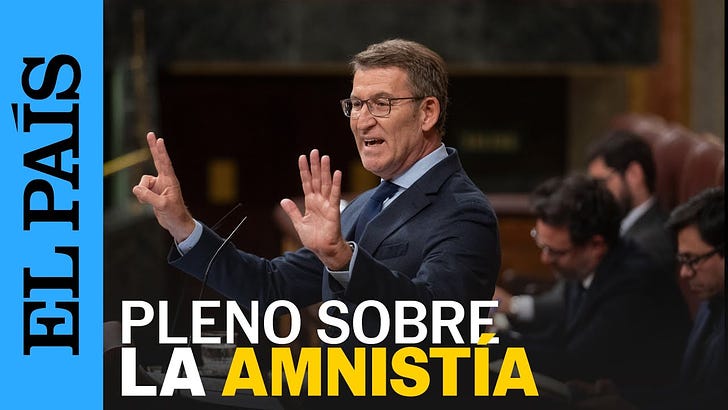
The center-right PP’s leader Alberto Núñez Feijóo didn’t hold back. While Prime Minister Pedro Sánchez was not present during Tuesday’s parliamentary session, Feijóo took the floor to address MPs and explain why, in his view, this bill doesn’t solve any problem in Catalonia but actually “extends it” to all of Spain.
“This is the saddest and most decadent parliamentary session since that evening of February 23,” he said, in reference to the 1981 coup attempt commonly known as 23F.
Feijóo also called the amnesty a “national shame and an international disgrace” because it is the product of “electoral fraud” and represents “political corruption” by going “against coexistence, separation of powers,” and the equality of all Spanish people. In other words, it’s bad. Very bad.
The PP head went on: “Sánchez lost the elections, and the only way to become president was to grant whatever was necessary to the independents,” and then Feijóo highlighted that, before the summer national elections, the PSOE thought granting amnesty to the Catalonian separatists was “unconstitutional”. Oh, how things change.
Indeed they did. Everything changed after July 23, when Sánchez suddenly needed seven votes to get a majority in Parliament and the only party that could give them to him was Junts, led by Catalonian separatist (and outlaw) Carles Puigdemont. Who, you know, would benefit from amnesty.
“They can dress it up with excuses, or constitutional law masterclasses, they can try to downplay its scope, ignore the Constitution… but nothing will change that this is the first payment of an investiture they bought with seven votes,” Feijóo complained (because that’s really all he can do, being that he doesn’t have the votes to change anything).
Far-right Vox leader Santiago Abascal was also pretty mad (and hurt, as it turns out).
It is no secret that the far-right leader is outraged by the amnesty bill, which he calls a “blow to the Constitution, to the equality of Spaniards before the law, to the judicial power, to the Rule of Law, and to the dignity, coexistence, and prosperity of Spaniards”. Really, to Spain.
But he also complained to Feijóo a lot for refusing to join forces with Vox to protest the bill, and particularly because on Sunday the PP leader condemned Abascal for his statements during an interview with Argentine media. (Intrigued? More on that below).
Far from Madrid (and conveniently, from the debate), PM Sánchez flew to Strasbourg on Tuesday, to address the EU Parliament Wednesday as Spain’s presidency of the EU Council comes to a close.
Sánchez spoke about what he did while holding the presidency for the last six months, his “achievements”, his criticism to the Gaza bombings and, of course, the amnesty law which he defended vehemently. Oh, and he blasted the Europe-wide PP group and its leader, Manfred Weber, who has harshly criticized the amnesty deal. So, making friends.
"Europe has gained a progressive ally," he said, adding that voters in Spain had had to decide between a pact of the right and the far-right that would “repeal social, economic, and environmental advancements” and apply “failed neoliberal recipes” and progressive forces that work to forward “social justice, labor dignity, respect for coexistence” and other good causes like feminism and the green transition. To simplify: me good, them bad, black and white. That was easy, right?
But then Carles Puigdemont took center stage.
Puigdemont hasn’t been making thing easy for Sánchez (remember his flirtation with the PP two weeks ago?) and he wasn’t about to start on Wednesday. Addressing the Prime Minister from the lectern during the EU Presidency Council Meeting, Puigdemont decidedly took aim at him.
Sure, his party Junts may have helped Sánchez become Prime Minister but that doesn’t mean they are friends. In fact, both separatist Catalonian parties Junts and ERC constantly criticize Sánchez and his party for not doing “enough” for their region.
Puigdemont warned Sánchez that “failure to fulfill promises creates distrust” and criticized him for still not being able to address MPs in Catalan during EU plenary sessions (you may recall that this was something Spain tried to push through—and failed—as other EU countries thought there were plenty more pressing matters to discuss).
And then it got worse: “Today I address you in your mother tongue… not mine,” he said speaking Spanish. “My freedom of expression is worth less than yours. Mr. Sánchez, opportunities should be seized. If they are ignored, consequences are not pleasant”.
This was the first time Pedro Sánchez and Carles Puigdemont came face to face in public and interacted since the Catalan leader fled to Brussels to avoid arrest in the aftermath of the illegal 1-O independence referendum (and he remains a fugitive from Spanish law, at least until the amnesty is approved).
Sánchez didn’t fire back, however. He simply responded that it’s in both their hands to achieve the amnesty law, which he said was “an important step” and has support by a “broad majority in Parliament”. Oh, and he’ll keep pushing Catalan inside Spain. In other words, the clash was more Kabuki theater than a fight to the death.
Oh, and in case you’re wondering, on the first voting of the bill this Tuesday, it was passed with 178 votes in favor (and 172 against). So, broad majority? Well, at least a majority.
🔔 A Message From Our Sponsor

Bucólico Café is a project of connection that was born as a specialty coffee shop.
We value time and understand that it represents both a cycle and an instant—chronology and nostalgia. Bucólico is a space that connects one’s soul with the purity, lightness and beauty of the countryside—while being in the city. Via a cup of coffee, a piece of cake or a song…
Located on Calle de Barbieri 4 — a few blocks from Plaza Chueca — Bucólico reassures the soul with a feeling of home.
Follow Bucólico Café on Instagram.
💬 Five things to discuss at dinner parties this week
1. Vox’s Abascal angers everyone but Vox
Santiago Abascal was in Argentina this weekend, where he attended the presidential inauguration of “anarcho-capitalist” Javier Milei (and presumably ate a good steak). United by their dislike for the left, they have been expressing mutual support via social media (and sometimes even recorded messages at political rallies) since the Argentine economist announced he was running for president.
Abascal made the media rounds in Buenos Aires, and talked to Argentine media juggernaut Clarín. There, the far-right leader criticized PM Sánchez saying he has “sold his principles” and will do “anything” to stay in power, and added that “there will be a moment when the people will want to hang him by his feet”. You know, just like Italians did after they killed fascist dictator Benito Mussolini in 1945. Not a subtle metaphor.
The outrage was immediate. PSOE leaders accused Abascal of making comments that “incited hatred” against the prime minister and that, one day, “we may have to regret irreparable harm” for them.
Sánchez’s cabinet director Oscar López said “this level of hatred and insult is unbearable and intolerable” and socialist parliamentary spokesperson Patxi López (no relation), said Abascal was “a totalitarian who has crossed all limits” after hanging out with Hungary’s Viktor Orban in Argentina and “threatening” the Prime Minister.
Indignation escalated as folks on the left called for the PP to break up the coalition governments it has with “neo-fascist Vox” in several autonomous communities. Pedro Sánchez himself accused Abascal of "inoculating hatred" and asked PP leader Feijóo for "reflection" on his alliances with that "hateful party."
Feijóo came out to publicly condemn Abascal’s statements, calling his words “regrettable”. But then he also said that they were in line with “the PSOE’s game of dividing Spain”.
But despite the widespread condemnation, neither Abascal nor Vox backed down. Vox spokesperson Ignacio Garriga said on Monday that his party’s leader “was only reminding people of the fate of many dictators”. You know, just a little historical allusion, right?
Never a dull week here.
2. 📕 Pedro Sánchez ‘wrote’ a book and everyone’s a critic
There are many things you can do with Pedro Sánchez’s new book, Tierra firme. You could, for example, read it. You could use it as a paperweight, or as a coaster. And you could put it on the shelf next to his previous book to show you were a fan. One thing you can’t do? Comment on it on Amazon.es. But more on that in a minute.
Sánchez presented his newly published political memoir of the last 4 years on Monday in Madrid’s Círculo de Bellas Artes, where he was interviewed by TV presenter Jorge Javier Vázquez (of Sálvame and Supervivientes 2024 fame) and journo Ángeles Caballero in front of a friendly, docile crowd that in no way would think of yelling “¡Que te vote Txapote!” at the PM.
Vázquez talked. A lot. He made jokes, like saying that Sánchez had been in his life for 10 years, which was longer than any other man. He asked really long questions. He made observations. In fact, he talked so much that someone can be heard at the 14:14 point in the video above saying, “Calle, hombre.” Shut up, man.
The presentation was actually an official work event. Or at least it seemed like it. The official Moncloa site and Presidency accounts on Twitter, Facebook and YouTube streamed it, and 14 of Sánchez’s cabinet members attended, sitting together to listen to Dad him speak.
In fact, it apparently was more of a work event than the presentation of the amnesty law, which Sánchez had scheduled for parliamentary debate on a day when he was flying to Strasbourg to speak to another parliament (see above) and which was attended by fewer cabinet members than the book launch.
With all this work, how did he have time to write the book anyway? It seems like he didn’t. The book was apparently ghost-written by Irene Lozano, the former PSOE MP and head of Espána Global (Spain’s national marketing arm) and importantly, a writer, who wrote his previous book Manual de resistencia based on recorded conversations with him.