
🏖️ This Week in Spain: Summer Voting
Also: Don Benito forever, a Spanish NATO boss (?) and Alejandro Sanz's dark moment.
By @IanMount and @AdrianBono | June 1, 2023 | Madrid | Issue #16
🎉 Welcome to The Tapa, an English-language, weekly newsletter about all things Spain!
🥜 This Week in a Nutshell: We thought after last weekend’s intense regional and municipal elections we would be taking a break from politics, at least for a few months. We were horribly wrong. The results were so bad that Prime Minister Sánchez decided to call a snap general election for July and now all we hear about is politics, politics, politics. And for the first time in Spanish history, people will be going to the polls in the middle of summer, which is freaking out pretty much everyone. Get ready. The next eight weeks are going to be intense.
🙏 Remember that if this email gets truncated at the bottom because it’s too long, just click here to read the rest on Substack.
🕺If you haven’t subscribed yet, please do so by clicking on the button below.
🫶 And if you already have, please send this newsletter around to your friends and family and help us keep growing.
Kiss your summer vacations goodbye
⛱️ What a Week! PM Sánchez Calls Snap Summer General Election After Dismal Sunday Results for PSOE
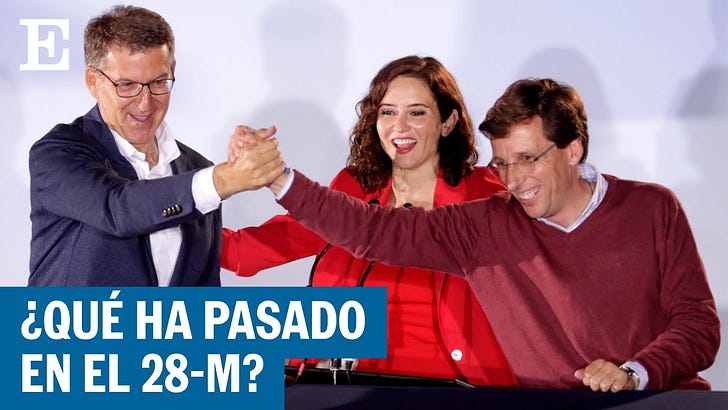
Didn’t see that one coming, did ya? Spanish PM Pedro Sánchez’s decision to call snap elections after his PSOE socialists were slapped down in the 28M polls was one of those rare events in politics: a genuinely surprising move.
Of course, Sánchez is no stranger to the brazen move. Like organizing the no-confidence vote that took down former PP premier Mariamo Rajoy in 2018. Or calling snap elections in 2019 when the left-leaning Catalan separatist party ERC refused to support his budget. Or then calling elections again when he couldn’t form a government with Podemos—and following those elections, forming a coalition with Podemos after saying he “couldn’t sleep” with them in the government. Fine, he’s zigged and zagged, and zogged, but this one really was a surprise.
So why did he do it?
Upending the chess board changes the subject and takes the focus off the PP. Populares boss Alberto Núñez Feijóo won a surprisingly stinging victory over the PSOE on Sunday, but in less than a day Sánchez stole back the spotlight by calling new elections. Victory lap? Nope. Time to plan for the next elections? Not that either.
Doing it now avoids a slow death by 1,000 papercuts over the next 6 months. You’ve put in notice at a job before, right? Two weeks, maybe a month, of easing out, doing progressively less work. Not bad. Now imagine six months of that—but while your enemies tear you down. Which leads us to…
Game of Thrones logic: It stops challengers inside the PSOE from taking him on. Imagine you’re the top dog of the pack, and then you lose—badly. Suddenly a bunch of the next generation—and some members of your own—begin to wonder if they might kill you off. Like, why stay around? (And hey, doing something crazy might scare them into thinking you’re the only one!)
OK, so what’s next?
From the PSOE, expect lots of scare talk about fascists. After losing the 28M elections, Sánchez went on the attack, sending a dire warning that this 23J election comes down to him or the extreme, far, crazy-pants right.
Sánchez said it’s time for the citizens of Spain to decide whether they want a president like Joe Biden or far-right leaders like Donald Trump and Jair Bolsonaro, comparing the PP to an extremist, far-right party. When talking about Vox, Sánchez said there is a “reactionary wave” spreading through Europe and that Spain is not immune to it.
If the PP wins the elections and creates a coalition government with Vox, he said, the “far-right and the extreme right” would undo all of the social progress his government has made and follow the playbook of what we saw happen in Washington and Brasilia. (Cuts to social spending, climate change action, pensions rises, LGBT rights, etc.)
To draw the contrast between the PSOE and the PP, Sánchez is said to be pushing for multiple debates with Feijóo.
From the PP, expect some scare talk too, about “freeing” Spain from the “radical left”—and vague chatter about the need to “repeal Sanchismo”.
Even before 28M, Madrid regional president Isabel Díaz Ayuso had described the regional elections as a choice between “Sanchismo or Spain”. After winning, she was equally, um, generous, about her adversaries. It was time to finish off “minorities who hate Spain” and end "this political and institutional degradation" in which "Pedro Sánchez had put the country."
PP boss Feijóo, significantly more mild-mannered than Ayuso, has stuck to talk about “repealing Sanchismo”. As in, “The Spanish are bored with the confrontation. I am going to unite them again in harmony and tolerance and recover the economy of our country. I am going to repeal Sanchismo”. Or, as he later added, Sánchez had to be turfed out because, "arrogance and egocentrism have to be punished at the polls."
Feijóo would very much like to avoid talk about deals with Vox. Although the coalition with Vox in Castilla y León hasn’t appeared to have hurt the PP too much, the question is which Vox will come out at negotiating time: the irritating but mostly-bark variety seen in Madrid and Andalucía, or a more aggressive version that would take down the PP if it didn’t get what it wanted. It’s because of this that Feijóo is putting off negotiations until after 23J—and why his only response to Vox so far has been, “If Vox wants to repeal Sanchismo, it is in a position to facilitate it.”
Will Sánchez’s move work? Let’s just say the jury is out. Way out.Honestly, calling early elections in July is a Hail Mary pass. And we hear Mary takes the summer off.
Sanchez’s hope is that a mix of fascism fright (on the left) and summer laziness (on the right) will allow his ungainly coalition of “Not PP and Vox” parties to win a majority.
For Sánchez’s plan to be at all viable, a union between the two far-left parties—Unidas Podemos and new Sumar—seems a prerequisite. It may be in the works (now, at the last hour), as Sumar founder and Second Deputy Prime Minister Yolanda Díaz recently reappeared to say that she “accepts the challenge” of creating a broad leftist front. But a deal between the two embattled parties (who regularly spat) would be a marriage of convenience at best.
Even if Sánchez were to pull off a victory, forming a coalition from those parties would be like herding cats. That is, cats who’ve taken speed.
For that reason, repeat elections after a “Not PP and Vox” victory might not only be possible, but perhaps likely. Kiko Llaneras of El País offers an excellent breakdown of the various possible outcomes. Spoiler alert: there are very few where the left comes out ahead (Sumar and Podemos joining is a must) and even then would require massive cat herding (see above)
Anyway, the whole PSOE coalition fantasy may be just…a fantasy. The world of money (in this case, JPMorgan) is predicting a PP-led government, with Vox supporting it from the inside or out. One support for that view? El Confidencial published a poll Wednesday giving the PP 144 seats and Vox 52 in Spain’s 350-member Parliament, which (sorry for the smell of smoke as we do the math) gives the two enough of a majority to form a government. And most of El País’s options (above) put the right ahead.
No matter what, the next eight weeks will be fun for political junkies—and really annoying for everyone else.
🔔 A Message From Our Sponsor
Bucólico Café is a specialty coffee shop located in Madrid that brings the simplicity and aesthetics of the countryside to the city. They offer homemade products and a variety of coffees from different origins and preparation methods
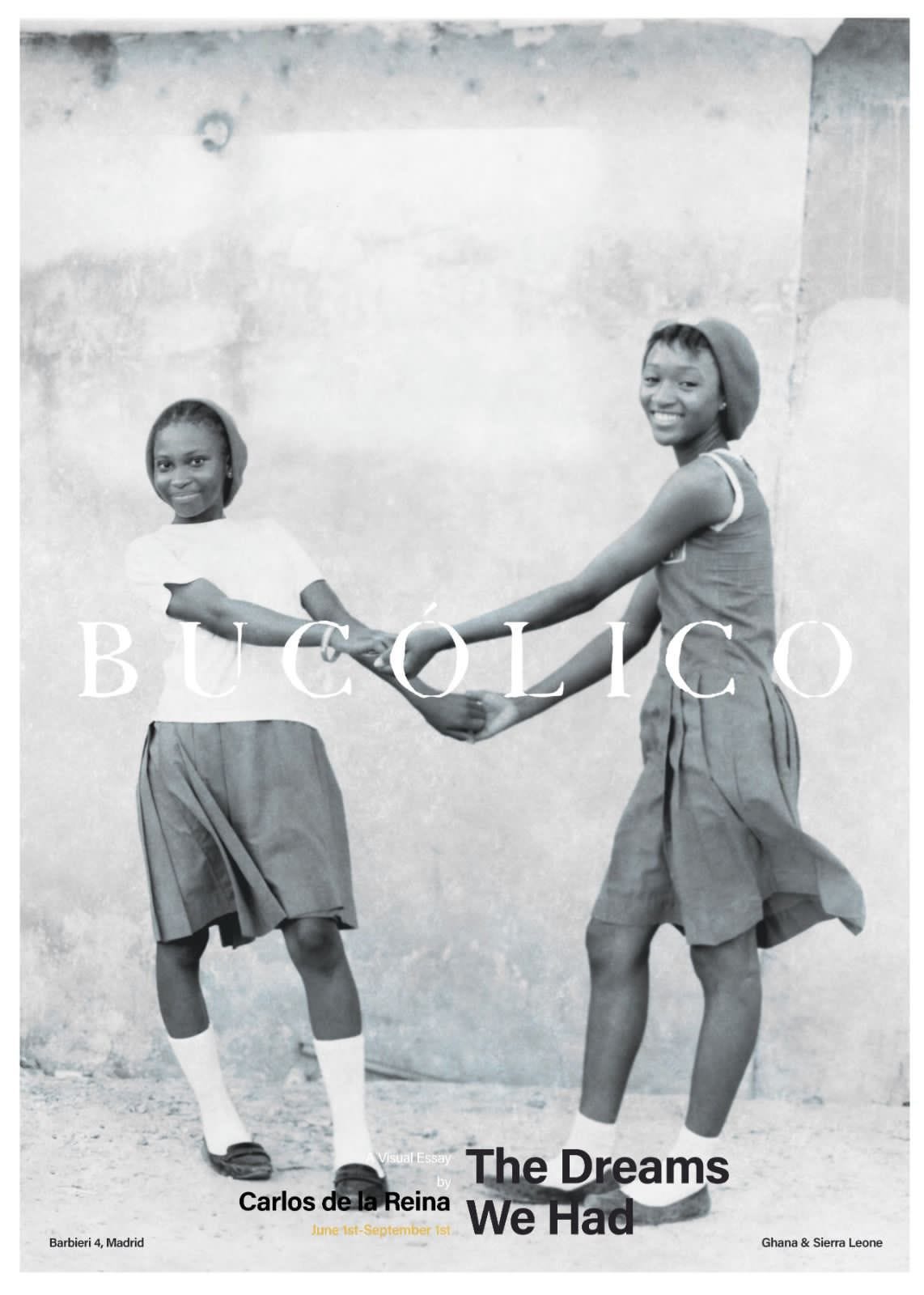
Bucólico is hosting an exhibition titled The Dreams We Had by photographer Carlos de la Reina, which captures the lives of children and teenagers in Ghana and Sierra Leone, highlighting the beauty and dreams that transcend stereotypes and barriers. It will be on display at Bucólico Café from June 1 to September 1.
Madrid-born photographer Carlos de la Reina challenges preconceived notions, capturing the diverse lives of children and young people along the West African coast. Through collaborations with organizations like 'Obinini Girls' and the 'Justice Brothers,' he emphasizes empowerment through sports.
Experience his unique perspective and captivating artwork at the exhibition in Bucólico Café, located on Calle de Barbieri 4 — a few blocks from Plaza Chueca.
Follow Bucólico Café on Instagram.
💬 Five things to discuss at dinner parties this week:
🤬 1. You want me to work the polls? In July?!
Having to vote on a hot summer day is already a hassle for a lot of people. But being called to poll worker duty is much, much worse, especially for those who were thinking of, like, going away on vacation that weekend.
Voting in Spain is not mandatory, so on July 23 millions of people will choose between a day at the beach or staying home to go to the polls (those who think ahead will get a mail-in ballot). Poll worker duty, however, is mandatory and inescapable. You know, like death and taxes. In fact, failing to comply with such a sacred responsibility can translate into a significant fine, or what’s worse, prison time. TL;DR if you are selected and were planning on being away that weekend, you’re pretty much screwed.
40% of the Spanish population takes its summer holidays in July, according to a report by travel search engine Jetcost. That’s why summer elections have sent everyone into panic mode—especially those who have already paid for their their plane tickets and hotel. Right now they have a sword of Damocles (aka poll worker duty) hanging over their heads.
El Mundo reports that Google searches on how to avoid poll worker duty skyrocketed immediately after Sánchez announced his decision to hold the general elections in July. “Can I be exempt if I have a trip?”, “When will I know if I’m selected?”, “If I’m selected, can I get a refund?” and “What happens if I don’t show up?” are some of the people’s many questions.
The draw to select the 545,184 poll workers who will have to show up at their polling stations on election day (out of 35 million voters, or 1.4% of elegible voters) is scheduled to take place between June 24 and June 28 . (It’s like The Hunger Games but worse, because here no one can volunteer as tribute). Three days after they are selected, they will receive a letter in the mail, telling them they are up for poll worker duty (181,728 will be named lead workers, while 363,456 will be selected as substitutes). Each polling spot has nine members: a president, two workers and two substitutes for each of them. And cheerleaders. Actually no, that last bit is not true.
For those wondering what happens if they don’t show up, failure to attend without a valid reason could be seen as a crime of abandonment or non-compliance with electoral duties, which may result in a prison sentence of three months to one year or a fine of six to twenty-four months.