
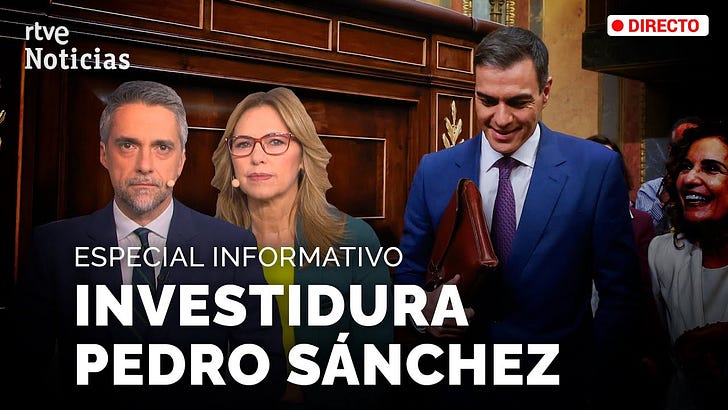
🇪🇸 This Week in Spain: Sánchez's Investiture Day
Also: 'Sálvame' is back (kind of) and... is Taylor Swift buying property in Mallorca?
By @IanMount and @AdrianBono | November 16, 2023 | Madrid | Issue #37
🎉 Welcome to The Tapa, an English-language, weekly newsletter about all things Spain!
🥜 This Week in a Nutshell: The big day is finally here. After months of comings and goings, a summer election, palace intrigue, complicated maths and failed investitures, it looks like, in the end, Pedro Sánchez managed to get exactly what he wanted. If all goes according to plan, the caretaker prime minister is on course to secure a new term in a parliamentary vote today.
🙏 Remember that if this email gets truncated at the bottom because it’s too long, just click here to read the rest on Substack.
🙌 But wait, there’s more! The Tapa has its very own LinkedIn page to grow a new community. Please check it out and, if you’re so inclined, follow us here.
🕺If you haven’t subscribed yet, please do so by clicking on the button below.
🫶 And if you already have, please send this newsletter around to your friends and family and help us keep growing.
Four more years
Pedro Sánchez on Course to be Voted Prime Minister
The Big Day. High Noon. The moment we’ve all been waiting for. Take whichever cliche you prefer, that’s what Wednesday was.
At least for Pedro Sánchez, Spain’s caretaker PSOE socialist Prime Minister who had cleared the way to repeat in the country’s top job.
And for Catalan separatists with legal problems, who’d negotiated a deal to get amnesty if Sánchez got his wish.
And for the right-wingers of Hazte Oír driving around Madrid in a bus plastered with an image of Sánchez as Hitler (Nazis were national socialists and Sánchez is a socialist so…get it?) and his party’s initials written as Pedro Sánchez Odia España. If it must be said, Hazte Oír do not like Sánchez or want him in power.
Sánchez’s Big Day—or, rather, the two-day investiture process that will previsiblemente culminate on Thursday in a (close to 100% likely) ‘yes’ vote for a new Sánchez term—in fact began yesterday at high noon in Parliament, with the speaker Francina Armengol reading the King’s proposal of Sánchez as a candidate. And then Sánchez stepped up to the dais to give his Big Speech.
The speech is, in theory, a chance for the candidate to explain his or her program (though in Spain always his to date) and why the MPs should vote for him.
Sánchez did explain some measures his government would put in place in a new term, but really that was the least awaited part of his speech and caused few sparks.
Sánchez said his new government would: a) provide free public transport for minors, young people, and the unemployed; b) maintain reduced IVA on basic foods for six more months; c) raise the income ceiling for people to apply for help paying their mortgages to €38,000; d) remove statutes of limitation on child sexual abuses and create a fund for those abused by the church; e) create a national mental health pact to train more psych professionals and expand treatment; and f) plenty of other smaller and/or less defined changes like creating “cultural rights”, which seems like basically more art everywhere, and blah blah.
It was all pretty palatable for people across the political spectrum—who doesn’t like free stuff and more art?—and complaints were largely limited to casposo grumblings that Sánchez doesn’t have the power to do some of the things and others had already been announced, and it was expensive, and blah blah.
Amnesty! Sánchez took almost an hour and a half to get to the main course, the dish everyone was waiting for (drumroll, please)… the, um, controversial deal his party made with Carles Puigdemont—the former Catalan regional boss who oversaw the illegal independence referendum in 2017 and then self-exiled to a McMansion in the Brussels suburbs—to get the seven votes from Junts, Puigdemont’s party, that Sánchez needs fort re-election.
And Sánchez being the risk-loving pol he is, he did not shy away.
Knowing full well that amnesty for Catalan separatists in itself has little support, Sánchez went for the best defense—that is, a good offense. He went on the attack.
So instead of defending amnesty as a good policy per se, Sánchez framed his agreeing to it as a necessary price to pay to keep right wing nutters like Vox—who would come in on the PP’s coattails—out of power.
“The circumstances are what they are,” Sánchez said, and one had to "make a virtue out of necessity." Plus, considering that, you know, the whole 1O separatist referendum madness happened while the PP was in power (in the body of PM Mariano Rajoy), the PSOE couldn’t exactly do worse: “The PP recipe led to disaster in Catalonia. We are committed to dialogue and forgiveness."
In other words, we had to do this unpleasant thing to avoid a government formed by the PP and the radical right. Which is basically the same argument Sánchez used to get just enough votes on 23J to stop the PP—propped up by and dependent on the far-righties of Vox—from coming to power. The argument in super-basic form: You may not like us, but they are very bad.
It all came back to this touchstone: almost any deal was justifiable in the name of stopping the far right, which is motivated by a distrust of democracy and a dislike of working people.
“Let's not be naive,” Sánchez said. “The PP's problem alongside Vox is not the amnesty, it is that they do not accept the result of the polls. We know that the amnesty matters very little to them. The economic powers that support them know that the amnesty will be good. What the rights do not want is for us to continue improving working conditions, that is why they do not want us to govern.”
Sánchez be blunt: “It is necessary that we continue governing to prevent Spain from retreating in the face of the reactionary wave that is advancing in all countries.”
Beyond that, there was lip service to how amnesty would ease tensions and calm the waters and blah blah blah. “We must bet on coexistence [and approve the amnesty] to consolidate the progress made in these last four years,” Sánchez said.
Following Sánchez’s epic doubling down, it was in-ev-it-a-ble that the level of hostile repartee would soar, and it did. Welcome to Insulting Zingerfest 2023!
First came Feijoo, who, just like Sánchez before him, trotted out election lines past and future.
Feijóo’s were aimed at firing up his electorate at Sánchez’s, um, useful flip-flops on policy and principles when it came to amnesty (he was absolutely against before 23J, and totally for it when he needed Junts votes after). It has, indeed, become a parlor game to list all the times Sánchez and his helpers said they wouldn’t do what they’ve now agreed to do.
“This investiture was born of a fraud," Feijóo said. “The deal brought to Parliament today was not voted on at the polls… Why don't they let Spaniards vote at the polls?"
Sánchez “does not have anyone's support, he has bought it by paying checks that we will all pay,” he added
These are worthwhile points, and some are arguably true. But while having good points and being right will get you a win at debate society, here, in Spain’s hardscrabble political world, you lose. You need to cobble together more MP votes than the other guy, and Feijóo didn’t.
While Feijóo was visibly frustrated with Sánchez, it was no comparison to the speech that Vox leader Santiago Abascal offered when it was his turn. In short, he was livid.
The far-right leader pulled no punches and accused Sánchez of “trying to stage a coup” and compared him to “Chávez, Maduro and Hitler” arguing that they all used their position in power to “break democracy”.
His words were interrupted by Parliament president Francina Armengol, who accused him of going against parliamentary decorum rules and against the “foundations of democracy”, warning him to withdraw his accusations. “This country knows what a coup is,” she said—pointing out to the bullet holes that can still be seen on the Parliament ceiling and referring to the failed coup of 1981.
Abascal refused to take back his words, and Armengol told him the language would be erased from the session’s minutes, to which he responded that such censorship was evidence it was indeed, a coup.
The far-right leader then warned PP leader Feijóo that if his party didn’t oppose the amnesty law in the Senate (where they have a majority) Vox would break up with the center-right and end their coalition governments in several of Spain’s autonomous communities (drama!).
After his speech, and before Pedro Sánchez was able to offer a response, all of Vox’s 33 MPs left the floor in sign of protest (Abascal included).
Later that evening, it was Isabel Díaz Ayuso’s turn to be involved in controversy after she was caught on camera calling Sánchez a “son of a bitch”.
Sanchez mentioned the corruption accusations made against her brother a couple of years ago (a court decided there was no evidence of wrongdoing in 2022). When the camera suddenly cut to her, she could be clearly seen saying “hijo de puta,” which—you guessed it—means the male child of a female dog.
When the media ran to ask her staffers about it, they replied she was just saying “me gusta la fruta” (“I like fruit”) which is a pretty random comment to make. But then someone from her team admitted she had actually insulted Sánchez because he had made an accusation without evidence. “It’s the least he deserves,” they said.
Late in the evening (when everyone was kind of done for the day) it was time for Catalan separatist parties ERC and Junts to speak. And it was awkward as hell, especially for Sánchez.
Neither of them minced words and clearly said this was simply a marriage of convenience. Neither party likes PSOE (or the Spanish government in general) and they both know that without their votes, Sánchez can’t be prime minister. So they decided to have some fun.
Gabriel Rufián from ERC (who loves to troll people in Parliament) warned Sánchez that his party “today has the power to make him do things” and yes, he even mentioned an independence referendum. “Look around,” he told him. “Do you see any alternative to us?”
“Don’t risk it,” he concluded while Sánchez just… sat there.
Then came Miriam Nogueras from Junts, who had a similar message for him and warned that they could withdraw their support “at any time”. “Don’t test your luck,” she warned. Once again, Sánchez just… sat there.
Sánchez was relatively brief and avoided direct confrontation when responding to both of them, saying that he had been “betting on having a dialogue” since he took office in 2018.
Oh, and one last thing: yes, once again there were violent protests outside the PSOE headquarters last night. Some 2,000 people gathered outside the building and some of the most extreme elements present began hurling beer bottles and other objects to the police. The night ended with at least 14 people arrested and nine injured.
🔔 A Message From Our Sponsor

Bucólico Café is a project of connection that was born as a specialty coffee shop.
We value time and understand that it represents both a cycle and an instant—chronology and nostalgia. Bucólico is a space that connects one’s soul with the purity, lightness and beauty of the countryside—while being in the city. Via a cup of coffee, a piece of cake or a song…
Located on Calle de Barbieri 4 — a few blocks from Plaza Chueca — Bucólico reassures the soul with a feeling of home.
Follow Bucólico Café on Instagram.
💬 Five things to discuss at dinner parties this week
1. 🇪🇸 What’s up with the hole in the flag?
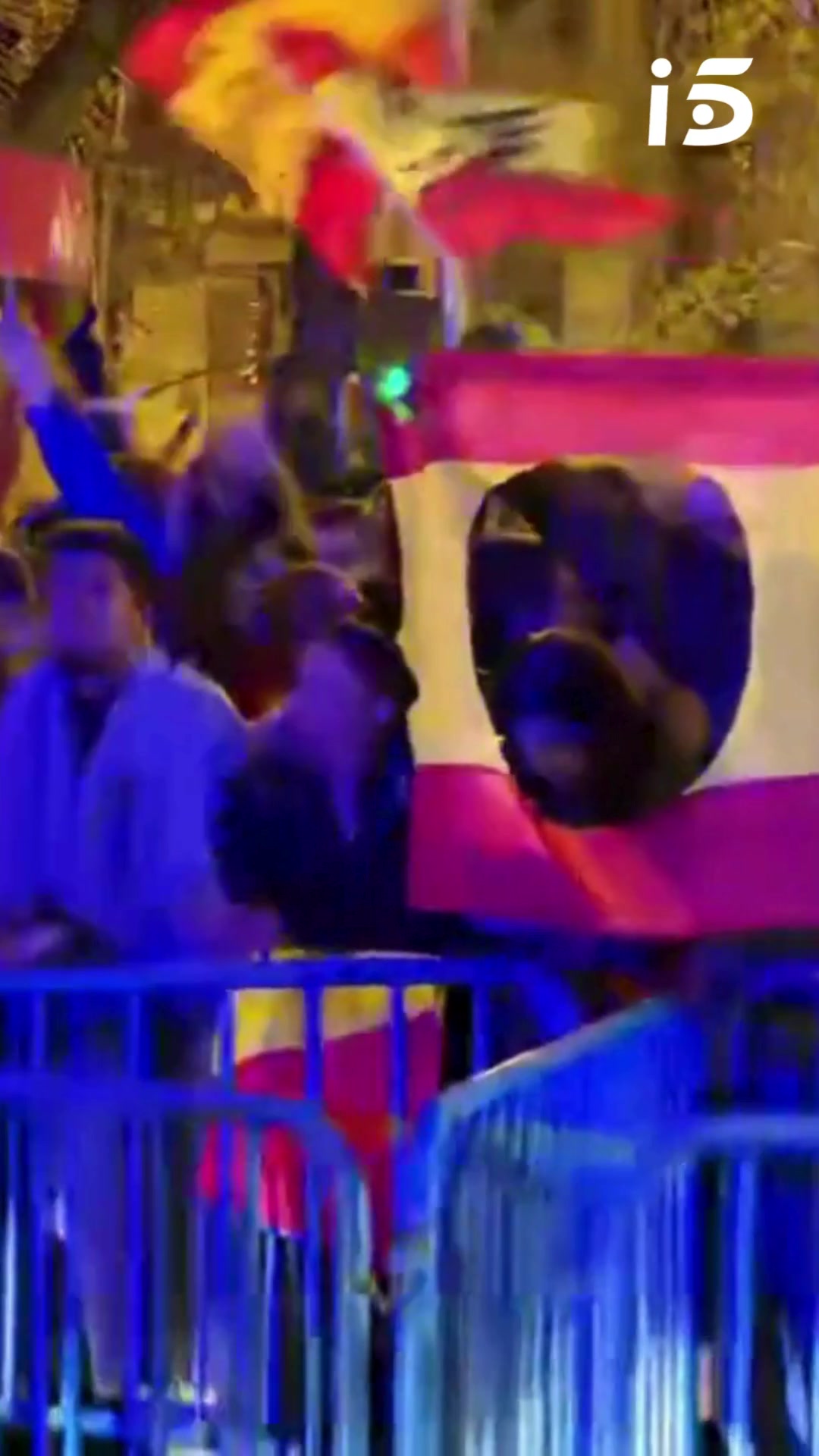
The anti-amnesty protests over the last weeks have sported tons of flags. From ones with bulls, to ones spray-painted with slogans, to the “pre-democratic” Franco-era variety to…those with a big hole in the center where the coat of arms would normally be. What gives with the last one?
Hungary 1956? It’s true! It has everything to do with Hungary 1956.
Anti-Soviet. Back in 1956, Hungarians rebelled against their country’s domination by their Soviet overlords. They were, well, put down. Some 2,500 were killed (and 700 Soviet soldiers died) and 200,000 Hungarians fled abroad.
What does this have to do with Spain and amnesty and stuff? Since Hungary’s 1956 put-down, cutting the coat of arms/state seal has become a symbol of a revolution of the people against their government.