
🗳️ This Week in Spain: PP Wins, PSOE Sinks
Also: Birth rates plummet, a dead duck political scandal and... a Russian hit job?
By @IanMount and @AdrianBono | February 22, 2024 | Madrid | Issue #45
🎉 Welcome to The Tapa, an English-language, weekly newsletter about all things Spain!
🥜 This Week in a Nutshell: There was no big surprise Sunday after the Galicia regional elections. The Partido Popular got enough votes to remain in power and the PSOE saw dismal results as many people chose the nationalist party BNG instead.
🙏 Remember that if this email gets truncated at the bottom because it’s too long, just click here to read the rest on Substack.
🙌 One more thing: We are offering paid subscriptions, and we’d be thrilled if you purchased one to help build this enterprise we’ve had so much fun creating. (And to those of you who have already subscribed, thanks for the love 🥰.)
🕺If you haven’t subscribed yet, please do so by clicking on the button below.
🫶 And if you already have, please send this newsletter around to your friends and family and help us keep growing.
Good news for Feijóo
🔵 Galicia Regional Elections: PP Remains in Power
The center-right Partido Popular (PP) finally caught a break this past Sunday in the Galicia regional elections, after a few complicated weeks for the conservatives.
While some polls predicted that a leftist coalition between nationalist BNG and the PSdeG (center-left PSOE’s local arm) could pull off an upset, the PP came out on top in the end and then ran around like they’d won a Nobel Prize.
This election marked a continuation of the PP’s dominance in Galicia, a stronghold where they've maintained a majority for most of the past 34 years.
The PP and PSOE’s leaders have both been on their heels recently (more below), so the election was seen as a referendum on both PP boss Alberto Núñez Feijóo and the PSOE leader (and Prime Minister) Pedro Sánchez.
How do we know it was seen as a referendum? National political leaders campaigned heavily alongside the regional candidates in Galicia’s four provinces.
So who are this election’s big winners and losers? Let’s take a look!
Big Winners:
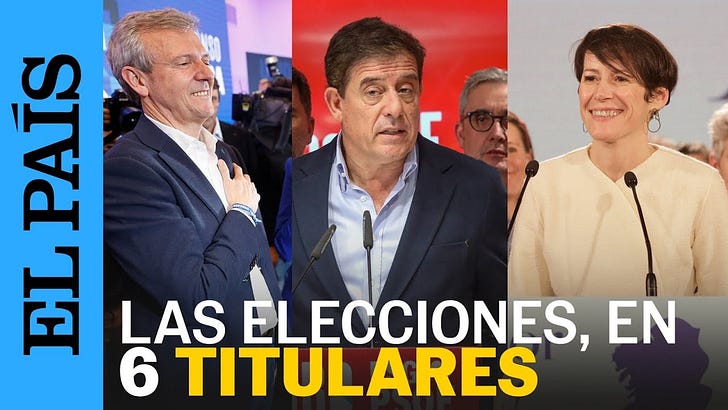
The Partido Popular. The PP stays in power after obtaining 40 seats out of 75 in the regional Parliament. While they lost two seats with respect to the 2020 election, they still got 47.36% of the vote (700.491 people) and a majority, and their current regional head Alfonso Rueda will get four more years.
Alberto Núñez Feijóo: This victory not only shows the PP's power in the region but also saves the hide of party boss Feijóo—a former Galicia president himself. After the damage caused by recent revelations that he had considered offering pardons or amnesty to Catalan separatist leaders if they helped him form a PP-led government, pundits claimed that a loss in Galicia could cost Feijóo the party leadership. But the results confirmed him as boss, an interpretation Feijóo, um, leaned into: “If they wanted this to be a plebiscite on my leadership, here is the result.”
Really, Feijóo was feeling cocky. On Wednesday, he and Sánchez clashed in Parliament and the PP leader was clearly emboldened by the results. “Here I am, on my feet,” he told Sánchez, “after a 40-9 result” (yes, it was a bad night for the socialists, more on that below).
Sánchez counterattacked by bringing up the scandal over the considered Catalan pardons, but Feijóo was having none of it. “You outdo yourself everyday,” he replied. “You started by lying about what I do, you continue lying about what I say, and now you lie about what I think. When it comes to lies, you win by a landslide.” Daaaaaaaaamn 🔥.
Winners:
The Bloque Nacionalista Gallego (Galician Nationalist Bloc or BNG): These guys came in second. So no 🏅. However, they had a fantastic election as they managed to secure 25 seats (six more than in 2020) — their best election results ever. The election solidifies the party as a major political force in the region (with 31.57% of the vote, or 467.074 voters), advocating a left-wing Galician nationalism.
Democracia Ourensana: “Who?”, you’re probably asking. Don’t worry, most people don’t know them either but these Ourense localists managed to win one seat (1.03% of the votes) so they deserve a shout out. Did the party get a big push from this viral video featuring Ourense mayor singing to the tunes of YMCA? Ab-so-lute-ly. Are they irrelevant? Yes. Are they happy? Also yes.
Losers:
PSdeG, PSOE and Prime Minister Pedro Sánchez: Yikes. It was a dismal night for the socialists. In fact, they only managed to hold nine seats out of the 14 they won four years ago (they got 14.04% of the vote, or 207.691 votes), a historic low for the party’s Galician branch (PSdeG) led by José Ramón Gómez Besteiro.
Was this a rejection of Sánchez’s plans to offer blanket amnesty to Catalan separatists facing legal troubles over the whole trying to break up with Spain thing? Well, it depends on who you ask.
The PSOE insists these elections were strictly regional and actually they lost because voters didn’t know their candidate. (Though people here vote straight party tickets.) Speaking to the press yesterday, Sánchez even said that the results were “in no way” related to the endless negotiations with Catalan separatist party Junts. Translation: These are not the droids you’re looking for.
But really? Socialist leaders are reportedly saying they are “exhausted” and “worried” that the amnesty debate is hurting the party, according to El Mundo.
That sounds more honest: “These are bad results, there’s no sugarcoating them,” said socialist A Coruña mayor Inés Rey.
Big losers
Last and definitely least, we have the big losers: Sumar, Podemos and Vox.
Sumar and Yolanda Díaz: This one must have hurt, as the leader of the lefty party, Second Deputy Prime Minister Díaz, is Galician (aka gallega). Despite Díaz’s efforts to hoist her candidate, Marta Lois, the party performed abysmally in its regional debut, notching up a meager 1.9% of the vote and no seats.
Podemos: Far-left Podemos saw even worse results, obtaining only 0.26% of the vote—fewer votes than animal rights party PACMA. Was there self-criticism from the party’s national leadership and talk about joining with Sumar? Nope.
Vox: The tighty righties failed once again to gain traction in Galicia and remain unable to steal a significant amount of votes from the PP. Vox fell short of entering the Galician Parliament (they only got 2.19% of the vote), just like in 2020
Next stop: Basque Country regional elections in the spring. Grab your popcorn🍿.
🔔 A Message From Our Sponsor — With a Coupon!

MEAT MADRID is your carnivorous stomach’s home away from home in Spain’s capital. Seriously, look at the name. And we’ve got an offer to prove it.
Hungover? Not yet? Come celebrate making it through Dry January with Wet February at MEAT. Tell your waiter you're with The Tapa or show him this coupon on your phone for two free drinks (beer, wine or soft drinks) with your meal (€15 min. check/diner). Valid through February.
MEAT is located on Calle de Santa Teresa 4, just off Plaza Santa Bárbara, and open every day from 13-16:30 and 19:30 to midnight. Reservations: 91 029 60 41.
Follow Meat Madrid on Instagram.
💬 Five things to discuss at dinner parties this week
1. 🇷🇺 That Russian pilot defector found dead in Alicante
One Spain story made the international headlines this week because it involved Russia and mysterious deaths. Maxim Kuzminov, the Russian pilot who made the news after defecting to Ukraine last year, was found murdered in Alicante last week, and signs point to a hit planned by Russian intelligence.
Kuzminov's defection was a big deal. He landed a Russian Mi8 military helicopter in Ukrainian territory and turned himself in, in a carefully planned defection and theft the Ukrainian authorities dubbed “Operation Synytsia.”
Ukrainian authorities said they offered protection and financial incentives to encourage Kuzminov to remain in Ukraine, but je chose to use his money (the Ukrainian government gave him $500,000) to move to the Spanish coast under a false name (Ukraine provided official documents for his new identity). Spanish intelligence was apparently never notified of this.
What we know. Kuzminov was found dead on Feb. 13 in a parking garage in Villajoyosa, Alicante. His body was riddled with bullets (he was shot five times) and had been run over by a car that was later found burned outside a nearby city. His identity was confirmed by Ukrainian intelligence.
Moscow’s foreign intelligence chief Sergei Naryshkin condemned his defection after learning of his death and said: “This traitor and criminal became a moral corpse at the very moment he planned his dirty and terrible crime”.
Not what it seemed. While initially thought to be a gang-on-gang crime, investigators soon realized that his papers were fake and that it was indeed Kuzminov, which caught the attention of the international media, especially coming only a few days after Putin critic Alexei Navalny died in prison.
Spanish intelligence services have no doubt that the Kremlin is behind his death but so far no much more is coming out of the government. (They still may be miffed at not being warned of his presence.🤔)
Kuzminov was “imprudent” and “well known” by the local police, ABC reports, because he had been involved in “altercations”. The publication also mentions drug use, prostitutes, but take that with a grain of sal as that is, coincidentally, what Russian media said was responsible for his death.
Not the best choice of lcoale: Kuzminov picked a preferred destination for Russian and Ukrainian citizens, so he was probably “identified quickly”. Local authorities call moving to Alicante a mistake, as it’s the Spanish province with the largest number of Russian citizens (17.500).
Kuzminov had apparently called Russia to “invite his girlfriend over”, El Español also reported, which may have helped Moscow pinpoint his location.
What we don’t know. The focus is now on who killed him, although it’s unlikely they are still in the country.
Spanish intelligence services admit that it’s “very difficult” to find evidence of those involved. They assume that the crime was committed by gunmen hired by Moscow who came from outside of Spain and by now are probably back abroad.
2. 🚜 Tractors, cows, vertigo and fascists—we got it all!
Nobody told Luis Planas that being Spain’s minister of agriculture was going to be so tough. But this week, oh it was! Thousands of farmers riding hundreds of tractors invaded the center of Madrid (honestly, this was sorta fun) to demand more government aid, for one thing.