
🗳️ This Week in Spain: Election Weekend!
Also: Racism in football, more crazy weather and an app for chores.
By @IanMount and @AdrianBono | May 25, 2023 | Madrid | Issue #15
🎉 Welcome to The Tapa, an English-language, weekly newsletter about all things Spain!
🥜 This Week in a Nutshell: We’re three days away from the municipal and regional elections, so brace yourselves this weekend. Also: Is Spain a racist country? The debate is on here and abroad, courtesy of racist football fans.
🙏 Also, it’s a long one today, so if it gets truncated at the bottom of your email, just click on the link to read the rest on Substack.
🕺If you haven’t subscribed yet, please do so by clicking on the button below.
🫶 And if you already have, please send this newsletter around to your friends and family and help us keep growing.
The explainer you were hoping for
🍿 Election Weekend: What You Need To Know
Hallelujah, it’s election time again! Okay, fine, we exaggerate slightly. But this Sunday, May 28—aka 28M—features local and regional elections, and we here at The Tapa are enough politics dorks to feel a little flutter of excitement at the prospect.
Much of the coverage in the lead-up to these elections has focused on them as a dry-run for national elections, which must be held by December—and most likely will be held in December, because Spain holds the EU presidency for the last six months of 2023, and there’s no reason PM Pedro Sánchez would want to mess that up with an election, and end up leaving his star turn early if his PSOE socialists fell from power.
We’re going to focus on the two main stories of that dry-run—and where we’ll see them play out. Namely, a) whether a downtrodden Podemos will survive 28M, because their survival will be key to repeating the current national coalition, and b) whether the center-right PP will be able to form local and regional governments without the far-right Vox, as coalitions with Vox would offer the left a key attacking angle in national elections. We will look at these two stories in three key places: Madrid, Barcelona, and Valencia.
First, though, the state of play. All municipalities will hold local elections on Sunday, as will 12 of Spain’s 17 regional parliaments (the other 5—Catalonia, Galicia, Castilla y León, Andalucía, and Basque Country—held early elections and got off schedule).
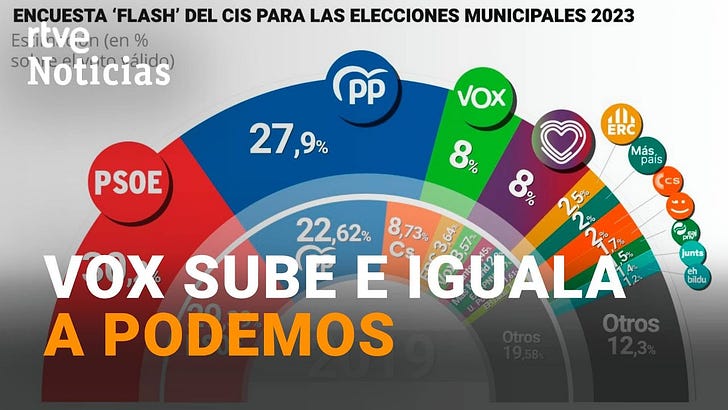
OK, on the left, what’s going on with Unidas Podemos? The far-left movement that started with the rise of Podemos in the Spanish political scene in 2014 is, as Tapa friend Guy Hudgecoe notes in this excellent Politico article, fading and desperately looking for votes. Here’s a quick history lesson:.
Podemos rose to prominence as a result of the indignados movement in the early ‘10s (indignados: citizens outraged over the austerity measures that came with the Spanish financial crisis). In 2014, they broke up Spain’s two-party system and became an alternative for voters who were angry over the state of the economy.
Podemos joined forces with the Izquierda Unida (United Left) in 2016 and formed the coalition known as Unidos Podemos (they eventually changed their name to Unidas Podemos in 2019 in recognition of the feminist movement). The party gained significant momentum in the 2015 and 2016 general elections, advocating for progressive policies, social justice, and a new political order.
In the 2019 general elections, the center-left PSOE led by current PM Pedro Sánchez and Unidas Podemos (then led by the now retired Pablo Iglesias) reached a deal to become Spain’s first coalition government since the return of democracy in the late 70s.
But, as Politico explains, things now are very different from what they were then— especially after the “only yes means yes” law fiasco and the rise of SUMAR’s Yolanda Díaz’s as a serious presidential contender:
“Podemos lacks strong leadership, with its credibility undermined by a bungled legislative initiative and at loggerheads with its leftist rivals. As a result, the party goes into these elections weaker than at any time since its foundation.”
And on the right, what’s up with Vox? The far-right, anti-immigrant party made a big splash in 2018 when it won its first regional seats in Andalucía and scrambled Spain’s party system much like Podemos had before it. Since then it’s entered or acted as crucial outside support in PP-led governments from Andalucía to Castilla y León and Madrid.
Unlike Podemos, Vox has not deflated (yet) but it has stagnated—or at least “found its level”—around 10%. That means that if it continues to pull those votes, it will be a necessary part of right-leaning majorities where the PP doesn’t win an outright majority. And therefore a recurring pain for the PP (and many other people, most likely), as Spain’s main right-wing party tries to pick up centrist votes for the December elections.
🔥 3 Hot Races to Follow
Madrid
Current regional governor Isabel Díaz Ayuso of the PP is expected to win an outright majority in the 136-seat regional assembly or at least come close enough that Vox will have little bargaining power in government formation—which you can see by the fact that Vox boss Santiago Abascal has basically given up on Madrid and is campaigning elsewhere. There will be more action on the left, where eyes will be on whether Podemos fails to garner enough votes to win any seats—which some polls predict—and whether Mas Madrid stays ahead of the PSOE as the left’s standard bearer. Unidas Podemos is polling around 5%—and that’s the minimum it needs to have representation.
The Madrid city race is closer. Current PP mayor José Luis Martínez Almeida is expected to easily win the most seats, but could fall short of repeating as mayor if the combined parties on the left manage to squeak out a majority. Más Madrid and the PSOE are not expected to get there alone, but if Unidas Podemos can enter city hall (they are running in the city for the first time) the equation could change. The election could even come down to current vice-mayor Begoña Villacis—if her bedraggled Ciudadanos party doesn’t disappear, she may emerge as the king (or mayor) maker.
Barcelona
En Comú Podem, the local coalition of Podemos in Barcelona (and the party of current mayor Ada Colau), is expected to perform well—but perhaps not well enough to retain the mayoralty. En Comú Podem, the Catalan branch of the PSOE (the PSC); and Junts—a renamed municipal version of the center-right Catalan nationalist/separatist party CIU—are expected to tie, with 10-11 seats each in the 41 seat city hall.
So who will be mayor? If Colau or PSC candidate Jaume Colboni end up ahead and have enough combined seats to form a majority, expect them to do so and name the top vote-getter of the two mayor. If they don’t reach 21 seats, however, you could see ERC (a left-wing Catalan nationalist/separatist party) push the PSC/En Comú pair over the line, or, every stranger, the PSC could join with Junts boss Xavier Trias and the PP (which is expected to get two seats) to form the ultimate “establishment-friendly” coalition. Weird, but true.
One final thing to watch in Barcelona: If Ada Colau doesn’t repeat as mayor, expect her to jump into national politics for the December elections as a SUMAR candidate, aiming for a minister’s role in a PSOE/SUMAR coalition.
Valencia
The Valencian community is currently under the rule of socialist Ximo Puig thanks to a coalition deal between PSOE, Compromís and Unidas Podemos. But while he is hoping to extend his term, the most recent polls suggest things are nearly tied and the PP could lead the region—although it will need help from Vox to reach the 50 votes needed for an absolute majority in the 99-seat regional assembly.
The polls predict the PP will go from 19 to 35 seats on Sunday (this big jump mostly due to the collapse of Ciudadanos, which currently has 18 seats). Meanwhile, Vox is expected to make a 5-seat jump, from 10 to 15. If those numbers remain, then a PP-Vox coalition would reach the 50 seats needed and PP candidate Carlos Mazón would become the new president of the Valencian government.
In the city of Valencia, things are equally uncertain and too close to call. Two-term Mayor Joan Ribó is seeking reelection with the left-leaning coalition Compromís, but latest polls show a PP push that could eventually unseat him and crown María José Catalá as the new mayor of the third largest city in Spain.
🔔 A Message From Our Sponsor

Bucólico Café is a project of connection that was born as a specialty coffee shop.
We value time and understand that it represents both a cycle and an instant—chronology and nostalgia. Bucólico is a space that connects one’s soul with the purity, lightness and beauty of the countryside—while being in the city. Via a cup of coffee, a piece of cake or a song…
Located on Calle de Barbieri 4 — a few blocks from Plaza Chueca — Bucólico reassures the soul with a feeling of home.
Follow Bucólico Café on Instagram.
💬 Five things to discuss at dinner parties this week:
1. Vinicius Jr. and the fight against racism in Spain
The disease that is racism in Spanish football once again showed its very ugly head—and this time it offered a lesson on how not to deal with racist fans. It also became an international scandal. Here’s what happened.
Real Madrid’s Brazilian forward, Vinícius Jr. (Vini) was subjected to racist chants on Sunday while his team was playing against Valencia at the Mestalla Stadium in La Liga (Spain’s First Division national football league).
A furious Vini identified a spectator who had been hurling racists insults at him minutes before the end of the second half. The game was briefly interrupted and eventually resumed after Vini agreed to rejoin. But when the racist chants continued, his Real Madrid teammates got involved, Valencia’s Hugo Duro clashed with the Brazilian forward, and during the confusion, the referee pulled out a red card for Vini, kicking him out of the game. The match ended with Valencia defeating Real Madrid 1-0.
An understandably outraged Vini took to Twitter to say that today, in Brazil, Spain is now known as a “country of racists”, adding that “racism is normal in La Liga”. He also said that the championship “which was once that of Ronaldinho, Ronaldo, Cristiano and Messi, now is one of racists”.
The tweet spread like wildfire (he has 6.8m followers). And while many condemned the racist chants against him, there was someone who decided to come out and criticize Vini instead: the president of La Liga, Javier Tebas.
In one of the world’s most epic tone-deaf tweets, Tebas told the Brazilian player that “before criticizing and slandering LaLiga, you should be better informed”, in reference the the anti-racism work that the league has—allegedly—been doing. Vini tweeted back saying, “I’m not your friend to discuss racism. I want actions and punishments.” (Tebas later apologized for his “misunderstood” tweet.)
Many Brazilian and Spanish officials came out in Vini’s defense, as did premier players from around the world. Even FIFA president Gianni Infantino commented on the case, adding that there is “no place for racism in football or in society.”
Vini Jr., who has been in Spain for five years, has led a crusade against racism since 2017, when during a Botafogo—Flamengo match in Rio, his family suffered a racist attack while he was playing. Since then he has launched a foundation in Brazil, Instituto Vini Jr. that raises awareness among public school teachers, on how to fight racism.
Carlo Ancelotti, Real Madrid's Italian manager, addressed the racist abuse that Vini endured in a press conference following the game on Sunday, pointedly refusing to talk about the game in order to focus on racism in Spain.
Even Brazilian president Lula da Silva took time during the G-7 summit in Hiroshima to ask La Liga to take “serious measures” against racist fans. “We can’t allow fascism and racism to take over football stadiums,” he said.
The Royal Spanish Football Federation’s Competition Committee announced a series of sanctions against Valencia after a meeting on Tuesday: a €45,000 fine (the highest ever given to a club over their supporters’ racist attitudes) and the closure of the stands in the Mestalla stadium where the racist chants came from.
Also on Tuesday, the National Police tweeted that they had arrested three suspects in the Valencia area aged 18 to 21 in connection to the racist chants. And four Atlético de Madrid “ultras” were arresting for hanging an effigy of Vinicius from a bridge in a previous incident. (Spanish justice, often slow, can move quickly when pushed.)