

👯 This Week in Spain: Coupling up for 23J
Also: Crazy kidnapping, absent Germans and Almeida's new lady.
By @IanMount and @AdrianBono | June 8, 2023 | Madrid | Issue #17
🎉 Welcome to The Tapa, an English-language, weekly newsletter about all things Spain!
🥜 This Week in a Nutshell: Just as we expected, this week has been insane. From a debate about debates to running against the clock to form political alliances, politicians in this country are so busy discussing the upcoming elections that one wonders when they’ll have time to govern.
🙏 Remember that if this email gets truncated at the bottom because it’s too long, just click here to read the rest on Substack.
🕺If you haven’t subscribed yet, please do so by clicking on the button below.
🫶 And if you already have, please send this newsletter around to your friends and family and help us keep growing.
Somebody’s gonna be left out
🧑🏼❤️🧑🏻 Time to Find a (Political) Dance Partner Before the Music Stops
First, let us start with an apology. As in we’re gonna talk about politics again, and we’re sorry about that. But there’s really no other option. At least we’ll keep it short. Pinky promise!
The clock is running out on the far-left—and therefore on socialist Prime Minister Pedro Sánchez’s chances. Coalitions have 10 days from the calling of elections to file their paperwork with the electoral commission—that is, until Friday, June 9 (at midnight, it seems). Smart analysts, like Teneo’s Antonio Barroso, note that for Sánchez’s PSOE to have even a chance to build a left-leaning majority, the “only scenario” is one where the two parties to his left—Sumar and Unidas Podemos—run together as a coalition.
With a deadline focusing the mind, this should be easy, right? The short answer is “Wrong!” Just listen to their words: “We are not going to wait until the last minute. We are finalizing the agreement." That’s Sumar's new spokesman, Ernest Urtasun, on a visit to the Doñana wetlands with Yolanda Díaz, the party’s boss (and current Second Deputy Prime Minister). Which sounds to us like, “It will happen at the last minute, if at all.” Because politics is opposite day. But maybe we’re cynical.
So why is forming a coalition so hard? Basically, the two parties don’t trust or like one another. At all. To boil it down, Sánchez prefers Sumar because 1) Yolanda Díaz polls better than any Podemos leader 2) Podemos collapsed in the 28M elections and 3) Podemos was behind the disastrous Solo Sí es Sí law (whose author, Irene Montero, polls worst of all). So Sumar—which was just friggin’ born—is telling Podemos that it will have to be the junior partner, and a lot of its toxic ministers (like Montero) will have to stay out of sight. And Podemos doesn’t like that one bit.
Proof #1: Former Podemos boss and Montero’s partner Pablo Iglesias slammed Sumar for looking for “revenge” and vetoing unpopular Podemos pols like Montero, current leader Ione Belarra and parliamentary spokesman Pablo Echenique. Podemos was already being "very generous", he said, in accepting that "it is no longer the hegemonic party in [the far left] despite being the party that has the most electoral support." In other words: Don’t mess with me.
Proof #2: Madrid assemblyman Félix López-Rey of Más Madrid (which will form part of Sumar) tweeted, “Imposing Irene Montero and Ione Belarra, the least popular Ministers of the government, is a mistake by Pablo Iglesias that endangers the construction of a progressive alternative.” In other words: Get them out.
Which leads us to…The Debate About Debates.
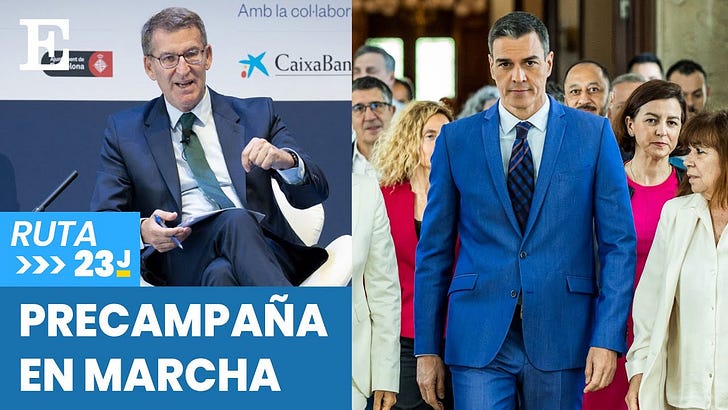
PM Sánchez is in desperate straits with his erstwhile allies (and only lifeline) squabbling with one other, so he did what desperate pols do—he called for TONS of debates. Speaking in Madrid on Monday, Sánchez offered up to six face-to-face debates with PP candidate Alberto Núñez Feijóo—that is, one debate per week until the elections on July 23. The Prime Minister also said beyond these six, he was up for a few other four-way debates, to include Sumar and far-right Vox. You don’t have anything on, do you?
Now, Feijóo isn’t so crazy about all of this and will want to avoid debating Sánchez—Feijóo is leading, and he’s less comfortable debating on live TV. PP spokesman Borja Semper: “Spain doesn't need six debates; it is Sánchez who needs them.”
Sumar boss Díaz also joined the conversation to complain about the idea of a series of one-on-one debates: “Anyone who believes that the future of Spain can be summed up in a photo of Pedro Sánchez and Feijóo is out of touch with the reality of our country,” she tweeted. “The two-party system is the past."
No presidential debates have been held in Spain since 2015 (when then-Prime Minister Mariano Rajoy debated hopeful Pedro Sánchez).
Before we leave, what do the polls say?
Most polls are saying that the PP has a clear lead over PSOE and will very probably reach an absolute majority by forming a coalition with hard-right Vox, but differ on the chances that the left has to remain in power after July 23.
According to the average of polls from Spain’s state-owned RTVE, the PP would be the most voted party with 31% of the votes and 134 seats. This represents an increase of 55 seats and 10 percentage points compared to the 2019 elections. With the 45 seats Vox is expected to get (it currently holds 52), the two parties would reach a total of 179 seats (176 are needed to reach a majority).
The PSOE would get 25% of the votes and 98 seats, three percentage points and 22 seats less than they currently hold. If they run as they are now (i.e. separate), Sumar would receive 11.9% (28 seats) and Podemos 3.1% (seven seats).

🔔 A Message From Our Sponsor

Secret Kingdoms is your English bookstore in Madrid. It specializes in Spanish history and literature, contemporary and classic novels, books for children and young adults of all ages, history and historical fiction, thrillers, science fiction, fantasy, poetry, biographies and much more.
Located on Calle de Moratín 7 — a few blocks away from the Prado Museum — and with over 20,000 new and used books, Secret Kingdoms has something for everyone.
Coming up in our reading series:
An Evening with Marjorie Kanter — June 10, 7:45 p.m.
Lane Greene — Writing With Style — June 16, 7:45 p.m.
Find out more at www.thesecretkingdoms.com
💬 Five things to discuss at dinner parties this week:
🕵🏻♂️ 1. That kidnapping mystery in Andalucía
This story is so crazy that a Netflix special may be in the works soon. Before you watch the video above (seriously, wait) let’s start with the facts.
It all began in Maracena (pop. 22,000), a town right outside of Granada, in Andalucía. On the morning of Feb. 21, a 44-year old named Pedro Gómez kidnapped Vanessa Romero, 46, a PSOE councilwoman from the same town.
Gómez asked Romero to give him a ride in her car—they sorta knew each other—when they saw each other outside her kids' school. Fine. But then…when she did, he pulled out a fake gun, tied her up and put her in the trunk. He then drove to Armilla, another small town on the Granada outskirts, and parked her car near a warehouse he’d recently rented.
Next? A Walmart break: Gómez took a train to Maracena to buy a butcher’s knife and duct tape while Romero was still trapped in the trunk. Problem with that? She managed to escape by kicking down the backseats and asking for help.
The End.
Just kidding. This is actually the beginning because as it turns out…(wait for it)…the kidnapper was the boyfriend of Maracena socialist mayor Berta Linares.
Fine. I am not my boyfriend’s keeper and all that. The police had approached the mayor on the day of the crime and described the situation to her. She worked with the authorities to try and find Gómez (they went to her home but the house was empty). Eventually, Gómez was arrested by the Maracena train tracks.
Linares offered a tearful press conference the next day (now see the video above) to say that Gómez had been undergoing psychiatric treatment for depression, but no one really knew what drove him to do it. Linares said he may have overheard her on the phone discussing town hall matters that involved Romero, and that’s what drove him to attack her. Gómez for his part stayed silent.
But a twist a few days before the 28M elections caused a big ol’ political earthquake. You see, secrecy in the case was lifted and we all found out that the judge handling the case had asked the regional High Court to investigate the mayor for maybe, you know, masterminding the kidnapping, along with the city’s ex-mayor, Noel López, who is currently the Secretary of Organization for the PSOE in Andalucía.
According to court docs, Gómez’s said the politicians had a meeting where they pushed him to commit the kidnapping (and yes, he had been diagnosed with bipolar disorder).
Gómez also said mayor/girlfriend Linares met with him on the morning of the kidnapping—contrary to what she told the press. In fact, the Guardia Civil provided footage from a nearby security camera that morning, corroborating the meeting, in which she allegedly informed him that Romero had managed to escape and that the police were looking for him.
Not only that, but turns out the judge was also eyeing another investigation, this time into local urban planning based on documents found in the kidnapped councilwoman's car.
The documents deal with up to five ongoing legal proceedings between the City Council and various companies, according to El País, as well as other public works projects in which dodgy payments or bidding played a role.
Romero said this is why she was kidnapped—as she had confronted Linares with the documents on several occasions.
Linares denies the accusations and says she is the victim of a “media lynching”. López, in the meantime, has stepped down from his position in the PSOE until the investigation is over.