
🥊 This Week in Spain: And Then There Were 37
Also: Doxxing celebrities and those weird political banners.
By @IanMount and @AdrianBono | May 18, 2023 | Madrid | Issue #14
🎉 Welcome to The Tapa, an English-language, weekly newsletter about all things Spain!
🥜 This Week in a Nutshell: ETA terrorism is once again being debated only days before the election thanks to Bildu. Because the more things change, the more things stay the same.
🕺If you haven’t subscribed yet, please do so by clicking on the button below.
🫶 And if you already have, please send this newsletter around to your friends and family and help us keep growing.
The gloves have come off
🤬 ‘Legal, But Not Decent’
The decision by EH Bildu, a left-wing, Basque nationalist/separatist party, to run 44 convicted members and associates of the ETA terrorist group—including seven convicted for murder—in the May 28 (28M) elections did not sit well with, well, anyone.
And it seriously hotted up the 28M campaign. EH Bildu has supported the razor-thin majority coalition led by socialist Prime Minister Pedro Sánchez, and received backing for things it wanted in return, so Sánchez’s right-wing opposition in the PP and Vox (and some politicians in his own party) immediately slammed Bildu and the PSOE leader.
PP boss Alberto Núñez Feijóo said, "Sánchez is a captive president of Bildu and is dragging down the entire nation,” while Madrid regional president Isabel Díaz Ayuso and Vox leaders called for Bildu to be banned.
Even Sánchez’s Interior Minister, Fernando Grande-Marlaska, said that including the ETA members caused “unjustified harm to the victims of terrorism”, while the PSOE President of Aragón, Javier Lambán, called for “breaking off any relationship with Bildu.”
Heading back through the ETA history tunnel: Ostensibly set up to fight for an independent Basque country, ETA’s terrorists killed 829 people, according to a 2009 Spanish government document, including 486 members of the police and armed forces, and 343 civilians.
The dead included everyone from Luis Carrero Blanco, the expected heir to Franco who was killed in a 1973 car-bombing in Madrid (the explosion was so large it sent his car several floors in the air and into the courtyard of the monastery next door), to the 21 people, including a pregnant woman and two children, who were killed in the 1987 Hipercor supermarket bombing in Barcelona.
This brutal history has long made running ETA candidates unthinkable, for obvious reasons. In fact, in 2003 Spain’s Supreme Court banned the Batasuna political party for being a “complement” of ETA, and to stop it amplifying and justifying the terrorist group’s attacks. Several years later, the EU’s human rights court upheld the decision.
So what then hell were they thinking? That’s the tricky bit. EH Bildu leader Arnaldo Otegi was a local MP and spokesperson for Batasuna—and an ETA member who was convicted of participating in the 1979 kidnapping of the director of the Michelín plant in Vitoria, Luis Abaitua (and suspected of participating in three others).
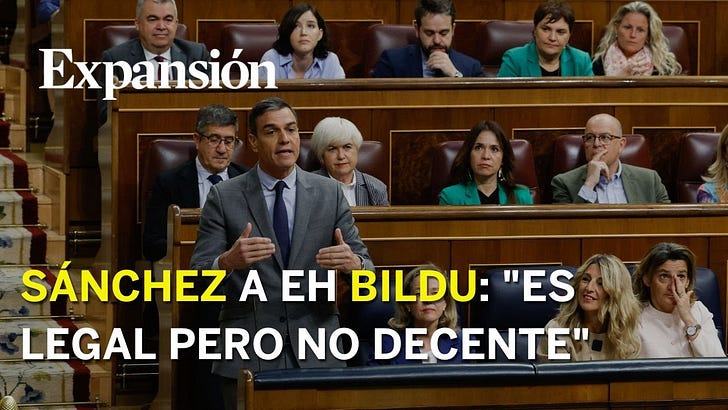
The backlash against Bildu—and the PSOE—from ETA victims and the opposition was swift and tough. Speaking from Washington, where he met with President Joe Biden, Sánchez himself weighed in to control the damage, calling the inclusion of the ETA candidates “legal but not decent”.
Behind the scenes, the PSOE expressed its, um, displeasure to Bildu, and leaned on the Basque party to do something to take off the heat. But the PSOE can’t afford to totally break ties with Bildu—as it will likely need the party’s support if it has any chance to stay in power after national elections later this year.
The other big problem for the PSOE—beyond Bildu’s gambit being a terrible look and morally dodgy—was that the move played into the PP’s desire to make the campaign about the PSOE’s suitability and choice of allies and made it much harder for the socialists to emphasize their achievements over the last few years, from new labor laws to the recovery from the pandemic.
The pushback worked—to a point. The seven EH Bildu candidates who had been convicted of being involved in murders announced they would not take up seats if elected, a move that calmed the waters—to a point—but also sent the opposition pushing for more (along the line of Feijóo’s “7 down, 37 to go”). For her part, the PSOE’s spokeswoman, Territorial Policy Minister Isabel Rodríguez, acknowledged that the 37 left were still a problem: “There are still many steps to take,” she said. You can almost hear her sigh.
Sánchez’s two face-to-face debates with the opposition since the Bildu incident devolved into pissing matches where Feijóo said Sánchez was “more generous with the hangman than the victims” and noted he had vowed multiple times in the past to never make deals with Bildu, and Sánchez responding that the PP was living in the past and when it had nothing to offer it just said “ETA, ETA, ETA.” Inspiring stuff! (Not.)
Ultimately, while the distraction could offer the PP a national poll bump among those who don’t totally trust Sánchez’s PSOE, it is unlikely to lead to a massive vote swing in regional and municipal elections where, as the phrase goes, “All politics is local.” And it won’t lead to the banning of EH Bildu: ETA ceased its terrorist activities 12 years ago and has since disbanded, and even victims groups call the party “legal.”
🔔 A Message From Our Sponsor

Bucólico Café is a project of connection that was born as a specialty coffee shop.
We value time and understand that it represents both a cycle and an instant—chronology and nostalgia. Bucólico is a space that connects one’s soul with the purity, lightness and beauty of the countryside—while being in the city. Via a cup of coffee, a piece of cake or a song…
Located on Calle de Barbieri 4 — a few blocks from Plaza Chueca — Bucólico reassures the soul with a feeling of home.
Follow Bucólico Café on Instagram.
💬 Five things to discuss at dinner parties this week:
1. ‘Forget it, Ana Rosa. It’s Chinatown.’
You probably already know who Ana Rosa Quintana is if you watch Spanish TV’s morning shows. And as we mentioned last week, the journalist and undisputed queen of morning television is set to take over the afternoons as well, as she prepares to fill the content void left by the cancellation of trash TV talk show Sálvame.
Never a stranger to controversy, Quintana was trending on social media early this week after making what was perceived by many to be a classist/racist comment against the Chinese community.
During the San Isidro festivities this weekend, Mayor José Luis Martínez-Almeida awarded the Madrid Medal of Honor to several celebrities and personalities. Quintana was among them, and as she went on stage to receive the medal celebrating her professional career, she started talking about how much she loves Madrid.
First it was the generic platitudes everyone uses. She said she was “happy and moved” to be there, adding that the fact that this was happening in the city where she was born “filled her with happiness.”
“Madrid is the land where thousands of Spaniards come to make a living. Madrid is all of Spain,” she said.
When describing her early childhood and humble beginnings, Quintana then decided to mention the neighborhood in Southern Madrid where she grew up. That’s when it went to hell.
“I grew up in Usera, a working-class neighborhood of hard-working people, before it became Chinatown,” she said. Her comment lit up Twitter like a phosphorus grenade, as thousands took to accuse her of racism and classism and of offending the Chinese community in Usera, the district with the highest concentration of Chinese citizens in all of Spain.
Quintana has been in hot water before, after making insensitive comments about the Black and Roma communities.
And this wasn’t even the first time Quintana made controversial comments about the Chinese community. Back in 2020, at the height of the COVID-19 pandemic, she accused Chinese people of “bringing us the virus”.
The outrage came from people who seemed to interpret her contrast between Usera as a neighborhood of working people and Usera as Chinatown as a dig against the Chinese population there. (It bears mentioning that calling Usera Chinatown is hard to call racist in itself—Madrid’s official tourism agency website literally promotes Usera as “Madrid’s Chinatown” and invites visitors to participate in the Chinese New Year festivities and try “the best Chinese food” in the city.)
Thousands of people have signed a petition on change.org to take her medal away for making a “racist, xenophobic” speech during the ceremony.
There’s even been a Twitter feud between Podemos’s mayoral candidate in Madrid Roberto Sotomayor and current deputy mayor Begoña Villacís (Ciudadanos). When Sotomayor said that, if elected, his first order would be to get that medal back, Villacís simply tweeted back: “You won’t take any City Hall medal back because you’re no one to do so.”
You thought Sálvame leaving our TVs would mean less drama? Think again.
2.🧑🏭 Job growth has a accent and a gender
You might have noticed that Spain has seen a job boom recently. At the end of the first quarter of 2023, the INE national statistics institute reported that there were 20.45m employed workers in Spain, up 368,000 from a year earlier and the highest first quarter number since 2008 when there was, you know, a housing bubble.