

🚅 The train crash blame game
Plus: The Sol camp is no more, the Left drafts a Whatsapp army and the football world mourns.
Madrid | Issue #167 | The Bubble is Spain's #1 English-language newsletter. We offer paid and free subscriptions (which you can customize). For sponsorships, click here.
🪦 The government plays musical chairs after two deadly train crashes
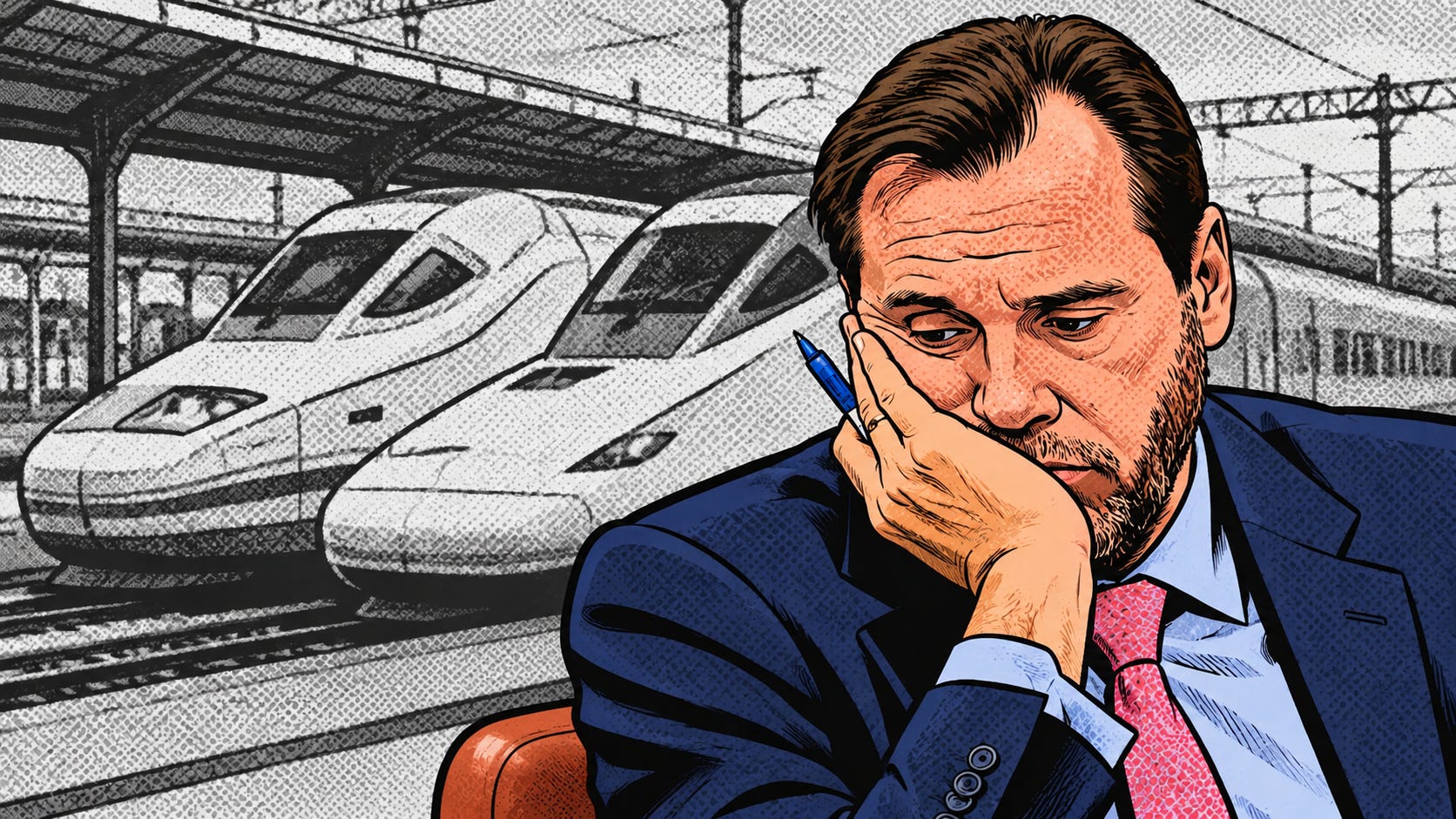
Transport Minister Óscar Puente resigned Tuesday, one week after a deadly high-speed train crash killed 69 people — the second disaster this year under his watch, leaving 115 dead in total.
What made his exit surprising wasn’t that it happened. It was that it happened against the explicit wishes of PM Pedro Sánchez, in the middle of an election campaign, after a full day of parliamentary testimony in which Puente had defended himself vigorously. Before resigning, he wrote to Sánchez: “I hope you don’t consider this a betrayal.”
So now what? Puente’s exit has scrambled a bitterly polarized election campaign with 24 days to go before the Nov. 29 polls. The PSOE has had to abandon much of its all-smiles “la fuerza del amor” campaign and is now betting that Puente’s decision to take political responsibility will itself become a weapon — by contrasting it with the PP’s continued support for former Valencia president Carlos Mazón, who didn't resign until a year after the deadly 2024 DANA floods killed over 200 people.
A new man in charge. Sánchez has handed responsibility for the transport ministry to Carlos Cuerpo, Spain’s economy minister — at least until the election.
A new style. Unlike Puente — a confrontational, polarizing figure mostly known for his skill at social media dissing — Cuerpo is a low-key economist with a reputation for technical competence. He’s also not a PSOE party member and, according to the CIS polling institute, is the government’s highest-rated minister (whether these two data points are related is up for discussion).
The new man is already making changes. Cuerpo summoned the country’s top railway officials, including Luis Pedro Marco de la Peña, president of Adif (the state-owned organization responsible for railway infrastructure), who tendered his resignation during the meeting; Cuerpo accepted it.
Spain’s high-speed rail network has long been a source of national pride. With more than 4,000 kilometers of high-speed tracks, the country takes pride in having one of the world’s largest networks, connecting major cities in just a few hours.
World-class — until now. The AVE has for decades been something people pointed to as an example of infrastructure done right and Spain's membership in the Very Developed World. But the two recent accidents have shaken that confidence to its core.
More trains, cheaper tickets, but at what cost? Spain opened its high-speed rail network to competition in 2021, allowing Ouigo and Iryo to challenge state-owned Renfe.
Good, but… The result was a success for passengers: ticket prices fell by around 40%, while annual passenger numbers nearly doubled, from 23.7m in 2022 to 44.5m in 2025. But all those additional trains are using the same tracks, putting greater pressure on the infrastructure.
Investment hasn’t kept up. While train traffic increased by 47%, average annual infrastructure spending rose by just 2.3% in real terms when comparing 2012–2017 with 2018–2025. Spain also spends roughly half the EU average per kilometer on railway maintenance and renewal.
Liberalization isn’t necessarily the problem, nor is there evidence that it caused the recent crashes. The concern is that Spain dramatically expanded its railway services without investing enough to support that growth.
So what’s the government doing about it? Sánchez admitted that public trust in the high-speed rail system has been broken and needs restoring, and announced a package of safety improvements designed to prevent another disaster. The most immediate measure would require trains to slow to a maximum of 40 km/h whenever the automatic safety system fails.
The proposed reforms include hiring additional rail traffic controllers, improving working conditions and rest periods, and strengthening signaling infrastructure so trains remain safely separated even during technical failures. (Things that maybe should have been done long ago.)
New safety system. Authorities also want to speed up the installation of the newer European ERTMS safety system on the Madrid–Seville line, now scheduled for early 2027. (That's after significant delays under the Sánchez government.)
What about the victims? The government has also announced an emergency assistance package for those affected by the Urda tragedy.
And the PP? It isn’t impressed. Party leader Alberto Núñez Feijóo says Puente’s resignation is “too little, too late”, and has called on Sánchez to follow his example, as they insist that the PM is ultimately responsible for the disasters and the deaths.
Far-right Vox has gone even further, with spokesperson Pepa Millán vowing to pursue legal action against Puente over the deaths in Adamuz and Urda.
Ultimately, the PSOE may be trying to do the impossible. Remaking its image into that of a responsible manager after eight years in power — and 115 high-speed train deaths — will be an uphill task.
More news below. 👇👇
🎙️ A new episode 8 of The Bubble Podcast is out!
Foreign policy and guiri confessions: former Foreign Minister Arancha González Laya joins our latest podcast to discuss Spain’s place in the world.
We also tackle the pension debate and hear American creator Danielle Grobman’s tips for escaping Madrid’s “expat” bubble. Escaping The Bubble remains discouraged.
🎧 Listen now. Spotify | Apple Podcasts | YouTube
💬 Five things to discuss at dinner parties
1. ⛺️ Police dismantle Puerta del Sol's housing protest camp
Goodbye tents. After 38 days of demonstrations and makeshift shelters, Madrid’s Puerta del Sol has been cleared. Police moved in during the early hours of Tuesday morning to dismantle the housing protest camp that had been set up on the iconic square since Sept. 26.
Wakey, wakey. At around 2:50 a.m., some 400 officers from the National Police and Madrid’s Municipal Police entered the square to remove the remaining campers and their tents.
Authorities evacuated 334 people, although only a fraction were still actively involved in the original protest.
Two people were arrested for resisting and disobeying police orders. Authorities say the operation was largely peaceful.
Not everyone agrees. Protesters say police arrived without warning while people were sleeping, prevented them from collecting their belongings, and used pepper spray against those who resisted. One spokesperson described it as an outrage.
Quick recap. The camp began after authorities evicted Maricarmen Abascal, an 87-year-old Madrid resident, from the apartment where she'd lived for 70 years. She died in the hospital two weeks later, becoming a symbol of Spain’s housing crisis.
The original camp organizers were the Sindicato de Inquilinas (Tenants’ Union), which demanded stronger protections against evictions and affordable housing. Inspired by the 2011 15M movement, hundreds occupied Sol under the banner Movimiento 26S.
The movement gradually unraveled. The Tenants’ Union withdrew on Oct. 3, leaving various grassroots committees in charge. By last weekend, most had announced they were packing up and taking their campaign into Madrid’s neighborhoods to prepare for a general strike on Nov. 11.
Who stayed behind? A smaller group of activists refused to leave. Just before the eviction, much of the remaining camp had become a refuge for homeless people because…housing.
So who ordered the eviction? The national government’s representative in Madrid, Pilar Trinidad, authorized the operation in coordination with Madrid City Hall (a rare display of mutual understanding between the PSOE and the PP).
Trinidad's office had warned organizers that the protest could no longer justify occupying the square indefinitely.
Madrid regional presi Isabel Díaz Ayuso blamed PM Sánchez for allowing the camp to remain for so long. “This is what Pedro Sánchez has permitted… Communism or freedom,” she tweeted. (So much for mutual understanding.)
Tons-o-trash. Municipal cleaning crews removed tents, tarps, and accumulated garbage (Mayor Almeida mentioned 36 tons), along with damaged park furnishings.
The movement is not over. Activists say they hope to turn the momentum generated by Maricarmen’s eviction into a broader movement for housing rights.
One last protest. On Tuesday evening, around 500 demonstrators marched from Sol to Cibeles to protest the eviction and ask for stronger housing protections. The march was mostly peaceful, but things got rough later when riot police moved in to disperse around 150 demonstrators who stayed in the area.
2. ⚽️ Tragedy strikes Spanish fútbol
The world of Spanish fútbol is mourning this week. The death of a beloved player in Spain’s second division, after a brutal on-field collision, has rattled players and fans across the country.
The sad news: Jesús de Miguel, a 30-year-old striker for CD Tenerife, died Tuesday morning at a Santa Cruz de Tenerife hospital — less than 24 hours after suffering a cardiac arrest on the field during a second-division match against FC Andorra.
The collision came in the 96th minute of a 2-2 game. Andorra goalkeeper Jesús Owono rushed nearly to midfield and struck De Miguel in the chest with his raised knee as the striker ran towards the goal.
De Miguel collapsed immediately. Medical staff revived him with CPR in the ambulance, and the club initially reported he was “stable within gravity.” But by 3:56 a.m. he had deteriorated neurologically, and he died at 8 a.m.
Owono, sent off immediately, spent the night crying and praying and has since closed his social media after a wave of threats. A police investigation has been opened. That’s standard procedure for any non-natural death in Spain, and prosecutors say a criminal case is unlikely given the contact occurred during live play.
De Miguel, a Madrid native, spent years in Spain’s lower divisions before 16 goals in a season helped CD Castellón win promotion to the second division. He joined Tenerife in 2025 and scored 11 goals in 29 games to help them earn promotion too — back-to-back promotions in back-to-back seasons.
Just coming back. This year he had been working back from a groin injury and had played just 98 minutes. He leaves a wife and an 18-month-old daughter.
The only comparable tragedy in Spanish football dates back to 1987, when Málaga goalkeeper Gallardo died weeks after a collision during a match against Celta Vigo.
Spain’s football federation suspended all cup matches. And UEFA, the European football authority, announced moments of silence across this week’s European fixtures. Tenerife will hold a tribute at their stadium on Saturday.
“There are no words of comfort,” CD Tenerife said. “There is absolutely nothing that can ease this overwhelming sense of sadness.”
3. 🛢️ Moeve gets out of that dirty drilling-for-oil thing
What do you call a petroleum firm that doesn’t “do” petroleum? Moeve, apparently. Yesterday brought the big announcement that the company — Spain’s second-largest oil company, behind Repsol — was getting out of the oil exploration and production business to concentrate on its “greener” side 🌳.
The newsy stuff: Moeve has agreed to sell its Algerian oil fields — three stakes in the Berkine basin producing more than 20,000 barrels a day — to Pertamina, Indonesia’s state oil giant, for somewhere between €500m and €1bn (neither side is confirming a number because…what’s €500m between friends?).
Moeve’s been selling off its exploration projects for three years. There was Abu Dhabi in 2023, Colombia and Peru in 2024, Suriname exploration permits in 2025, and Algeria now. Moeve claims to be the first major “fully-integrated” (i.e. drilling to gas stations) European energy company to entirely exit the “upstream” business — meaning the steps from finding oil to pumping it out of the ground are now officially someone else’s problem (though it still processes and sells the stuff!).
The architect of this pivot is Dutch CEO Maarten Wetselaar, who came from Shell in March 2022 with a mandate to remake the company. His “Positive Motion” strategy envisions a future split between traditional fuels and what Moeve calls “green molecules” — green hydrogen, second-generation biofuels, biomethane — with renewables eventually reaching a third of the energy mix by 2050.
The flagship bet is the Valle Andaluz del Hidrógeno Verde, billed as Europe’s largest green hydrogen project, with €2.4bn committed alongside partners.
Before we get all clappy about the greenness of it all, a note of caution: green hydrogen is still expensive to produce, hard to transport and stubbornly slow to scale. It may yet be essential to the energy transition. It may also be one of those technologies that sounds better in a PowerPoint deck than in an actual energy market.
Moeve is committed — which is either visionary or a very expensive leap of faith, depending on how the next decade goes. (We’ll give them the benefit of the doubt as we’ve spent, um, 0 years in the energy industry.)
Now the name makes sense. Back in October 2024, the company rebranded from CEPSA — short for Compañía Española de Petróleos, S.A., or the Spanish Petroleum Company — to Moeve, a name meant to convey…moving groovy (right?) 🕺.
4. 🪖 The left tries to build a WhatsApp army (à la Brazil)

Can memes win an election? (Maybe? Maybe.) With this country heading to the polls on Nov. 29, the country’s left-wing parties (center-left PSOE, the leftish Frente Amplio coalition and far-left Podemos) are borrowing a strategy from Brazil, where aging progre Presi Lula da Silva recently defeated conservative/child-of-convict Flávio Bolsonaro in an unexpected electoral comeback.
The idea? Recruit thousands of ordinary people through WhatsApp and use their collective power to make lefty messages go viral.
Wait, what happened in Brazil? After losing the first round of the presidential election, Lula’s campaign enlisted politician André Janones to build a massive 11m-person WhatsApp network called Lula’s Army.
The trick? Instead of relying exclusively on social media algorithms, the campaign used personal WhatsApp conversations to spread its message; this strategy is seen as key to Lula’s victory.
And now Spain wants its own army. Supporters of Pedro Sánchez, Ada Colau’s Frente Amplio, and Podemos have launched WhatsApp channels that are growing rapidly.
The numbers so far: A PSOE-friendly channel called La fuerza de la gente has attracted around 50,000 followers, while Frente Amplio’s Frenteamplistas has roughly 45,000. Podemos has also joined the effort, with around 20,000 followers.
For those not good at math. That’s more than 100,000 across the three channels, although the PSOE says its channel is not officially operated by the party.
What do they actually do? Mostly, they share memes, campaign videos, voice messages from leaders like Colau and Eduardo Rubiño, and directions asking followers to distribute their content.
Frente Amplio even used a viral Belén Esteban (our queen) meme to mock Vox’s Santiago Abascal.
Just don’t look. One of the most widely circulated messages urges supporters to starve the far right of oxygen.
Huh? As in, don’t engage. Don’t comment on, like, or share provocative posts from political opponents, even to criticize them. Because every interaction can help algorithms push those posts to more people. The idea? Promote your own side instead.
Rubiño says the strategy can effectively hack social media algorithms. His message to supporters? “The candidate is you.”
A long way to go. To match Brazil’s WhatsApp mobilization relative to population, Spain would need a network of roughly 2.5m people. The current numbers are nowhere near that.
Will it work? WhatsApp is used by nearly 95% of Spanish internet users, making it an attractive campaigning tool, but Brazil has a very strong culture of political engagement through messaging apps. Spain’s channels are still relatively small.
They have three weeks to go.
5. 🧬 Mind if we sequence Salvador Dalí’s leg DNA?
So here’s a wacky only-in-Spain story for ya. It involves a geneticist, a psychic, and the severed leg of one of history’s greatest surrealists (seriously). Let’s just say that Spain can’t quite decide what to do about it.
The latest: Right now, there’s a major retrospective of the work of moustachioed surrealist Salvador Dalí at Madrid’s Museo Thyssen — focused on his obsession with science, DNA and Freudian psychoanalysis.
Inspiration. The exhibition has revived a genuinely weird proposal — to sequence the master’s full genome to study the genetic roots of creativity (just like with Einstein’s brain).
Exqueeze me? The idea belongs to Antonio Alonso, the geneticist at the center of one of Spain’s stranger recent legal episodes. In 2017, as I (Ian Mount, that is) reported for the Financial Times, a court ordered the exhumation of Dalí’s body in Figueres (Girona) to settle a paternity claim from Pilar Abel, a fortune-teller who insisted she was his daughter.
Workers lifted a 1.5-ton slab from his crypt. His embalmer noted that Dalí’s moustache was “intact, pointing to 10 minutes after 10, just like he wanted.”
Dalí’s legs were then cut off at the knees (‼️), packed into a cardboard box, and the right one was driven 700km to Alonso’s Madrid-area lab. (Yes, we are serious.)
The results came back soon, and negative. Abel was not his daughter. But Alonso had what we could call an inspiration. Dalí was obsessed with DNA — he called it “the memory of God,” painted a monumental canvas in its honor in 1963, and was buried in a shroud embroidered with DNA helices.
Seriously, obsessed. James Watson, co-discoverer of the double helix, once showed up at Dalí’s New York hotel in 1965 and left a note: “The second most intelligent man in the world wants to meet the first.” Dalí came down in 10 minutes.
Alonso pitched the sequencing idea to the Gala-Salvador Dalí Foundation weeks after the exhumation — but it happened to be days before the failed Catalan independence referendum (Oct. 1, 2017), possibly the worst moment for the institution to make headlines (or a decision about anything). The proposal died quietly and never went public. Until now.
Here’s the “But, but, but…” You see, leftover DNA extracts from the original test are still sitting in Alonso’s lab. The tomb wouldn’t need to be touched again.
But the Foundation still says no to testing, because of “ethical, legal and scientific questions of special sensitivity.”
Alonso has an answer: “Since we already committed the outrage of cutting off his legs and sending them in a box, let’s at least extract some added value from what’s already done.”
He has a point, right?
🔔 Don’t forget to follow us on Instagram!
If you’re not following us on Instagram yet, you’re missing out. We’re posting exclusive content with our collaborators across Spain, breaking news updates, and pop culture coverage. Click on the post above and come hang with us!
🙏 Once again, please remember to share this newsletter with your friends on social media. The more we grow, the more information we’ll be able to offer each week.