

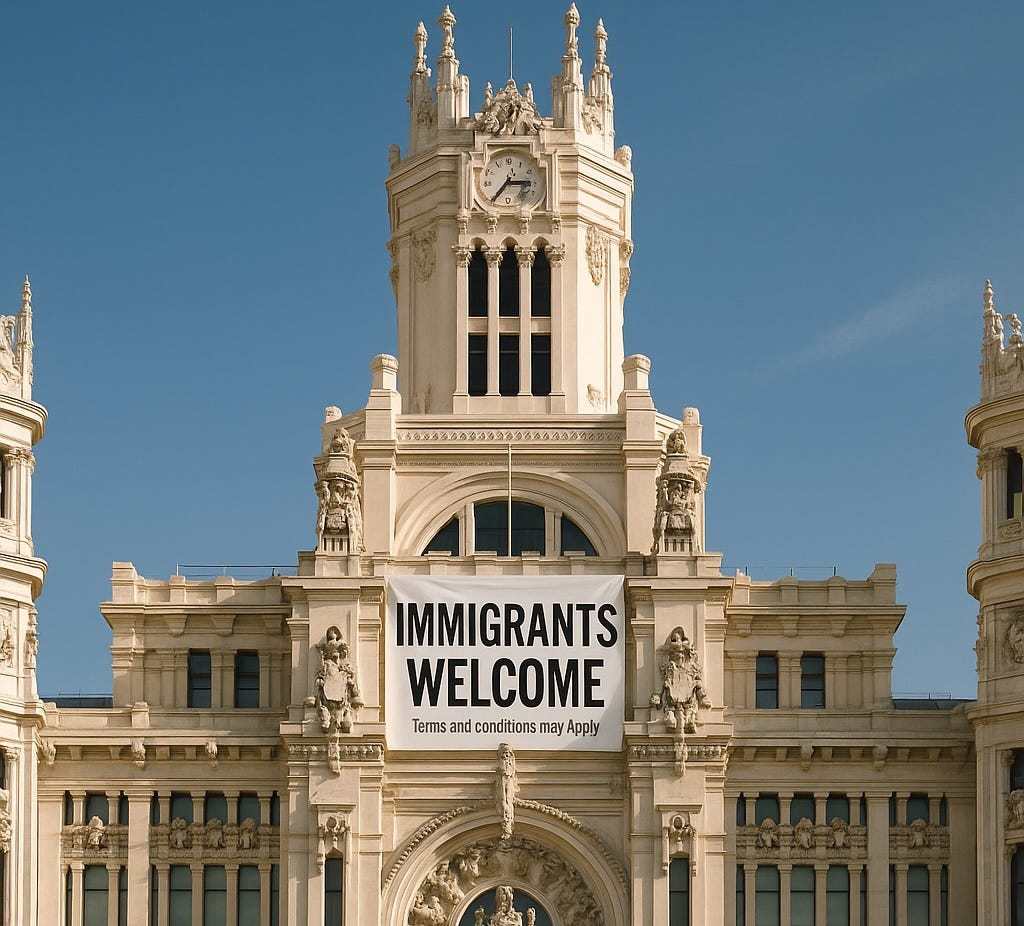
🛂 Spain's immigration views are changing
Plus: Ayuso vs. King Felipe VI, Comic-Con Málaga goes sideways, and Valencia gets wet.
Madrid | Issue #119
🇪🇸 The Bubble is Spain's #1 English-language, best-selling newsletter. We offer paid subscriptions, and we’d be thrilled to have your support!
🚨 Customize your subscription! You can personalize your Bubble experience so you only get the emails you want—and never the ones you don’t. Click here to learn how.
📺 Sponsorship opportunities. Want to get your brand in front of our engaged and influential audience of professionals, creatives, and government workers? We’re now offering a variety of ways to do so. Click here to find out how and book a spot.
Who gets in?
🏡 The PP actually has an immigration policy now—and it shows how Spain is changing
Spain has long been an immigration outlier. Public opinion was unusually welcoming, which inspired a deluge of armchair psychology a la “Spaniards sympathize because many of them emigrated during Franco” etc.
But that’s begun to change. Spain has absorbed more than 1.5m immigrants in the last 5 years while the local-born population has shrunk; growing far-right party Vox blames immigrants for just about everything; and the housing market has gone feral, pricing out locals and inspiring resentment against foreign buyers.
The outcome? In the latest CIS Barometer, 20.7% of Spaniards ranked immigration as one of the country’s top three problems, up from just 4% in early 2023.
Enter the center-right Partido Popular. This week, PP head (🤣) Alberto Núñez Feijóo finally rolled out a full-fledged immigration plan at the party’s Murcia conference. Considering the PSOE of PM Pedro Sánchez is basically like “immigration is always fantastic”, and Vox would like to glue the door shut, this is the PP’s chance to differentiate itself—define where it thinks Spain is going.
So what does Feijóo’s shiny new policy actually say? Think Anglo-Saxon with a Spanish twist.
The headline idea is a “points visa”. That comes straight out of Canada, Australia, and Brexit Britain, where applicants score based on skills, (Spanish) language ability, age, and whether they’re willing to work in sectors with skills shortages like farming or construction.
Bonus points if you’re from Latin America (the PP stresses “shared culture and history”), or if your home country plays ball on border control. Minus points if you’re from a place they consider “disorderly.” (Wanna take a guess where that would be?)
Integration won’t be automatic. You’ll need to learn Spanish, know the Constitution, and buy into “European values” like gender equality and rule of law. Nationality, they say, should be the “culmination” of that process, not just a box to tick.
In terms of sticks, PP promises “zero tolerance” on crime. Serious offenses mean automatic loss of residency, and repeat petty crimes could get you deported, too. Oh, and benefits would be tied more tightly to work. Feijóo wants long-term residency—and access to programs like the Ingreso Mínimo Vital (Minimum Basic Income)—to depend not just on time in Spain but on steady employment and contributions to the system.
It’s a package designed to look “serious” compared to PSOE’s openness and Vox’s expulsion fantasies. Whether it’s workable is another question: experts say Spain’s labor market isn’t nearly as transparent or attractive as Canada’s or the U.K.’s. But politically? PP now has an immigration script — and it’s betting that’s exactly what Spain wants to hear.
The question? Whether it is. The ad hominem reactions from the PSOE and Vox to the PP—whose plan until now could be characterized as “illegal immigration is bad and criminals should leave”—suggests that for once Feijóo didn’t trip over his own feet when he said Spain was “open and welcoming” but that “neither of the extremes [PSOE and Vox] is true, and consequently, the solution is neither to regularize everyone nor to throw them all into the sea.”
The PSOE sent out speakers on the down low. Friendly media (La Sexta) quoted unnamed sources accusing Feijóo of “tackling immigration from a perspective of racism” and calling the PP “the Vox of AliExpress”. Minister of the Presidency Félix Bolaños (often used as an attack dog) said Feijóo was engaging in “clearly xenophobic speech” and was “No. 2” of Vox boss Santiago Abascal (the Far-Right Freddy Mercury!).
Vox acted all offended. “‘Throw them all into the sea’?? Feijóo joins the demonization of VOX with lies and manipulations,” Abascal himself wrote on X.
So what’s next? There’s no election yet scheduled until 2027 to test the PP’s turn, but a growing amount of commentary (and some electoral results) suggests immigration has become a real issue to voters even on the left, and points to the turn by Denmark’s socialists to more migration control as key to its neutralization of the far-right in the country.
More news below. 👇👇
🔔 But first, check out our Instagram account
If you’re not following us on Instagram yet, you’re missing out. We’re posting exclusive content with our collaborators across Spain, breaking news updates, and pop culture coverage. Click on the post above and come hang with us!
💬 Five things to discuss at dinner parties
1.🇵🇸 Didn’t see that coming: Ayuso dings King Felipe VI
You are right to expect the sky to fall any second now. Why? Because Madrid regional President Isabel Díaz Ayuso of the PP criticized King Felipe VI this week. Yes, of the “we love the King more than a runny pincho de tortilla with a caña” PP. My god, what happened?
Wait a second—let’s explain. Last week, Spain’s King Felipe VI (aka 👑F6) caused a stir at the UN General Assembly when he criticized Israel’s offensive in Gaza.
Sin pelos en la lengua. In unusually blunt terms, F6 called the situation a “massacre” and denounced “aberrant acts that repulse human conscience.” While he condemned Hamas terrorism, he also called on Israel to stop its military campaign.
The speech lined up neatly with Pedro Sánchez’s government, one of the loudest voices in Europe against Israel’s actions. Sánchez and allies have even used the word “genocide” to describe them.
Then again, there’s a reason for that. F6’s speech was co-drafted with the Sánchez administration, which is pretty common for constitutional monarchies (and explains why the U.K. royalty sounds more Tory with the Tories in power, and vice versa with Labour).
But there are limits. F6 stopped short of using the term “genocide” (the Palace reportedly had the final say).
Might use it soon, though? That term has become a dividing line in Spanish politics: the left has embraced it, while the PP is still undecided on whether they should use it (although some of its leaders are already).
Cue Ayuso. The Madrid president, normally a flag-waver for both Israel and the monarchy, drew an unprecedented line after the speech. That is, “The King reigns, but does not govern,” she told TV viewers (this is true—the King is the Head of State, while the PM is the head of government). She insisted she remains a monarchist, but suggested F6 should stick to being a “figure of conciliation” and not take political stances (😱). On genocide? She said that’s for “international courts” to decide.
That’s striking. Ayuso has built her brand on defending Spain’s institutions (especially the Crown). And she’s increasingly on her own inside the PP, doubling down on staunch support for Israel while other party leaders hedge. She even met Israeli officials in Madrid last week to show her solidarity.
Cue the tighty righty chorus. Meanwhile, Spain’s far-right launched a F6 pile-on. As in, Vox leaders, usually the monarchy’s fiercest defenders, slammed the speech.
Blame F6 or Sánchez? MEP Hermann Tertsch called the speech a “globalist socialist pamphlet,” while fellow MEP Juan Carlos Girauta claimed Sánchez had set a “trap” for the King.
Incel party. Online, ultras revived their favorite insult for the monarch: Felpudo VI (“Doormat VI”).
A big accomplishment, kinda. With a single UN speech, F6 managed to spark dismay among conservatives, fury from the far-right, and a public rebuke from Ayuso — one of the monarchy’s most loyal champions.
And the irony? The left is splitting too—Sánchez is backing Trump’s Gaza “peace plan”, while junior coalition partner Sumar is calling it a “farce.” On Gaza, Spain is fractured across the whole spectrum.
2. 🇮🇱 Israel intercepts Gaza flotilla and Spain’s left fights about it
Israel intercepted several boats from the Global Sumud Flotilla as they tried to break the maritime blockade of Gaza last night, setting off a conflict that Madrid (and the world) had been nervously awaiting for days.
Flotilla no more. Organizers said Israeli naval forces boarded vessels in international waters, cutting communications and livestreams. The Israeli Foreign Ministry also posted a video showing a navy officer telling the flotilla it was “approaching a blockaded zone” and should instead dock in Ashdod, where aid could be “channeled through established routes.”
Flotilla members called it “an illegal attack on unarmed humanitarians.” The condition of flotilla passengers was not immediately clear, though Israel’s Foreign Ministry posted a video of high-profile activist Greta Thunberg being handed a drink and a coat on X. Former Barcelona Mayor Ada Colau had also apparently been detained.
After midnight, media outlets reported the activists taken into custody were being “safely taken to an Israeli port.” At around 8 a.m. today, El Español reported that about half the 44 boats had been intercepted, while the other half were continuing their trip.
Earlier words: Let’s not escalate. Back in Madrid, PM Sánchez had earlier urged Israel not to target the flotilla, stressing the mission posed “no threat” and offering its members full diplomatic protection.
Spain’s Navy ship Furor had been deployed to the eastern Mediterranean to keep watch, but with strict orders: stay outside the 150-mile Israeli exclusion zone, monitor the flotilla from radar range, and only intervene in case a rescue was needed.
Defense Minister Margarita Robles was blunt. “The risk is enormous—the Furor will not enter the zone.” If it did, Israel could interpret it as an act of war, and things would go to hell very, very quickly.
Safety first. On Wednesday afternoon, the government had lauded the mission as legitimate, but told activists not to cross into Israeli-declared waters.
Cracks show. That position didn’t sit well with everyone on the left. Yolanda Díaz, Spain’s second deputy prime minister and leader of leftist Sumar (the PSOE’s junior partner in Parliament), praised the flotilla as “legitimate and necessary” and accused Israeli PM Benjamin Netanyahu of war crimes, demanding Spain and the EU protect the boats.
Far-left Podemos went further, saying Sánchez was “doing Netanyahu’s dirty work” by asking the flotilla to turn back. Party leader Ione Belarra insisted the Furor should escort the flotilla, while Irene Montero accused the government of telling activists to “abandon their mission.”
On board, prominent activists and volunteers expressed frustration at Spain’s hands-off approach. Several said they felt “unprotected” after learning the Furor would stay far from the exclusion zone. For them, Madrid’s cautious policy amounted to abandonment.
3. 🌧️ Dear Gabrielle: No one invited you, and we can’t pronounce your name
Spain freaks out when a massive rainstorm is coming. Especially Valencia and the Balearic Islands, which regularly get hit with torrential storms that lead to deadly flooding. Like, remember last October’s DANA-driven disaster in Valencia that killed more than 200 people while regional presi Carlos Mazón was distracted by a three-hour lunch and left residents so angry they threw mud at PM Sánchez? Yeah, that.
This is why folks went 🍌🍌when they heard a hurricane named Gabrielle was bearing down from the Atlantic. First, no one wants a hurricane here. And second, Gabrielle sounds hideous in Spanish. Ga-bri-ey-yey. Ugh.
So how’d this happen? Gabrielle was apparently a meteorological freakshow. Not that you care when a river of mud is coursing through your kitchen, but let’s explain.
Gabrielle didn’t start life as a Spanish problem. She was born on Sept. 17 in the middle of the Atlantic as a regular ol’ tropical storm. Within 48 hours, she bulked up into a Category 4 hurricane—the kind that usually menaces the Caribbean, not, um, Cantabria.
But… By the time she hit the Azores, she’d already begun to weaken and mutate, colliding with a trough of cold air high in the atmosphere. That collision stripped away her “classic hurricane” look (those spirals!) and turned her into a hybrid beast: part tropical, part extratropical (love that word!), still packing a warm core and lots of rain.
Wrong, again. Forecasters at first said she’d slide into Lisbon and just sprinkle Galicia. But Gabrielle veered north, brushed Oporto, and then got an extra shot of juice from an atmospheric river—basically a firehose of tropical moisture—just offshore. That river poured into a superheated Mediterranean, giving her fresh energy as she moved into the Peninsula. By the time she reached the east coast, Gabrielle had morphed into a DANA, Spain’s most feared weather gremlin—a storm that stalls in place and just dumps.
That’s how a mid-Atlantic hurricane ended up dumping buckets on Valencia. And dump she did.
Spain’s AEMET weather service hit the red alert early and often. Gabrielle dumped 220 l/m² in the Valencia town of Barx (the equivalent of about 8.66 inches of rain, or three feet of snow) in a matter of hours. Real de Gandía got 50 l/m² in just 20 minutes.
But it was really Ibiza that suffered. There it rained some 254 l/m² in several hours, more than half a year’s rainfall, setting a daily record dating back to at least 1952. Look at the video above and try to figure out where the land stops and the sea begins. 🫣
Don’t bring out your dead. Happily, while there were injuries, it appears there were no fatalities. Maybe we have learned something?
4. 👮🏼 “Me, a drug trafficker? How’d you get that idea? I’m a pilgrim.”
Who among us has not—while fleeing police, soaked to the marrow, clutching a wetsuit—hopped into a taxi and claimed to be a humble Camino de Santiago peregrino? God knows we at The Bubble have… many, many times.
But the Santiago pilgrim alibi was merely the cherry on top of Galicia’s latest narco-sundae. Let us count the ways.
The cat-and-mouse began in August, when Spain’s Policía Nacional and the U.S. DEA were alerted to a cocaine smuggling network in Outes, near the Galician west coast. They soon discovered the group had set up cover businesses in boat repair and rentals, but their boatyards hid speed boats with crazy high-horsepower engines, not the kind of gear you use to fish for sardines.
In the small hours of Sept. 13, the plan was set in motion. From O Freixo, several speedboats slipped out to meet a semisubmersible that had just crossed the Atlantic with tons of cocaine. The drop point was Niñeiriños beach, near A Pobra do Caramiñal. There, crews began offloading bale after bale, stacking them into two trailers bound for a safe house.
But police were already watching. As the convoys pulled away in the dark, officers gave chase. One cocaine-packed trailer overturned, spilling a 1,000 kilos across the road (someone knows how to throw a party! 🥳).
The second one managed to escape and hide the Bolivian Marching Powder (h/t Jay McInerney) — but it did little good, as local police found the rest of the stash early the next morning, hidden under a tarp on the same beach. For the first time in Galicia, cocaine transported by a narcosub had been caught on land.
But here’s the best bit. Meanwhile, the three men who had crossed the ocean inside the sub tried to vanish. Soaked to the bone and hauling a wetsuit, they climbed into a taxi in Pobra and told the driver they were pilgrims.
The story didn’t quite jibe, though — the wet gear, the Colombian and Ecuadorian accents, the rest… Local police, tipped off by the suspicious taxista, arrested the trio minutes later.
More busts. By week’s end, Operation Saona spread across Barbanza and O Salnés. Eighteen raids netted 14 arrests, including businessmen linked to boatyards in Cambados and Sanxenxo (ex-King Juan Carlos I’s fave place in Galicia!). Police displayed the haul — 3,650 kilos of cocaine, plus cash, boats, vehicles, radios, phones… Twelve suspects are now in prison.
The semisub itself was never recovered, almost certainly scuttled with its hatch open, as in past cases.
The officials were triumphant. “Seizing the drugs is good,” said the head of Spain’s anti-drug unit, “but dismantling the organization is better.”
Yeah, maybe. But the story keeps repeating. In fact, it’s the fourth sub found since 2019. This one just happened to end with a taxi ride, a wetsuit, and the least convincing Camino pilgrimage Galicia has seen in a heap long time.
5. 🫠 The San Diego Comic-Con Málaga was an underwhelming mess
Big deal for Spain. Earlier this year, we reported that, for the first time, the San Diego Comic-Con would have an international edition, and Málaga was the chosen city 🎉. This was huge news for Spain’s entertainment industry as it tried to position itself as Europe’s film hub.
But weak debut. However, after the first edition, we’re left wondering whether there will be another one next year (spoiler alert: there will).
Fyre Festival vibes. More than 120,000 people descended on Málaga this past weekend. The expected economic impact? €50 million. The guest list promised Hollywood glamour—with appearances by Arnold Schwarzenegger and Jared Leto, plus other pop culture stars—and tickets (€50 a pop) vanished within hours after they went on sale in the spring.
By Sunday night, however, the buzz had turned into a scandal. Or as hundreds of fans said, hell on earth.
Come for the queues. The number one complaint? The lines. Fans reported waiting up to six hours under the sun just to get into the venue, only to find more endless queues inside for panels, autographs, or even the official store.
Cheap bastards. On top of that, there were only a few water fountains available, and to make matters worse, organizers banned attendees from bringing their own food or drinks 😡. And inside, the food and water that was available sold for exorbitant prices.
I’d like to talk to the manager. On Change.org, over 2,000 fans have signed a petition demanding refunds at the time this was written, accusing the organizers of overselling tickets, changing schedules without warning, and putting attendees’ safety at risk.
Revenge. Consumer groups Facua and OCU received hundreds of complaints after some attendees described stampede-like situations when standing in line, and Facua denounced Comic-Con Malaga to City Hall for not allowing food inside.
Late-stage capitalism. Meanwhile, others tried to cash in: exclusive Comic-Con Málaga collectibles—like limited edition Funko Pops that cost around €25—were being resold on Wallapop for hundreds of euros (meaning the people buying them weren’t fans but resellers).
Damned scalpers. Instead of celebrating fandom, hundreds of fans took to TikTok and YouTube to say scalpers had turned the event into a money grab.
We’ll do better next time. Málaga Mayor Francisco de la Torre admitted that “the issue of excessive queues has to be resolved” and announced a review with organizers. Andalusian president Juanma Moreno also weighed in, promising to “correct mistakes” before next year’s edition.
See you all there next year! (If we get a media pass, that is—hint, hint.)
🙏 Once again, please remember to share this newsletter with your friends on social media. The more we grow, the more information we’ll be able to offer each week.
We’ll be back next week with more.