
🚅 Spain's Great Train Robbery
Plus: Salvame is back! (sorta) and blackouts can't stop Spanish spenders.
Madrid | Issue #101
🇪🇸 The Bubble is Spain's #1 English-language newsletter. We offer paid subscriptions and we’d be thrilled to have your support!
Can’t get there from here
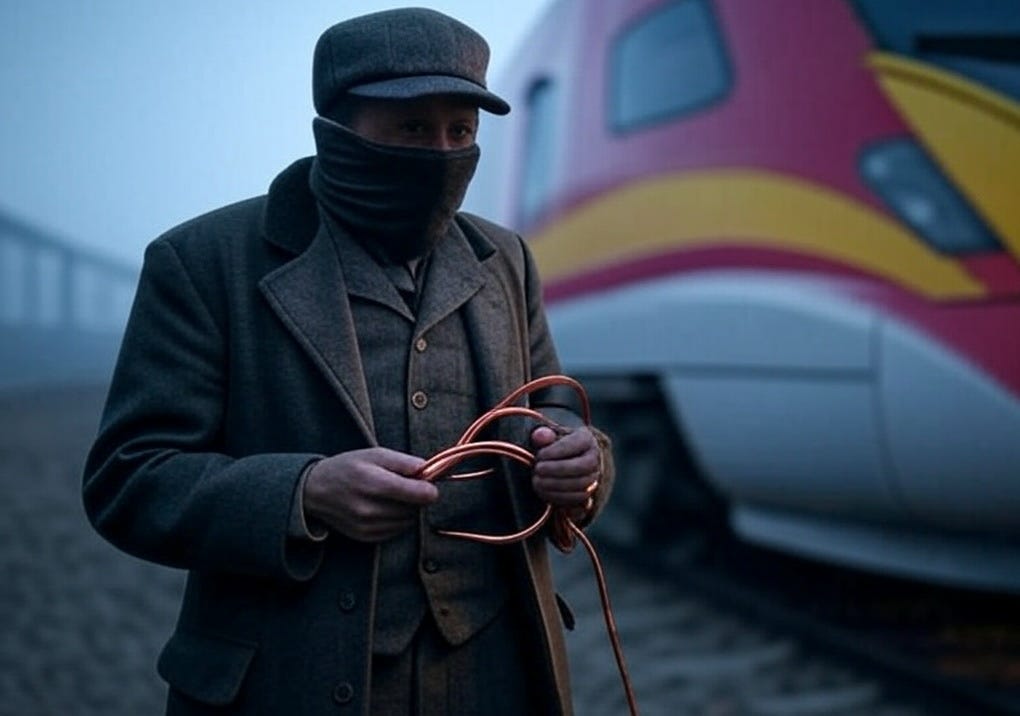
Copper Theft in Spain Happens Mainly on the Train
Spain really had a lot on last week. A historic blackout. Then a national holiday. Then a Madrid holiday to celebrate rising up against the French invaders (and losing). And the cherry on the top? A massive train outage Sunday that stranded over 10,000 people. Who says Spain doesn’t know how to have fun? (No one says that, actually.)
The news. On Sunday, just six days after the blackout stranded 35,000 train passengers, the theft of copper wiring along the tracks at five spots in the towns of Los Yébenes and Manzaneque (Toledo) on the Madrid-Sevilla line affected 10,700 passengers on 30 trains that suffered hours-long delays or were canceled. Making it all worse, a train from Iryo (an Italian competitor to Renfe) had a problem with overhead electrical wires along the same line. Bad luck!
Why so many? Many Madrileños were returning after taking advantage of the four-day holiday to go to the beach, while others were heading to Sevilla to enjoy this week’s Feria (if you don’t know what that is, check out our Instagram guest!).
A theft? So what? That’s the thing. Stealing copper—from trains, businesses, abandoned buildings—is a pretty common crime. It pays €4-6/kilo, according to El Español, and some Eastern European gangs apparently specialize in it.
Blame game. But because no one knows exactly what happened, Spain’s political parties started to speculate, and blame each other. Remember last week’s Gran Apagón? Just like that. So here’s a new episode of Who Needs Facts When You’ve Got Opinions?
Transport Minister Oscar Puente kicked it off Sunday night, when he posted on X that “We have suffered an act of serious sabotage”—that is, not a theft, but an act meant to cause chaos and, perhaps, make the PSOE-led government look bad.
Double down. The Transport Minister/PSOE attack dog dug in deeper Monday, claiming the value of the stolen copper was only some €1,000 💰, which would make economic motivations difficult to understand: "Everything clearly points to a deliberate act…to cause damage."
PSOE pile-on. Other government leaders amplified Puente’s sabotage claims, with the PSOE’s parliamentary spokesman Patxi López lowering the value of the copper to €500 (pretty soon it’ll be free!) and adding: "Either we have the dumbest thieves in the world, or it's something else."
Well, maybe not. Government spokeswoman Pilar Alegría backed off the sabotage claims and the Interior Ministry noted that copper was increasingly valuable so theft sorta makes sense, but the opposition had already jumped on PM Pedro Sánchez’s government for what they claimed was using the scare word sabotage to cover up its own incompetence at providing security on public infrastructure.
The Troll Queen. Madrid President Isabel Díaz Ayuso of the opposition center-right PP rolled the copper drama up with last week’s blackout and blamed the government for both (2x1 is a great deal!): "Everything the government directly manages is chaos and it's getting worse." Now, don’t get her wrong, "no one is in favor of sabotage, and if there is, we condemn it. But the truth is that nothing works with this government."
A bit more. The PP's Carmen Fúnez, denounced a "lack of infrastructure security" for which the Transport Minister was to blame: "The person responsible for preventing the problem is portraying himself as a victim."
PP boss Alberto Nuñez Feijóo also spoke. But as usual, what he said wasn’t memorable. Like, he said that images of people stranded on trains for the second week in a row was embarrassing, and Spaniards shouldn’t have to pay ever more taxes for worse services, etc.
Well, Spanish politics may be crabby, but at least Spain’s Great Train Robbery gave us this:
More news below. 👇👇
🔔 Check out our sponsor—and an offer for Bubble readers
Iberian Wine Tours has a special offer for Bubble readers on one of its excellent and exclusive wine adventures—The Golden River Tour from Madrid to Porto in May 2026. (For objective, third-party praise, check out the gushing commentary and 147/151 5 ⭐ reviews on Feefo.)
Would you like to come along? Bubble subscribers have the chance to get in on this very intimate tour with a double discount—a $100 early bird discount for those who sign up before May 1, and another $100 off for Bubble readers with code BUBBLE100.
💬 Five things to discuss at dinner parties this week
1. 💡 Spain lost €400M in the blackout—but already got half back!
Last week’s historic blackout feels so over by now. If anything, it showed the world that when we’re (temporarily) faced with going back to the Stone Age, we just chill and hang out with friends.
But while we were group hugging and singing songs by Jarabe de Palo in Plaza Olavide, we were not taking into account one teeny, tiny detail: the power outage’s sudden shock to the Spanish economy. Which was… pretty bad.
In the red. Consumer spending collapsed by 34% while the Iberian Peninsula was plunged into darkness, according to estimates from CaixaBank Research.
Your
moneycredit card is no good here. The data, pulled from anonymized card payments, ATM withdrawals, and e-commerce activity, provides the first serious attempt to quantify the immediate economic fallout from the massive grid failure.
No electricity, no 💳. The blackout, which began shortly after noon on April 28, disrupted everything from rail networks and mobile coverage to point-of-sale systems and digital banking infrastructure.
No, no, and no. Card readers were down, online payments failed, and ATMs were out of service. That meant Spaniards had little choice but to pause most economic activity (hence the collective singing and dancing), especially in sectors like retail, hospitality, and mobility, which rely heavily on digital transactions.
Island spending. In-person card spending by people on the mainland was 42% lower than that of residents in the Balearic Islands, the Canary Islands, Ceuta, and Melilla—all territories that were not directly affected by the power outage.
At first glance, things looked… bad. Some early analyses floated loss estimates upwards of €1 billion, driven by the scale and impact of the outage. But CaixaBank’s updated models now put the net loss closer to €400 million, or around 0.1% of quarterly GDP. A hit, but not a catastrophe.
Why so little? Turns out the spending didn’t disappear: it was just delayed. As soon as the lights came back on and the systems recovered, so did consumer behavior. (Also, lots of places took payment in cash and didn’t report it to the tax man. Just sayin’.)
Boing. Within the 48 hours following the blackout, CaixaBank observed a sharp rebound in transaction volumes, as people rushed to make up for missed purchases, suggesting a compensatory surge.
Retail therapy. E-commerce also bounced back, with nearly half of Monday’s digital sales drop recovered in the days that followed.
Bounceback. By factoring in this rebound, CaixaBank revised the net spending loss for the blackout day to 15%, much lower than the initial 34% collapse.
The Ministry of Economy echoed these findings, estimating that around €140 million had already been recovered by the end of the same week.
This will leave a “modest” dent in Spain’s Q2 economic data, but the broader trajectory remains strong. We’re still expected to grow by 2.6% in 2025, outpacing most of the eurozone countries. 💅
2. 📊 Gen Z ❤️ Vox? Spain’s youth warms up to the far-right despite Trump slump

Here’s a surprising plot twist in Spain’s political landscape: Vox is becoming the party of choice for many young voters. According to the latest 40dB. poll for El País and Cadena SER, Santiago Abascal’s far-right formation now ranks first in voting intention among 18- to 24-year-olds, with 21.2% support, beating both PSOE (19%) and the PP (15.9%) in that demographic.
Not just a clean youth wave. However, the real frontrunner among young Spaniards is… apathy: more than 30% say they’re undecided, abstaining, or would cast a blank vote (honestly, can you blame them?).
Still, the fact that Vox tops the list—especially with its anti-feminist, anti-migrant rhetoric—suggests disillusionment and online culture may be driving new voter behavior.
Zooming out, Vox is also the only major party to slightly improve on its 2023 election results, sitting at 13.4% in estimated national vote share, up one point since the last general election.