

👨🎓 Spain's education fails
Plus: Sánchez's Morocco fever dream, Spanish Oscar contenders, and SEAT says bye-bye?
Madrid | Issue #159 | The Bubble is Spain's #1 English-language newsletter. We offer paid and free subscriptions (which you can customize). For sponsorships, click here.
👨🎓 The OECD says Spain's students are stoopid
That’s gonna leave a (bad) mark! A week after we told you about Catalan education officials fired or placed under investigation for gaming the PISA exam — the OECD’s global education study of 15-year-olds — and rendering the region’s results invalid, Spain’s national scores landed. The verdict: Spain’s worst PISA results ever, igniting a blame game of epic proportions. Let’s get into it.
What the hell happened? Spain scored 451 in reading, 457 in math, and 477 in science — historic lows in all three, all below OECD averages. Since the OECD benchmarks 20 points as roughly one school year, Spain’s 23-point reading drop since 2022 means kids effectively lost a full academic year.
It doesn’t get better with time. Zoom out a decade, and it’s grimmer. Since Spain’s all-time highs in 2015, students have shed 45 points in reading, 29 in math, and 16 in science — that’s two-plus lost school years in reading, which stands in for critical thinking on the PISA. A third of students can’t clear basic reading or math benchmarks. Only 2% are excellent readers. Grim. 🤮
Some kids are worse off than others. Valencia collapsed 58 points in reading, nearly three school years, and the Basque Country fell 47. Every region fell in every subject, save for Castilla-La Mancha, in science.
Bright spots not so bright. Even the relative bright spots of Madrid, Asturias, and Castilla y León all still dropped sharply. Catalonia’s results, meanwhile, are excluded from the official international rankings entirely, given that it excluded 23% of the students who were meant to take the test.
The context. A few things happened between Spain’s 2015 peak and its 2025 nadir.
COVID. A pandemic hit when these students were 10 or 11, at precisely the moment they were transitioning from learning to read to reading to learn. Which left a mark, as anyone who had kids then (or was a kid then) knows.
Antisocial media. Social media and smartphones became universal, giving kids such a short attention span that many students now struggle with texts over 400 words; “hasty readers” who answer quickly and incorrectly jumped from 7% to 11% OECD-wide, and reading for pleasure has been declining since 2009.
Classrooms got harder. Immigrant students, who often need extra help, are up 64% in Spain since 2018; bullying rose; and 49% of school heads report teacher shortages, 10 points above the OECD average. Also, in 2020, Spain passed a new education law, called the LOMLOE or “Ley Celaá”, which shifted curriculum emphasis from content mastery toward softer competency frameworks.
The fallout. No one wants to be the politician who made their country’s students dumber, so fingers were pointed. Lots of them.
The left. The government and left-leaning papers that support it, like El País and El Diario, point to screens. OECD analyst Tue Halgreen gave them cover by noting that the global decline correlates with device use, not specific policies. (And Spain is doing something about that: 86% of Spanish schools already ban phones vs. 49% OECD-wide.)
The right. The opposition PP and papers like El Español tell a different story. They chest-beat that Spain’s best-ever PISA scores came in 2015, under the PP’s rival LOMCE law — more content-focused (i.e. memorize and regurgitate), with end-of-stage national exams that “concentrated minds,” as former Education Minister Wert (the law’s author) put it. Researcher José Manuel Lacasa of the Instituto F de Investigación Educativa (right-leaning) notes that the worst collapses were posted by Valencia and the Basque Country — the regions, along with Catalonia, that adopted LOMLOE-style policies earliest. “The worst is yet to come,” he told ABC. (Not surprisingly, Spain's secretary of state of education Abelardo de la Rosa flatly rejected any link to the LOMLOE: “The decline is so general it must be considered in context.”)
The language thing. Some analysts also point to linguistic immersion policies in the Basque Country and Catalonia — where students are tested primarily in Basque or Catalan rather than Castilian Spanish, which is the home language to many — as a compounding factor (critics suggest Catalonia excluded students who weren’t native Catalan speakers to boost its scores). The left disputes the extent.
At least it’s not just us! The OECD warned that the “continued drop” in scores is a global problem, not a uniquely Spanish one. But Spain’s scores are falling faster than the OECD average — and the 10-year trend is one of the worst in the developed world. 😬
More news below. 👇👇
🎙️ Episode 5 of The Bubble Podcast is out!
On our latest episode (recorded right before the Ceuta crisis), we discuss immigration, belonging, and identity in Spain with writer Noor Ammar Lamarty, ask whether the PP is moving closer to Vox ahead of the next election, and explore the TV shows, from Verano Azul to Sálvame, that help explain Spanish society.
Subscribe and listen on Spotify, Apple Podcasts, and YouTube!
💬 Five things to discuss at dinner parties
1. 💣 Everyone except Sánchez thinks Morocco was behind Ceuta
Parliament is back, and Sánchez returned to the floor last Thursday to address one of the biggest crises in Spain’s recent history: Ceuta. More than a month after around 72,000 migrants crossed into the Spanish enclave over two days, leaving 141 dead, the PM gave MPs his account and found himself isolated over one question: was Morocco behind it?
Sánchez says there still isn’t any “solid evidence”. He also insisted the government received no warning predicting a crisis on this scale.
We'll be transparent now. He also promised to publish the intelligence reports surrounding the crisis and demanded explanations over why a separate police report (prepared for an Audiencia Nacional judge and pointing to Moroccan involvement) wasn’t shared with police superiors.
No one is buying it. PP boss Alberto Núñez Feijóo accused Sánchez of either lying or being incompetent; far-right Vox’s Santiago Abascal called what happened an attack on Spain and said the PM is a traitor (even the 🍊 menace is joining the criticism).
With friends like thee… More awkwardly, Sánchez’s own parliamentary allies rejected his version: leftish Sumar said exonerating Morocco was “not credible,” while ERC, Podemos, Bildu and the PNV all pointed to Rabat’s responsibility in one form or another.
The Spanish public overwhelmingly agrees with them. A new 40dB/El País poll found that almost 90% of Spaniards believe Morocco was responsible, while 63% think Sánchez handled the situation badly or very badly.
Sánchez said he isn’t ruling Morocco out entirely. He says that if solid evidence shows Rabat planned or executed the operation, Spain will respond “with total force.”
Meanwhile, Ceuta is a ticking time bomb. Thousands of migrants are still moving around the city, and many frustrated residents are now turning that anger on anyone they think might have crossed the border illegally.
Ceuta’s regional president Juan Jesús Vivas (PP) visited Brussels to warn EU officials that “Ceuta is a pressure cooker that could explode at any moment,” calling for a bigger European presence in the city and a concrete plan to return irregular migrants to Morocco.
Even the King is getting involved. Felipe VI met with Defense Minister Margarita Robles and Spain’s military leadership to discuss Ceuta “from the point of view of defense” (suggesting this isn’t just a migrant crisis).
Money, please. Brussels is stepping in with €114.7m in emergency aid to help Spain deal with the ongoing crisis in Ceuta.
Sánchez did make one concession yesterday: Spain needs to get better at anticipating this kind of crisis. In an interview with PSOE-friendly La 1, he said what happened in Ceuta was a “hybrid attack” (that involved disinformation campaigns on social media) and that Spanish intelligence needs to become more sophisticated at detecting online activity that could signal mass movements before they happen.
Dreaming is free. He also confirmed he intends to run for another term in 2027. He’ll need quite the comeback. Most recent polls put the PP and Vox above 50% of the vote combined for the first time, while the PSOE, Sumar and Podemos together sit at just 36.1%.
The Ceuta crisis plays directly into Vox’s strongest issue: immigration. 27% of Spaniards now say Vox is the party best equipped to handle it, ahead of both the PSOE and PP.
If those numbers hold, the likely outcome next year is clearly a PP-Vox government.
2. 🎬 Spain has narrowed its Oscar race down to three
Woohoo! Spain has narrowed its Oscar race down to three. The Spanish Film Academy has preselected La bola negra, Los domingos, and El ser querido as the three films that could represent our country at the 99th Academy Awards in the Best International Feature Film category.
Academy members now vote again, with Spain’s final choice announced on Sept. 16. Care to place a bet? We do. 😉
⚫️ La bola negra (see trailer above). Javier Calvo and Javier Ambrossi (aka Los Javis) won Best Director at Cannes for their ambitious drama connecting three queer stories set in 1932, 1937 and 2017, with Federico García Lorca and a century of LGBTQ+ history running through them.
The cast includes Guitarricadelafuente, Milo Quifes, Brays Efe (aka Paquita Salas) and Carlos González, alongside other, ahem, little-known supporting names: Penélope Cruz and Glenn Close. It opens in Spanish theaters on Sept. 25, before eventually streaming on Movistar Plus+ (or Netflix, if you live abroad).
⛪ Los domingos. Alauda Ruiz de Azúa’s drama follows a 17-year-old girl who announces that she wants to become a cloistered nun, throwing her comfortable Bilbao family into a debate over faith, freedom, indoctrination, and whether she’s really old enough to make that decision.
Blanca Soroa plays the teenager, alongside Patricia López Arnaiz and Miguel Garcés. It’s arguably the most decorated of the three already, having won the Golden Shell at San Sebastián and the Goya for Best Picture. You can watch it now on Movistar Plus+.
💔 El ser querido. Rodrigo Sorogoyen moves away from the thrillers he’s famous for with a much more intimate family drama starring Javier Bardem and Victoria Luengo.
Bardem plays a celebrated, two-time-Oscar-winning film director who returns to Spain and reunites with the daughter he effectively abandoned 13 years earlier, reopening a considerable amount of emotional damage while he’s shooting his latest movie. It premiered in Spanish theaters in August and is coming soon to Movistar Plus+.
🎄 Surprisingly (although not really), Pedro Almodóvar’s Bitter Christmas didn’t make the cut.
Hollywood will announce the 15-film international shortlist on Dec. 15, before revealing the final five Oscar nominees on Jan. 21, 2027. The Oscars themselves take place March 14, with Conan O’Brien returning as host.
We predict La Bola Negra will go far.
3. 👩🏻⚖️ Supreme Court pauses law that lets Spanish nietos vote
Remember Spain’s controversial mass migrant regularization? Well, forget about that dustup. It’s time to discuss another contentious regularization, the Ley de Nietos (The Grandchildren’s Law), a provision of the 2022 Ley de Memoria Democrática that granted Spanish citizenship — and the right to vote — to grandchildren of Civil War and Franco exiles. The Supreme Court just put a hold on it — and it’s far more complex than you could imagine.
The latest. The Supremes temporarily suspended the part of the law that gave automatic voter registration to those nationalized under the Ley de Nietos. The hold was requested by the tight righties of Vox and the right-wing legal group Iustitia Europa, who warned that without a pause, upcoming elections could be “irreversibly tainted.”
Who loses out? The ruling affects 333,696 people already inscribed on Spain’s overseas electoral roll, whose voting rights have been suspended for future elections, plus 238,065 who obtained nationality but haven’t yet been registered. The carve-out: those who can prove via consular certificate that their parents or grandparents actually fled for political reasons keep their votes. Everyone else must chill.
So what’s the dealio? The Ley de Nietos had broad support when it passed in 2022 — even the PP voted for a similar Senate measure in 2018, and PP boss Feijóo personally campaigned in Buenos Aires in 2023 promising nationality to descendants of Spanish emigrants. The problem came six days after the law passed, when the Justice Ministry quietly issued an instruction that changed pretty much everything. Instead of requiring proof of exile, it presumed that anyone whose ancestor left Spain between July 18, 1936 and Dec. 31, 1955 qualified.
And that means? That interpretation turned a targeted civil-war reparation into a blanket naturalization for the Spanish diaspora. Applications hit 2.45m (‼️), and while monthly registrations were projected at 10–16,000, the actual number hit 29,000 in just 60 days.
The vote-rigging argument. Feijóo now calls it “electoral engineering”, while Vox calls it outright vote-rigging, arguing that the unpopular Sánchez government is trying to win upcoming elections by packing the voter rolls.
Trumpistan. The government calls that take “Trumpismo“, and Reuters drew the same parallel explicitly, comparing the rhetoric to Trump’s and Bolsonaro’s election-denial playbooks.
Side effects. The court’s ruling creates an uncomfortable two-tier citizenship, where descendants of proven exiles keep their votes, while everyone else in the process hangs in limbo.
What’s next? The Supreme Court has ordered the electoral roll to separate the two categories of registrations within 15 days; the JEC then has 10 days to issue a clarifying instruction. The final ruling on the merits could take considerably longer, and elections could arrive before it does.
Hot take. It’s true that the Sánchez gov is desperate to find a way to try to win next year’s almost unwinnable elections. But we're not sure this is that. Plus, this is a bad look for the stumble-prone PP — and one that likely won’t win it votes overseas.
4. 🚗 SEAT is dead! Long live SEAT!
You've probably been wondering why so many Spaniards are weeping in the street about the fate of the SEAT car brand? Okay, probably not. But while we’ve seen no actual tears, we do detect a touch of nostalgia in the air about SEAT. Why? Oh, maybe because it sorta defined the Spanish car industry for the last 76 years — and may soon die.
The news. A German magazine, WirtschaftsWoche, got its hands on a confidential 147-page internal report prepared for the supervisory board at the struggling Volkswagen car company, which is restructuring (i.e., cutting its own organs out). The verdict on SEAT, VW’s Spanish subsidiary: “the brand will be phased out in an orderly and cost-efficient manner by the end of 2029 at the latest.” 😱
Cue freak out. Foment del Treball, the main business lobby in Catalonia (where SEATs are made), declared SEAT “part of our industrial heritage” and said its future in the region “must be absolutely guaranteed”; unions at the Martorell factory vowed to fight. Oh, and the PP demanded a “profound shift” in the Spanish government’s industrial policy (because everything is Sánchez’s fault).
And the company? VW, for its part, issued a diplomatic non-denial: “several scenarios remain possible beyond 2030.”
A brief history. SEAT was founded in 1950 literally to modernize Spain. The Seat 600 (kinda like the Fiat 500) became the symbol of upward mobility in the Franco era and sold 800,000 between 1957 and 1973. The Ibiza, launched in 1984, has sold 6m units and is still the second best-selling car in Spain this year. VW took over in 1986, and SEAT grew into Spain’s largest industrial company (and exporter), with €15bn in annual revenue and 13,000 employees today.
So why is VW done with it? The numbers stopped making sense. Cupra, the sportier, pricier brand SEAT itself spun off in 2018, now outsells the parent by 28% and makes far more money per car. SEAT’s lineup is getting old (there’s been no real Ibiza overhaul since 2017); it has no electric model, and sales fell 17% last year. So, sad times.
And now… With VW carrying 500,000 vehicles of excess annual global capacity, something had to give. So little baby Cupra ate the parent. 👶
5. 🗣️ Archaeologists found a 2,400-year-old human head
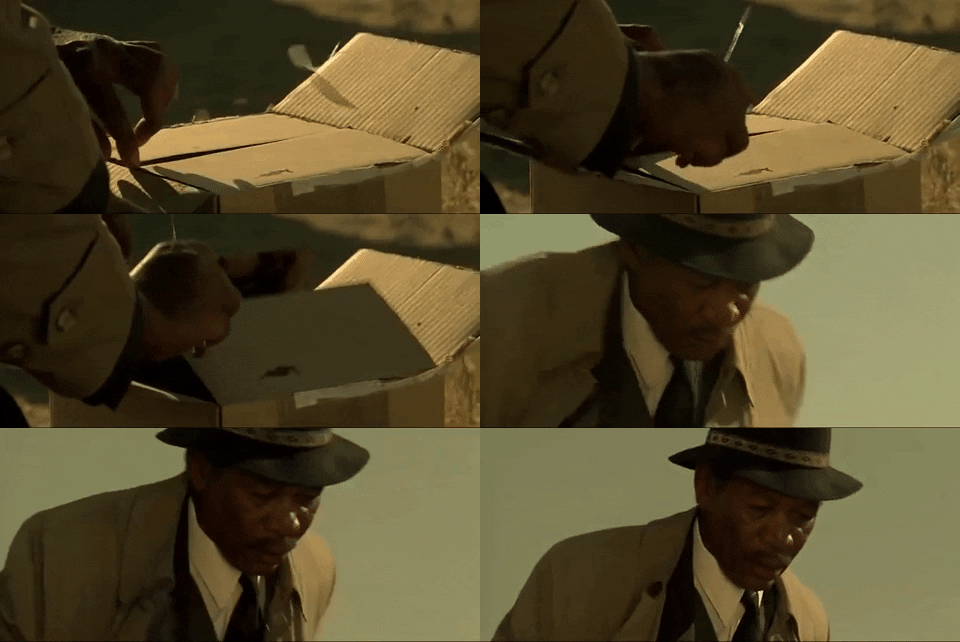
If you thought the ending of Seven was gruesome (Google it, kids!), we bring you a similar story with a much happier ending. Archaeologists digging through an ancient Roman city in Albacete found something rather unexpected inside a wall: a 2,400-year-old human head. Don’t panic…it’s made of stone! (Unlike, you know… the one in Seven).
This is huge news because it may finally help solve one of the biggest mysteries at one of Spain’s most fascinating archaeological sites. (No, not the one about whether the lost city of Atlantis was in Spain. A different one.)
The nearly life-sized limestone head was found at Libisosa, beneath the modern town of Lezuza. It dates to the 5th or 4th century BC, but archaeologists discovered it built into the wall of a much later Roman granary (aka a grain house). Basically, the Romans used a centuries-old Iberian sculpture as a brick.
So, whose head is it? Not Gwyneth Paltrow’s (seriously, go watch Seven). The face is unfortunately missing, but the hair survived: braids gathered at the back, curls over the forehead, and a visible ear. Those details suggest it depicted a young man, possibly a teenager, from an important local family.
He may once have been considerably more impressive. Researchers think the head belonged either to a standing figure or a monumental horseman (like the undead dude from Sleepy Hollow, maybe?), probably erected over the tomb of a member of the local elite. People couldn’t brag on Instagram back then, so these sculptures acted as displays of status, family lineage, and power.
And this was before the Romans arrived. Libisosa began as an oppidum, or fortified city, of the Oretani, an Iberian people who lived across parts of modern Albacete, Ciudad Real and Jaén. The settlement was destroyed during the Sertorian War in the 1st century BC, leaving streets, objects and even bodies remarkably well preserved.
That’s why Libisosa has been nicknamed the “Iberian Pompeii.” Rome later built the colony of Libisosa Foroaugustana over it, and the city was important enough to be mentioned by Pliny the Elder.
But here’s why a stone head is such a big deal. Archaeologists have been excavating Libisosa since 1996, yet they have never found its Iberian cemetery. The head may finally be the clue they needed.
The theory is that the Romans dismantled the old necropolis and used its monuments as a quarry. If this head ended up in a nearby Roman building, the tomb it originally belonged to probably wasn’t very far away, and other pieces could still be scattered around the site. It’s basically the plot of Poltergeist but, like, in the 70s. (The literal 70s, because the Sertorian War ended in 70 BC).
What happened to his face? It may simply have been worn away after centuries of abuse, but archaeologists haven’t ruled out deliberate destruction. They’re now analyzing the stone and searching for microscopic traces of pigment, since Iberian sculptures would originally have been painted in bright colors rather than left bare.
There should be plenty more where that came from. Libisosa covers more than 30 hectares and has already produced over 155,000 archaeological objects—but after three decades of excavations, only around 10% of the site has been explored.
Meaning that somewhere under that hill in Albacete, 90% of an ancient city, and perhaps its long-lost cemetery, is still waiting to be found.
🔔 Don’t forget to follow us on TikTok!
If you’re not following us on TikTok yet, you’re missing out. We’re posting exclusive content with our collaborators across Spain, breaking news updates, and pop culture coverage. Click on the post above and come hang with us!
🙏 Once again, please remember to share this newsletter with your friends on social media. The more we grow, the more information we’ll be able to offer each week.