

Skip to content
Madrid

🗳️ Spain votes. The chaos begins

Plus: Puigdemont is coming back (maybe), Messi buys a team, and new pics of a Lorca play during the Civil War.

Madrid | Issue #163 | The Bubble is Spain's #1 English-language newsletter. We offer paid and free subscriptions (which you can customize). For sponsorships, click here.

(In a solemn note before today’s newsletter: Last night, María Carmen Abascal — aka Maricarmen, the 87-year-old woman whose eviction set off the current battle over Spain's housing crisis, died last night. Our condolences to Maricarmen’s family. We hope they’re given the privacy and space they need to grieve after so much public attention.)

Subscribe now


🗳️ Spain was already plunging into elections and a general strike. Then Maricarmen died.

Spain's going to the polls. Honestly, there's nothing like voting (especially if, like one of us, you've just become a Spanish citizen). So we'd like to send out a big Thank You 🤗 to Pedro Sánchez for admitting his majority-free government had no future and calling snap parliamentary elections. ¡Gracias, Mr. Handsome!

  • The 411. Just after 9 a.m. on Monday (because who really starts on time in Spain), Sánchez stepped up to a podium at Moncloa and told the country that, after the defeat of his two housing decrees last Friday, it was time to elect a new Parliament.

  • His words. Sánchez said Spain needed to “secure a much broader progressive majority in Parliament” (unlikely, polls suggest), and added a dare: “You, the people of Spain, must decide what role you wish to play in it, and also what role you want Spain to play. You must choose whether to join that far-right wave—which causes regression wherever it governs—or whether you want Spain to remain a bastion of openness, social justice, and environmental responsibility.” Soaring rhetoric much?

What now? Well, Spain has 54 days to get its electoral act together. The official machinery kicks in this week, with the election decree published Tuesday and candidates due to register between Oct. 21 and 26. Then comes the fun part: the 15-day campaign starts Nov. 13, postal voting is already open, and on Nov. 29, everyone gets to decide who they want running the country.

  • The campaigns in a nutshell 🥜. Sánchez will say that he is the only one who can save the world from a far-right apocalypse; PP boss Alberto Nuñez FeijĂło will say Sánchez is a mafioso and a dictator, and Spain needs to return to its sensible roots; and the far right (Vox) will blame everything on Muslim migrants. (The far left — Sumar or whatever it’s to be called — will say whatever gets it attention. More on that in a minute.)

October surprise. That is, those were the expected campaign strategies before last night, when Maricarmen, the 87-year-old whose eviction from her Madrid apartment set off the current conflagration, died hours before signing a new lease that would have allowed her to return home.

'Big Front'. Talking about the far left, the many small parties to the left of Sánchez are looking to form a Frente Amplio (presentation date: Oct. 17) to not get clobbered in the elections, being that Sánchez's leftward turn has stolen many of their voters. Now they just have to pick a leader…

Trumpy claims. Not to be ignored, Madrid regional presi Isabel Díaz Ayuso of the PP told voters not to cast their ballots by mail because, you know, Sánchez could tamper with them. We've heard that from a certain 🍊 menace, no?

  • FeijĂło followed up later to cast some doubt on mail-in ballots, but in his usual milquetoast style.

  • And a book! While Isabel’s been prepping fraud claims, she’s also been penning her memoirs; we’ll tell you when we know more, but for now we can say the cover is emo fab.

And elections were only declared 72 hours ago. It’s gonna be a long month and a half.

More news below. 👇👇


This non-partisan voter campaign is paid for by Democrats Abroad to help eligible Americans in Spain vote from abroad, regardless of party.

Are you an American living in Spain? You can vote in U.S. elections from here! If you’re an eligible U.S. citizen, request your ballot now at VoteFromAbroad.org and choose to receive it by email. Once it arrives, complete and return it promptly, following your state’s instructions and deadlines. Need help? The website offers state-by-state guidance and support from voter assistance volunteers. Request your ballot here.


🎙️ A new episode of The Bubble Podcast is out!

In this new episode, we discuss the Ceuta migration crisis; we have a one-on-one with journalist and writer David Jiménez and discuss weird Spanish obsessions. Subscribe and listen on Spotify, Apple Podcasts, and YouTube!


đź’¬ Five things to discuss at dinner parties

1. 🇪🇸 Carles Puigdemont can finally come home. But will he?

That only took nine years. Spain’s (lefty majority) Constitutional Court ordered the (majority righty) Supreme Court to apply PM Sánchez controversial Amnesty Law, which drops misuse-of-public-funds charges against those who led Catalonia’s failed independence referendum in 2017. That clears the way for former Catalan president Carles Puigdemont to return to Spain without being arrested.

  • Wait… who? Puigdemont ran Catalonia during the referendum and subsequent declaration of independence (which amounted to nothing), then fled to Waterloo, Belgium, to avoid prosecution. He has lived there ever since, in a McMansion. Other separatist leaders stayed behind and eventually went to prison.

  • Accidents of fate. He became one of Spain’s most powerful political players after inconclusive elections in 2023, when Sánchez needed support from Puigdemont’s seven Junts MPs to remain prime minister. In return, he promised an amnesty for Puigdemont and the other separatist leaders.

And that’s where things got messy. The Amnesty Law passed in 2024, but the Supreme Court refused to apply it to malversación — misuse of public funds — arguing that the separatist leaders had personally benefited from the spending.

  • The Constitutional Court now says nope. In a 7–5 ruling, it said that interpretation was too restrictive and “contrary to the spirit and purpose” of a law that explicitly intended to cover public money spent pursuing Catalan independence (the idea is that it’s fine to misspend public money on a cause, but not on personal stuff, like a nice car). The Supreme Court subsequently lifted Puigdemont’s arrest warrant.

So when is Puigdemont coming back? Apparently not yet. His lawyer says they first want to make sure the Supreme Court has definitively closed the case. And then there’s the small matter of a general election on Nov. 29.

  • Puigdemont will likely wait until after the election. His camp wants his return after nine years abroad to look like a political homecoming, not an electoral stunt. Plus, Junts is expected to have a rough election. Staying away lets current leader MĂ­riam Nogueras take the blame.

  • And don’t expect Sánchez-Puigdemont 2.0. Junts secretary-general Jordi Turull says supporting Sánchez again is “impossible” because the party “got burned” by their last agreement. Junts has also ruled out facilitating a PP-Vox government.

So… nobody’s getting their vote. Fun times.


2. 🏠 The housing decrees return — with a general strike!

Parliament voted down the housing laws, but that doesn’t mean they’re dead. On Tuesday, a day after PM Sánchez declared snap elections because his government’s housing decrees got shot down on the parliamentary floor, his government decreed two just-slightly-different versions. And it looks like at least one will pass.

  • But wait, how? Because Spain has a thing called the DiputaciĂłn Permanente — basically a rump Congress. When Parliament is dissolved for an election, it stays behind for a few essential jobs, including approving or rejecting government decrees. And unlike in Parliament, Sánchez has a majority in the Dippy.

The new decrees are mostly the old ones in slightly different outfits. The first brings back the shield against evictions of vulnerable people, extends expiring rental contracts, offers tax breaks to tenants and small landlords, and beefs up rules against turning ordinary homes into tourist or fake “seasonal” rentals. It also creates €10bn in zero-interest loans for first-time buyers, and adds €680mn in guarantees to boost construction.

Subtle tweak. In addition, it extends the restrictions on speculative home purchases by “vulture” funds to gran tenedores ˆ— basically, anyone who owns 10 or more properties (or five in “stressed” housing areas). Which could be uncomfortable for some of Sánchez’s ministers, who own some serious real estate themselves.
  • The likely winner: The first decree. It has broader political support and is expected to get through the DiputaciĂłn Permanente.

  • The likely loser: The second decree, which would automatically extend rental contracts. The Basque national party doesn’t support it because, like, property owners don’t want tenants for life. So its passage is highly unlikely.

Will any of this calm Spain’s housing crisis? Probably not much.

  • And people know it. In fact, the folks who have been camping out in Madrid’s Puerta del Sol, along with the unions, are already planning to make their feelings known — with a general strike on Nov. 11, the first backed by Spain’s two biggest unions, UGT and CCOO, in 14 years.

The strike is being organized around the housing crisis (obvs) and the demand for homes ordinary people can actually afford. It will also be held just 18 days before the Nov. 29 election and one day before the election campaign officially begins.

  • The government says it respects the right to strike. The business groups say housing isn’t a labor issue — and don’t like making companies and workers pay for a protest aimed at the government. PP and Vox are unhappy, too (also obvs).

Apparently one political crisis at a time would be too easy. So Spain is getting an election, a housing crisis, two half-resurrected housing decrees and a general strike all at once! 🥳


3. âš˝ Lionel Messi bought a Spanish fĂştbol club. And another.

So much for sticking to what you know best. Former Barça superduperstar Lionel Messi has spent the little time he has off the pitch amassing a small empire of fútbol clubs. And this week he went BIG in Spain.

  • The latest: On Oct. 1, a team in Spain’s second division — CD Eldense — announced that Messi would be its new owner, pending approval from Spain’s High Council for Sports. La pulga (The Flea, as the little fella is known) is buying 100% of the club, at a reported price of somewhere between €10 and €15 million, which is roughly what Messi earns in the time it takes you to read this article.

The club: Eldense was founded in 1921 in Elda, a 55,000-person city in Alicante province — by a group of Barcelona fans. Which is why, for 105 years, they’ve played in blaugrana, Barça’s blue and garnet colors. That detail, sources say, is what caught Messi’s eye.

  • Not great…yet. Eldense’s best-ever league finish was seventh in Segunda — in 1963, waaay before Messi was born. They almost went bust in the late 2010s, clawed their way back to the second division in 2023, got relegated again, won promotion last season, and are currently sitting 17th of 22. It is, in other words, a project. Not a glamor acquisition.

  • But the new owner already has people excited. After Eldense beat Real Oviedo 4-1 last Friday (after starting down 0-1), Messi posted a photo of himself watching the match — mate gourd in hand — captioned simply “Aupa Deportivo“ (“Let’s go, Deportivo”). A dozen new sponsors materialized within days. Wonder why? 🤔

But there’s more! The purchase reboots the rivalry between Messi and former Real Madrid megastar Cristiano Ronaldo, who, between them, won every Ballon d’Or from 2008 to 2017. Now they’ll face each other in the boardroom: Ronaldo holds a 25% stake in Almería, also in Segunda. Their clubs are due to meet on May 2, 2027. Almería beat Eldense 3-0 in the first fixture. Bragging rights are very much a thing here.

  • About that little empire: Eldense isn’t Messi’s only Spanish club. In April he bought UE CornellĂ , a fifth-tier side on the outskirts of Barcelona (its alumni include Jordi Alba and David Raya). And in Uruguay, he and Luis Suárez co-founded Deportivo LSM in 2025 — and it was promoted to the third tier in its first season. La Pulga can’t stop, won’t stop.


4. đź’¸ Apartment scammer tricks 800 tourists in Madrid

This is what you will not see from the apartment that does not exist. By Martti Salmi on Unsplash

It started Friday. Visitors from Nigeria, Morocco, Ecuador, even a guy from San Sebastián arrived in a constant trickle, looking for the apartment they had rented on Booking.com, the one alongside Retiro Park at Av. de Menéndez Pelayo 19, eager to drop off their bags, take a load off, and see the best Madrid had to offer. One problem, though: it didn’t exist.

  • The news: A scammer listed a non-existent apartment on Booking with a great value proposition: €90–€180 a night for a supposedly fabulous 53m2 apartment with a king-size bed, breakfast, parking, private bathroom, airport transfer, spa and 24-hour multilingual reception. The photos showed a swanky piso with views of a fancy building that isn’t even in the neighborhood. None of it existed. Nada

Still, more than 800 people appear to have fallen for it over five days. A taxi pulls up, someone gets out with luggage, looks at No. 19, looks at their phone, then looks very confused.

  • The building is residential. There is no tourist apartment. There is, however, a sign on the door helpfully explaining that the accommodation doesn’t exist and suggesting guests report the payment to the police. ¡Bienvenidos a Madrid!

The sidewalk had become an international support group by Tuesday night, El País reports in a lovely, bemused article featuring Nigerians, Moroccans, Ecuadorians, Poles, Russians, business travelers, students and that guy from San Sebastián, all standing around with suitcases wondering where they were going to sleep.

  • Setting the scene. The building’s concierge, Cris BellĂłn, had apparently become the unofficial Madrid tourist office. “Look, another one!” she reportedly exclaimed as yet another taxi pulled up. At one point, about 50 stranded guests were milling around outside.

The best/worst part? The fake apartment was still listed on Booking.com at the time of the article’s publication (it appears to have since been taken down). And it had a 7.7 rating and more than 700 reviews, including glowing comments about the “cleanliness and friendliness of the owner” and one guest praising its location in… Ría de Ferrol, Galicia. (Scammers can’t be choosers when it comes to cloning reviews and descriptions, it seems.)

  • We give them five stars for imagination. Zero stars for having an actual apartment (or, like, common human decency.) 🥴


5. 🎭 Lorca’s theater lives on: 45 lost photographs discovered

Walter Reuter (FGFZ / Arqueología de Imágenes)

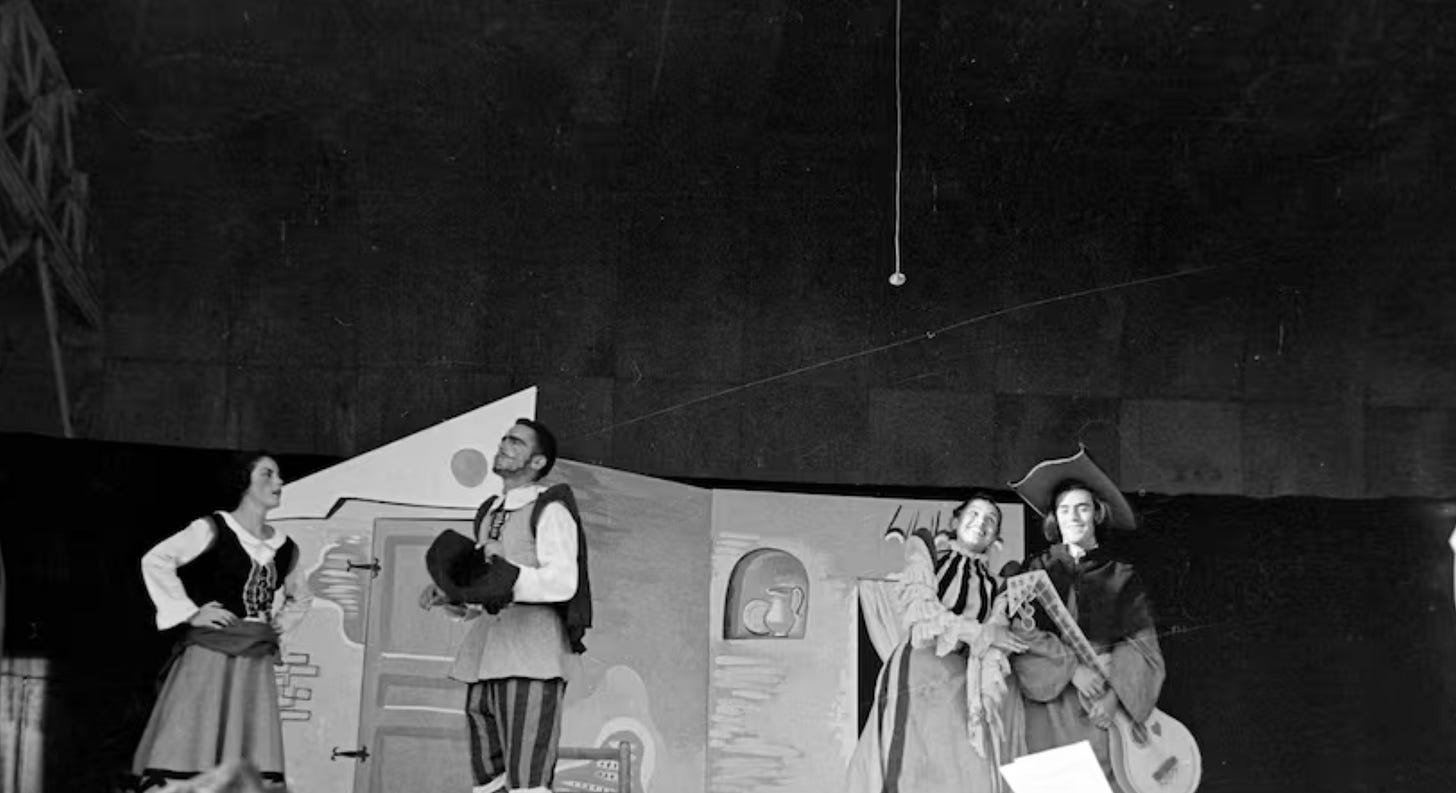
Imagine going to the theater while bombs are falling on your city. That’s exactly what thousands of people did in Valencia on Aug. 29, 1937, when La Barraca, the theater company founded by legendary playwright Federico García Lorca, performed three short plays by Cervantes. Now, almost 90 years later, 45 previously unseen photographs of that extraordinary afternoon have been discovered.

  • Better than a time capsule. The photographs show young actors performing in Valencia’s Viveros Gardens before an enormous crowd of perhaps 2,000 people, reports El PaĂ­s.

  • A family affair. There are children perched on their fathers’ shoulders, soldiers, farmers and families enjoying an afternoon of theater in the middle of the Spanish Civil War.

And they were literally sitting in a can. The images were taken by German photographer Walter Reuter, who fled Nazi Germany in 1933 and later documented the war for the Spanish Republic.

  • His negatives were among more than 4,000 discovered a decade ago inside an old film canister at filmmaker Guillermo Fernández Zúñiga’s home. Archivist Aku Estebaranz identified the 45 photographs while cataloging the collection.

But what exactly was La Barraca? It was Lorca’s ambitious project, back in 1932, to bring classical Spanish theater to ordinary people, particularly those living in rural areal who rarely had access to performances. University students traveled around Spain staging plays by writers such as Cervantes and Lope de Vega, often in public squares.

  • Lorca felt theater belonged to everyone. La Barraca represented his belief that culture shouldn’t be reserved for the rich or educated. And after his death, the company continued performing, even entertaining Republican soldiers and wounded patients during the Civil War.

  • The tragedy? Lorca never saw this performance. He had already been arrested and executed by forces aligned with Franco’s military uprising near Granada in August 1936. His left-wing associations, outspoken cultural views, and homosexuality made him a target of the repression unleashed by the Nationalists.

And if you’ve seen La Bola Negra, there’s an interesting connection here. Los Javis’ film draws inspiration from an unfinished Lorca work and these newly discovered photographs offer another glimpse into Lorca’s world and the cultural legacy that survived his murder.

  • Perhaps the most remarkable detail? While Valencia endured air raids and the Republic fought for survival, thousands of people still gathered to watch a group of students perform Cervantes.

Long live Lorca.


🔔 Don’t forget to follow us on Instagram!

If you’re not following us on Instagram yet, you’re missing out. We’re posting exclusive content with our collaborators across Spain, breaking news updates, and pop culture coverage. Click on the post above and come hang with us!

🙏 Once again, please remember to share this newsletter with your friends on social media. The more we grow, the more information we’ll be able to offer each week.

Share

Read the original on Substack