

❤️🩹 Spain tells self-employed it will let them live
Plus: Rosalía rocks Madrid, a fight among the language police, and no black cats for you.
Madrid | Issue #122
🇪🇸 The Bubble is Spain's #1 English-language, best-selling newsletter. We offer paid subscriptions, and we’d be thrilled to have your support!
🚨 Customize your subscription! You can personalize your Bubble experience so you only get the emails you want—and never the ones you don’t. Click here to learn how.
📺 Sponsorship opportunities. Want to get your brand in front of our engaged and influential audience of professionals, creatives, and government workers? We’re now offering a variety of ways to do so. Click here to find out how and book a spot.
Never mind
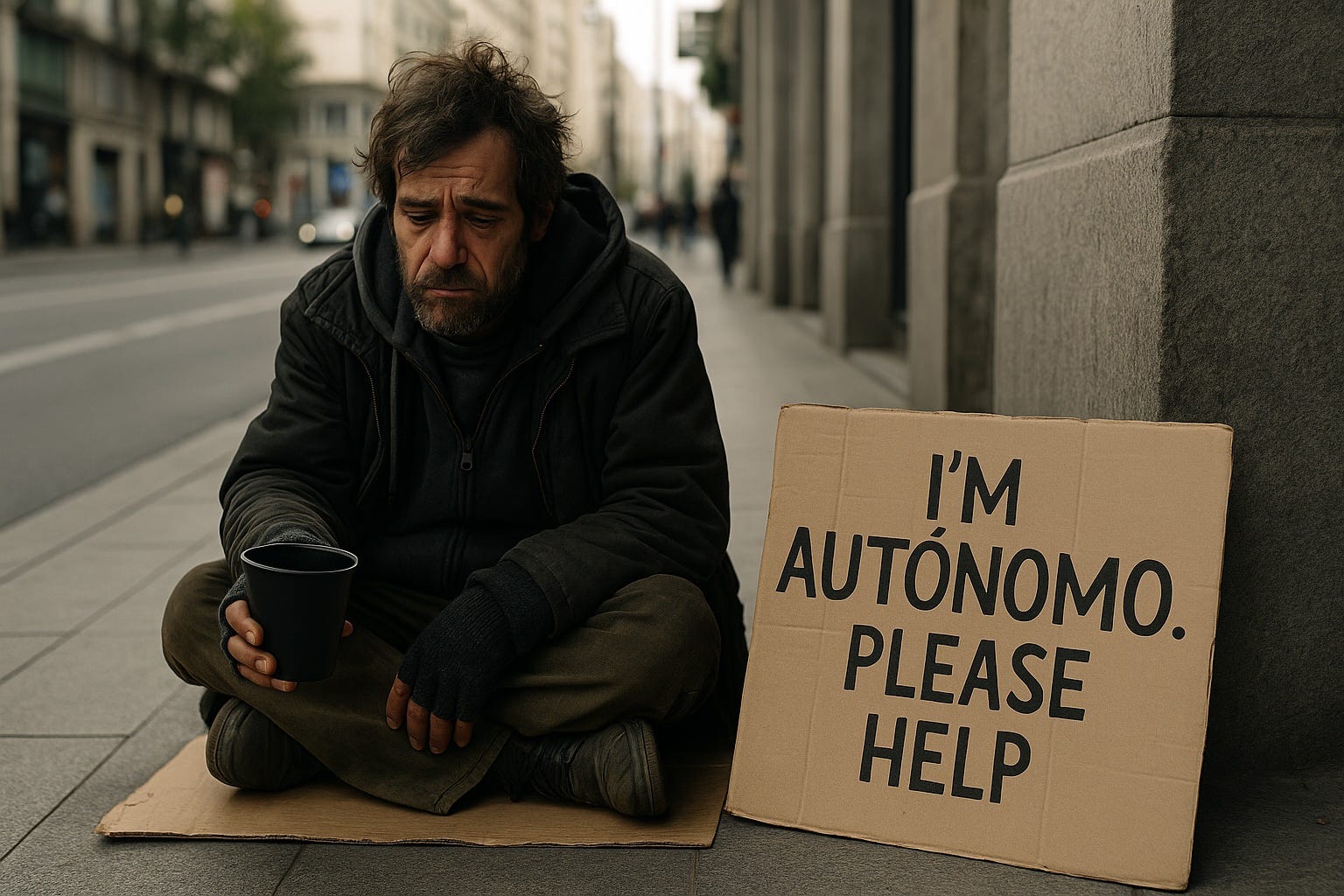
🤡 Government to autónomos: Just kidding!
Climbdown. Walkback. Rethink. Pick your word, the government of Prime Minister Pedro Sánchez indulged in it bigly timely this week. Days after floating a massive three-year rise in social security cuotas (monthly payments) for Spain’s self-employed — which we reported on last week — Social Security Minister Elma Saiz slammed into reverse so hard you could almost hear the beeping.
Soak the
richmiddle class. Last week, Social Security circulated draft tables that would have jacked up payments for the self-employed (aka autónomos) between 4% and 35% in 2026, with similarly chunky increases the next two years. By the end of the glide path, many self-employed would be handing over 20%–38% of income to Social Security—before paying income tax (19%–47% of net). The stated logic? Align contributions with ingresos reales (actual income), as agreed in a 2022 reform.Basically a popular revolt. Literally no one liked this plan (well, maybe Saiz did for a minute). Every party from the right-leaning opposition of PP and Vox to PSOE left-wing ally ERC — and even the socialists’ own coalition partner Sumar — rejected the hikes. The leader of the ATA autónomos union, Lorenzo Amor, dubbed it a “sablazo” (sword slash) — and one member of the government complained that they were giving “wings” to the far-right Vox. 😰
Totally didn’t mean what you thought I said before. Saiz used an interview with the reliably PSOE-friendly El País published Monday to, um, roll out the new, new thing: a freeze of cuotas for the lowest-paid autónomos, and increases for everyone else so small they’re barely visible to the naked eye. (She also claimed the ministry “no ha hecho cálculos recaudatorios” — hadn’t calculated the revenue impact — which is…hard to believe.)
But anyway… Saiz’s Q&A kicked off the Day of Walkback. Later Monday, the ministry rolled out the specifics: the new proposal would raise the monthly pay-in by at most €14.75 (for the highest earners), or a maximum of 2.5% 🎉 in 2026 (no news about later years). And with this “big swerve”, as the autónomos union called it, the cuota increase went from a sword slash to a feathery tickle.
Failure has no friends. The top bosses of Spain’s government — PM Sánchez and Deputy PM and Finance Minister María Jesús Montero — clearly did not want to be associated with this righteously unpopular move. Luckily, on Tuesday, El País ran a piece that suggested Saiz hadn’t fully briefed them before dropping the original grenade, and recounted how, once they saw the blowback she’d unleashed, they came together to pressure her to reverse course. Whether this is what happened or some intense ass-covering, we cannot say, but Saiz clearly had no friends.
Unpopular ≠ illogical. While Saiz’s proposed pay-ins were politically radioactive, they came out of something resembling logic. That is, Spain’s social security system is unsustainable as is.
Haves and have-nots. New retirees’ average pension is now around €1,760, which (yes) recently eclipsed the average wage for under-35s (€1,670). (Seems kinda backwards, no?) Autónomos, however, retire worse off: Saiz points out that a lifetime self-employed worker still ends up with €650 less per month in retirement than a comparable employee—because autónomos historically under-contributed.
Why is that? People with a regular j-o-b only pay about 6-7% of their salary in social security because their employer chips in the rest of the 30%+ charge. So an autónomo wanting a “Salary Man” pension has to self-fund the employer share. Surprise — most can’t or won’t. The shift toward paying on ingresos reales was supposed to fix that gradually. But “gradually” met “politically suicidal,” and here we are.
What now? Basically, this kicks the can down the road. Unless social security finds a pot of gold, expect more poor-ish retired autónomos in the years ahead.
And Elma Saiz? We wouldn’t be surprised if she “retires” from her social security work pretty soon.
More news below. 👇👇
🔔 But first, check out our Instagram account
If you’re not following us on Instagram yet, you’re missing out. We’re posting exclusive content with our collaborators across Spain, breaking news updates, and pop culture coverage. Click on the post above and come hang with us!
💬 Five things to discuss at dinner parties
1. ⏰ This weekend we change the clocks, and Sánchez says, “No more!”
Spain switches to winter time this Sunday (aka seasonal depression), setting clocks back one hour and giving everyone the illusion of extra sleep.
But it might be the last change, if Pedro Sánchez gets his way.
The PM surprised Europe this week by proposing to scrap daylight savings time across the EU starting in 2026, reviving a debate that’s been snoozing for years.
Sánchez also made a personal appeal, posting a video on X: “Honestly, I don’t see the point anymore,” he said, citing surveys that show most Europeans (around 80%) want to stop changing the clocks.
He added that energy savings from the changes are negligible (about €6 per household per year), while scientific studies show that time changes mess with sleep and wellbeing.
The big question. Which time would Spain keep? Sánchez didn’t say, though most assume he’s leaning toward winter time (aka the gloomy option that sucks 🤢), which would mean earlier sunsets in summer, and no more daylight at 10 p.m.
Is there still hope that we’ll stay in the summer time (aka the option that rules 😎)? Polls show around 70% of Spaniards prefer this time so Sánchez might want to tread carefully.
Then there’s the old argument that Spain is in the “wrong” time zone altogether. Geographically, it belongs in the same zone as Portugal and the U.K. (Greenwich Mean Time) but has followed Central European Time since Franco.
Sánchez’s team says this plan modernizes rules and reflects science and public opinion. The European Commission agrees — enough to praise it and put it in a drawer. It called the move “the most logical path forward,” and promised a new impact study to help states decide — Brussels-speak for “see you in a few years.”
But here’s the catch. Only three of the 27 EU members currently back Spain’s push. (Finland, Poland…and Spain.) And sympathetic countries, like Germany and the Baltics, say they need more time to coordinate with neighbors.
Other probs. Some governments fear it could create a “chaos of time zones” across Europe, especially since countries would be allowed to pick the winter or summer hour. Others, like Portugal and Greece, oppose any change at all.
Back home. Catalan separatist party Junts used the proposal to take a jab at Sánchez. “We should talk less about changing the time and more about the time for change,” it said in parliament, accusing him of focusing on symbolic issues while ignoring real stuff…like the autónomos and housing crises. (For once we agree with Junts.)
So for now, nothing changes (except the clocks, of course).
2. 🗣️ The RAE vs. Cervantes slap-fight, explained
Sayre’s Law says academic politics are so vicious because the stakes are so small. Now, Spain has proved we can raise the stakes and keep the viciousness: the heads of Spain’s two big language bodies—the RAE (dictionary people) and the Instituto Cervantes (Spain’s soft-power Spanish-promoters)—just brawled in public. In Peru. At a language conference. 🙃
What set it off? Days before the International Congress of the Spanish Language (CILE) in Arequipa, the Cervantes chief Luis García Montero took a swipe at RAE director Santiago Muñoz Machado, bemoaning that the Academy was “in the hands of a professor of administrative law, an expert in running business from his law office for multinationals”—i.e., not a linguist. The RAE fired back with a statement expressing its “absolute repulse” for the “incomprehensible” remarks and defending Muñoz Machado’s record.
Then they took it on the road. At the Peru conference, the duo shared a press table and traded more barbs. The spat became the conference subplot, overshadowing panels on, you know, language. Even the closing session broke tradition by not announcing the next host city—because everyone was wound up in the drama.
WTF is this about? On the surface: personalities and turf. The Cervantes, which works under Spain’s PSOE-run Foreign Ministry, wants a more expansive, contemporary take on Spanish—one that is open to linguistic diversity and inclusive language. The RAE, a private academy with public funding, guards the grammar gates and has repeatedly rejected the “todes/e/@” stuff as outside Spanish morphology. Underneath: politics and succession. Muñoz Machado’s RAE mandate ends in 2026, and one question is whether the PSOE government can nudge an ally into the chair. (Another García Montero zinger: “I think everyone is happy that Muñoz Machado only has one year left.”)
Enter Pérez-Reverte with a flamethrower. Bestselling author/RAE academic/literary troll Arturo Pérez-Reverte accused the Foreign Ministry of trying to “colonize” the Academy via Cervantes and called García Montero “mediocre y paniaguado” (aka a mediocre toady). In this telling, the quarrel isn’t just catty, but a government move to bring the RAE to heel after its “no” to inclusive language. Some academics whisper similar fears; the government demurs.
So who’s winning? No one. The Asale (Latin American academies) publicly praised Muñoz Machado’s leadership; the RAE and Cervantes both left Arequipa a bit singed; and the Congress ended with a vague plea for peace. Meanwhile, Spanish keeps being spoken by 500 million people regardless of who controls the podium.
A takeaway for non-obsessives. This isn’t about how to use the subjunctive. It’s about who sets the tone of global Spanish, and whether politicians can choose the referees.
3. 🎶 From Rosalía to La Oreja de Van Gogh: It’s been a huge (and chaotic) week for Spanish music
It’s been one of those weeks when Spanish pop shifts gear. On one hand, Rosalía—already a global name—just announced her new album, set to drop in early November. On the other, veteran pop band La Oreja de Van Gogh revealed a major shake-up in their lineup and a full-blown new era on the horizon.
Guess who’s back. You may not know them (though you should), but La Oreja de Van Gogh is one of the biggest Spanish pop bands ever. (Seriously, you’ve never listened to Rosas?)
Amaia Montero, the band’s original lead singer from 1996 to 2007, is officially returning. After a year of silence following the drama-laced exit of Leire Martínez (who had replaced Montero), the group is preparing for a 2026 reunion tour and has already teased a new song. Trust us: this will be the pop culture event of the year.
What no one saw coming? Founding guitarist Pablo Benegas is stepping aside for this new era, saying he’s not joining the tour (rumor: burnout).
Failure to launch. Fans were waiting for tickets to drop Monday at noon—but an Amazon Web Services crash delayed sales until 4 p.m., sending thousands of people online into meltdown. Which was fun to watch.
Guess who’s back, part 2. Catalan superstar Rosalía on Monday night revealed that her long-awaited follow-up to Motomami will be called Lux and will drop on Nov. 7.
Teased on a billboard in Times Square (which Rosalía posted on TikTok Live before it was leaked), the real show came hours later in Madrid’s Plaza de Callao, where she staged a chaotic scavenger hunt (to find her) that ended with her sprinting down Gran Vía, surrounded by screaming fans.
The stunt wasn’t just peak Rosalía—it was also apparently very unlicensed. City officials confirmed the gathering, which drew 500 people and briefly shut a metro station, hadn’t been authorized.
Madrid Mayor José Luis Martínez-Almeida criticized the event, claiming it “put people’s physical safety at risk” (eye roll) and lacked the required permits, forcing riot police to intervene and traffic to be shut down on Gran Vía.
He did, however, say it was good that she chose an emblematic place such as Plaza de Callao to make such an announcement. 🤣
Whether she’ll be fined—or forgiven because she’s, well, Rosalía—remains unclear.
The album title, Lux (“light” in Latin), hints at the spiritual turn Rosalia has been teasing for months. She’s been seen in churches, playing with religious imagery, and talking about wanting to live “like a nun” in creative solitude. The cover—her in monastic white robes and a veil—leans into this new identity: less Motomami, more mystical pop priestess.
We’ll take it.
4.😢 Outrage in Seville after 14-year-old’s suicide sparks bullying scandal
This one’s really sad. Spain is reeling after the suicide of a 14-year-old student in Seville last week that exposed a devastating case of school bullying and institutional failure.
Sandra Peña, a student at the Catholic school Las Irlandesas de Loreto, took her life last Tuesday by jumping from her apartment balcony, just steps from the school.
Her family says Sandra had repeatedly told them she was being bullied by three classmates and had reported it to the school twice. Despite that — and an earlier suicide attempt — the school never activated the anti-bullying protocol required by law.
What went wrong? Andalucía’s Department of Education says the school “implemented a series of measures” after the family’s complaints, like moving Sandra to another class, but inspectors confirmed the school failed to activate both the bullying and suicide-prevention protocols, despite being legally obliged to do so.
That omission could have serious consequences. The regional government now says the school could lose its public funding if investigators determine that its negligence contributed to Sandra’s death.
The Junta de Andalucía has forwarded its findings to the Fiscalía (the Public Prosecutor), which has opened three separate investigations: one into the school’s legal responsibility; another into the three alleged bullies (all minors), and a third into the online harassment and publication of the girls’ photos after the incident.
Public outrage. The case has provoked national outrage. Outside Las Irlandesas, mourners left flowers and candles, while others expressed fury through graffiti, calling the school “complicit” and “cowardly.”
Over the weekend, the walls were spray-painted again, this time with the names and photos of the alleged bullies, alongside the word “asesinas” (“murderers”).
Those same images have spread rapidly on social media, prompting prosecutors to demand that online platforms remove the photos and personal data of the minors. Authorities warned that “bullying cannot be fought with more bullying,” and that exposing underage suspects could lead to new criminal charges.
The school’s response. After days of silence, the school issued a brief statement calling for “caution and responsibility” and condemning the “violence” that had erupted around the campus, including incidents where objects were thrown into the playground and students were harassed on their way to class simply for wearing the school uniform. It made no reference to Sandra’s complaints of bullying or to the school’s failure to activate the required protocols.
Meanwhile, Sandra’s family is still mourning while considering whether to join the case as a private plaintiff. Prosecutors will decide whether the three classmates should face reform measures under Spain’s juvenile justice system.
Beyond the legal process, the tragedy has ignited a national debate about how schools handle bullying, and whether Spain’s anti-bullying protocols, in place since 2011, are actually being enforced.
5. 🐈⬛ Who says Spain doesn’t celebrate Halloween?
Halloween is apparently a dangerous time to be a black cat in Catalonia 🤦♀️. Terrassa, a working-class city about half an hour from Barcelona, has frozen the adoption of black cats until Nov. 10. Why? To protect them from being used in “macabre practices” by those who get all satanic-ritual-happy this time of year.
That’s according to Terrassa’s deputy mayor and animal welfare head Noel Duque, who recently announced on his Insta that the city’s shelter — the Centre d’Atenció d’Animals Domèstics, or CAAD — would not allow any black cats to be adopted from early October through Halloween.
Beware: the underworld! 🧙 (Cue maniacal laughter.) “There is an underworld that we cannot deny, but at least we can warn about,” Duque said. He also added that the measure “does not imply any discrimination based on the color or characteristics of the animals.” Good to know Terrassa is just careful, not racist.
You can have a black cat — just not now. The CAAD houses about 100 cats, 12 of whom are black. If you want one, you can apply, but you can’t pick up your bundle of joy until November, by which time your urge to sacrifice anything furry will, one hopes, have passed.
But is this really a thing? Duque admits he has no hard data, only that animal-protection workers say “suspicious” adoption requests tend to spike around Halloween.
Happily La Vanguardia got to the bottom of this. The paper writes that police have no record of macabre acts involving cats, rabbits, chickens, or lambs in Catalonia last Halloween: “However, there have been incidents in other areas. On October 14, 2024, the decapitated head and four severed legs of a ram were found next to the Factory shopping center in San Sebastián de los Reyes, Madrid, in an allegedly satanic act.” 😱
Why would someone sacrifice a black cat? Legend holds that they are satanic, or that their witch masters can inhabit them. Because of these superstitions, black cats have some of the lowest adoption rates and highest euthanasia rates in U.S. shelters, many of which—like Terrassa—won’t adopt them in the lead-up to Halloween. Seems that Terrassa’s not alone in this logic-optional fight!
So yes, Spain does Halloween after all. Just ask the cats. 🎃
🙏 Once again, please remember to share this newsletter with your friends on social media. The more we grow, the more information we’ll be able to offer each week.
We’ll be back next week with more.