

💣 Sánchez's Ceuta nightmare deepens
Plus: Catalonia fails a big test, and Ayuso's penthouse is not going away.
Madrid | Issue #158 | The Bubble is Spain's #1 English-language newsletter. We offer paid and free subscriptions (which you can customize). For sponsorships, click here.
💥 Did Spain’s police just blow a hole in the government’s Ceuta story?
BOOM. A month after thousands of people crossed into Ceuta over two days, Spain still doesn’t know exactly what happened (or won't say), and now the country’s own police may have blown a rather enormous hole in the government’s narrative.
Blowing up the story. On Tuesday night, El Español reported that a 55-page police report sent to a judge says Moroccan security forces helped “guide” migrants into Spanish territory and suggests the operation was intended to overwhelm Spain’s ability to respond.
And that's not all. On top of that, the police gave the report to the judge without the Interior Ministry knowing it existed.
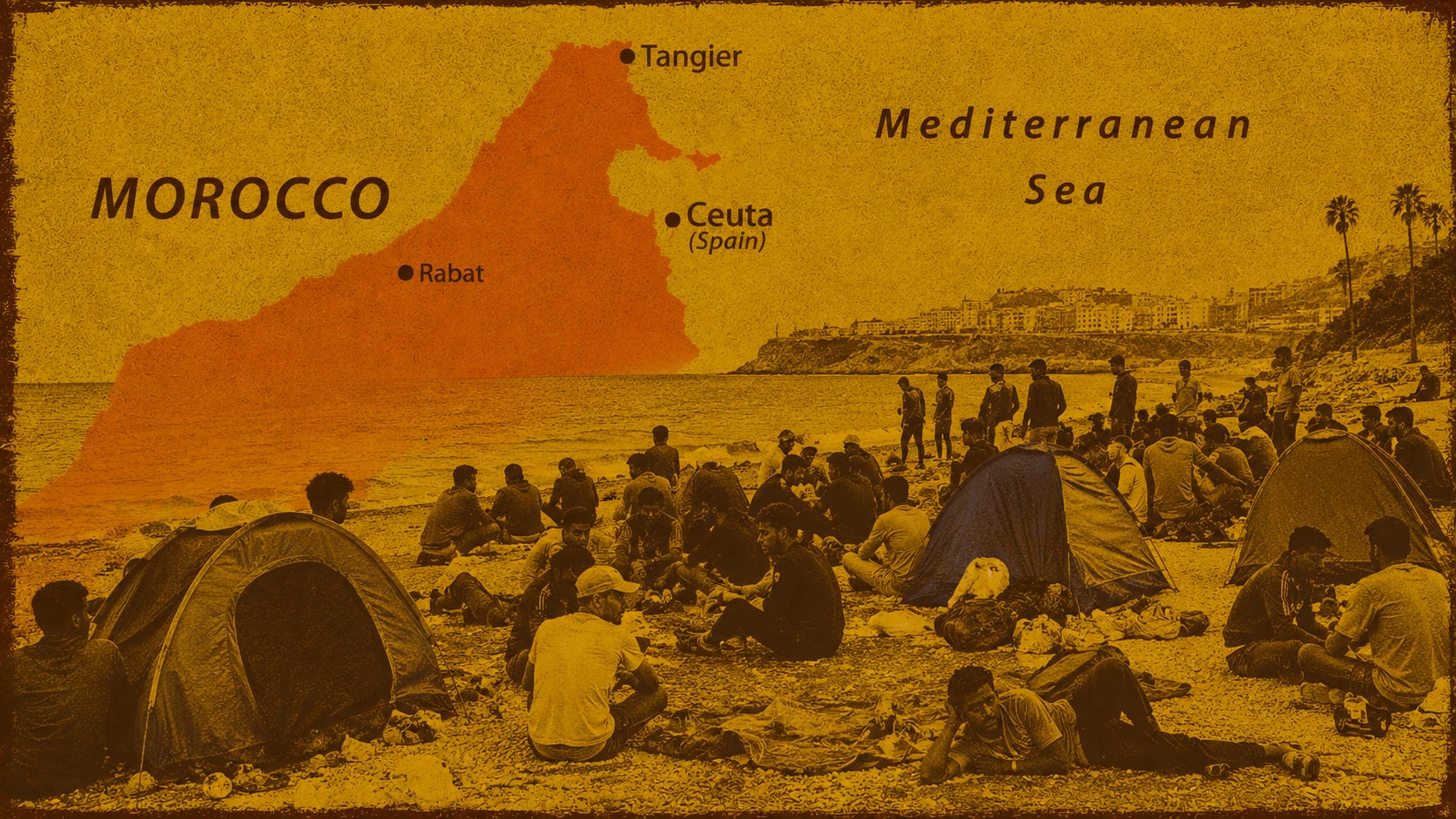
Quick recap. On July 30 and 31, around 72,000 people crossed from Morocco into Ceuta, overwhelming the tiny Spanish exclave (we covered it here). A month later, 5,000-10,000 remain there, public services and businesses are under enormous strain, residents are afraid to leave their homes, and Ceuta’s president Juan Jesús Vivas (from the center-right PP) says the city is a pressure cooker that could explode any second.
The government’s story hasn’t really changed. Prime Minister Pedro Sánchez (center-left PSOE) has resisted accusations that Rabat deliberately engineered the crisis and has continued defending Spain’s relationship with Morocco, thanking them for their “quick response”, while his government has also blamed the flood of migrants on coordinated human traffickers and said Russian and Israeli networks tried to exploit the crisis online.
Um, no. Opposition leaders, and even the government’s junior partners in Parliament, weren’t buying the story.
Then came Tuesday night’s bombshell story. Investigators from the National Police’s Centro Nacional de Inmigración y Fronteras (CENIF) analyzed videos and social media messages from the crisis and reached some fairly extraordinary conclusions.
I'll be your illegal border crossing guide. According to local media, the report describes “permissiveness” by Moroccan security forces, and they participated by “guiding the crossing through the water.”
Not just people looking for a better life. To make things worse, investigators say the events were not accidental and that the whole point may have been to direct a massive flow of people toward Ceuta with the objective of “eliminating Spain’s capacity to respond.”
On the down low. The report was commissioned by National Court judge María Tardón, who, according to Spain’s police chief, ordered investigators not to share its preparation or contents with their superiors (not even at the top of the Interior ministry) while the judicial investigation remained secret. ‼️
Wait… what?! Imagine Spain’s government learning what its own police thought about a national-security crisis from… the press. 😱 Interior Minister Fernando Grande-Marlaska demanded explanations from National Police chief Francisco Pardo, while government sources told El País that the situation was “inconceivable” and complained they were effectively “blind” to what investigators were doing.
The conspiracy theories began. Some government officials reportedly wondered whether the police were deliberately operating against the government. ‼️
But wait, we’re not done. The police chief says the report doesn’t blame Morocco. Well, not exactly. Pardo told Marlaska that no police report attributes the “planning or execution” of the crisis to Moroccan security forces. That is technically compatible with investigators saying Moroccan officers participated or facilitated the crossings, but it hardly makes the situation clearer. 🙄
Break out the popcorn. 🍿 The result is
a shit showan extraordinary institutional mess in which the report describes Moroccan participation while Interior insists it doesn’t establish Moroccan responsibility. So… the Moroccan authorities weren’t the mastermind, just… aides? 🤔
Bad timing. Speaking of inconveniences, yesterday was Ceuta Day, a holiday marking the appointment of the first governor of Ceuta in 1415. In order to show solidarity with it, many demonstrations were organized across Spain.
Taking their toys and going home. The Socialist party, however, refused to participate, arguing that the supposedly nonpartisan rallies had become politicized by the PP and Vox.
We're not gonna take it. Meanwhile, regional president Vivas used his official address to issue perhaps the starkest warning yet: “Ceuta can’t take any more.” He said the city remains in “serious danger,” accused Morocco of deliberately trying to suffocate Ceuta and Melilla, and warned that Spain has effectively left control over its territorial integrity “in Morocco’s hands.”
Everyone smells blood. PP boss Alberto Núñez Feijóo, visiting Ceuta for the third time since the crisis began, accused Sánchez’s government of lying and praised the police and intelligence services.
And at the extremes… Far-right Vox joined PP-organized demonstrations across Spain. Far-left Podemos went further, calling the episode an act of Moroccan “hybrid warfare” and demanding Marlaska resign immediately. 😵💫
With friends like these. Even leftish coalition Sumar — which is part of the government — isn’t buying the government’s certainty. Health Minister Mónica García said that, if the report is confirmed, Moroccan participation would be “serious” and Madrid must demand explanations from Rabat.
Where does all this leave Sánchez? After a pretty slow response (it was August, after all 🏝️), Sánchez thanked Ceuta for its “serenity”, admitted that many felt the government’s response had been “insufficient” and highlighted a new €309m aid package, saying the priority is getting migrants off the streets and restoring normality.
What about Morocco though? The government is sticking to its cautious line: it says there is still no police finding that Morocco planned the operation, wants to examine the report in full, and continues treating Rabat as a crucial partner blah blah blah. Which, at this point, is pretty
susweird. And sounds a lot like 🐂💩.
More news below. 👇👇
🎙️ Episode 5 of The Bubble Podcast is out!
On our latest episode (recorded right before the Ceuta crisis), we discuss immigration, belonging and identity in Spain with writer Noor Ammar Lamarty, ask whether the PP is moving closer to Vox ahead of the next election, and explore the TV shows, from Verano Azul to Sálvame, that help explain Spanish society.
Subscribe and listen on Spotify, Apple Podcasts, and YouTube!
💬 Five things to discuss at dinner parties
1. 🏠 Ayuso’s €6.3m penthouse “attic” refuses to disappear
Heading into summer like woa. Right before our summer break, we mentioned a small political scandal involving the purchase of a €6.3 million penthouse “attic” that seemed to be giving Madrid’s regional president Isabel Díaz Ayuso more than a headache.
Guess what. The story is back (or rather, it never went away) because Ayuso’s team has now acknowledged that one of her advisers visited it before the purchase, and Ayuso herself went to see it afterward.
A recap. In April, the regional government quietly bought a luxury penthouse an “attic” in Chamberí through public company Planifica Madrid, supposedly as a possible temporary workspace for Ayuso while the Real Casa de Correos, in Puerta del Sol, was renovated.
The problem. The property is legally residential, not an office, and the search criteria reportedly called for 250-400 square meters and a large terrace; oddly specific requirements for temporary government offices.
The other problem. The
penthouse“attic” is (coincidentally, we’re sure), located literally across the street from where Ayuso’s mother lives.
Ayuso said she knew basically nothing about it. When the purchase became public in late July, she called the story a smear campaign, insisted the apartment had not been bought for her to live in, and later said she had “not the faintest idea” about the details.
The PP wasn’t thrilled. Party officials privately described the operation as an error and struggled to understand why the regional government had bought an
expensive luxury residence“attic” through a high-end real estate agency.Dad's not happy. PP leader Alberto Núñez Feijóo publicly said the responsible department still needed to explain why it bought a property that couldn’t legally be used as an office.
Madrid tried to kill the story. Within about 24 hours of the scandal erupting, the government announced it would sell the penthouse “attic” (now offered for €6.7m; because Madrid prices are that insane) and put the proceeds toward reconstruction after the Sierra Oeste wildfires.
Nothing to see here. Ayuso then declared the matter finished with the very Ayuso-esque quote: “Está en venta, chao pescao.” (“It’s for sale, end of story” — or, as The Guardian put it, “see you later alligator”).
Except not quite. Her government now admits that an adviser inspected the property before officials decided to buy it, and Ayuso herself visited in June or early July, after the €6.3m purchase had already been completed.
Nothing to see here, pt. 2. Her team says she was merely assessing it as one possible location for her temporary office and had not made a final decision to move there (fun fact: Madrid has no official residence for its regional president, unlike some other comunidades autónomas).
Why should I care about all of this? Visiting the penthouse “attic” doesn’t prove it was secretly bought as Ayuso’s home. But it makes her earlier insistence that she had essentially no knowledge of the operation considerably harder to reconcile with what actually happened.
We've got questions. Who decided Madrid needed to buy a €6.3 million
luxury apartment“attic”? Why did an “office” need a huge terrace? Why buy a residential property that couldn’t legally be used as one? And why was none of this publicly announced until journalists found it?So much complaining. Five complaints relating to the purchase are already before a Madrid judge, and the opposition is pushing for scrutiny by the Tribunal de Cuentas (essentially the country’s public-money watchdog and auditing court).
Whoopsie!
2. 🧑🎓 Catalonia fails its big exam
We’ve never gotten caught cheating on an exam by taping the answers inside our sunglasses. But Catalonia? That’s a different story. This week brought firings and disciplinary proceedings in its education department after it came to light that it had engaged in some, let’s say, questionable behavior around a major international exam.
The scandal. Results from the latest PISA exam — a global education study of 15-year-olds run by the OECD — will be invalid for Catalonia, because 23% of selected 15-year-olds were exempted from the test vs. the OECD’s maximum of 5%. And this week, the Catalan government’s #2 in education, secretary general Teresa Sambola was fired, and disciplinary files were opened against three officials, after the Education department admitted the mess is its own fault following weeks of passing the blame. “The responsibility lies with the department,” admitted Education Minister Esther Niubó.
The history. This is Catalonia’s second PISA scandal in three years. In 2022, the region’s scores hit historic lows — reading scores dropped 20 points (experts say 10 = failure; 20 = a lost academic year) — and the then-head of Catalonia’s Evaluation Council was fired after he blamed the collapse on too many immigrant students in the sample.
No bosses. That firing left the Council essentially leaderless during the 2025 testing period. The national Education Ministry warned Catalan authorities seven times between April 9 and May 30 that the exclusion rate was way too high — while tests were still being administered. The warnings never reached the schools.
The (unproven) political angle. Catalonia and the Basque Country run Spain’s two most aggressive linguistic immersion systems — where classes are taught primarily in Catalan or Euskera rather than Castilian — and both tanked in PISA 2022. Right-of-center critics argue this year’s exclusions in Catalonia were deliberate. That is, the idea was to remove struggling students — who are, disproportionately, those who don’t speak Catalan at home — and hide the model’s failure.
The Basque Country, for its part, didn’t exclude students in schools across the system. But it did reduce the number of participating schools, from 97 in 2022 to the bare OECD minimum of 56 this time. “There may be secondary intentions,” says education researcher José Manuel Lacasa — though he adds the bad results aren’t only about immersion, but also “declining curricular rigor.”
Let’s be clear. This theory is politically charged and loudly pushed by national right-wing parties. But it can’t be completely discarded.
PISA results will be published on Sept. 8, which happens to be the first day of school in Catalonia. Timing!
3. 💸 The inflation is coming, the inflation is coming…
Did things seem to get more expensive while you were on vacation? They did. While you were lolling on the beach like a carmelized croqueta, inflation in August spiked to its highest level in 43 months. That’s what you get for turning your back on the economy.
The news: Spain’s August CPI hit 4.3% — up from 3.6% in July, and above analyst expectations of around 4%. That’s the highest since the 6% of February 2023, when the country was still wrestling with post-Ukraine invasion chaos and a Covid hangover.
Why: Fuel. The Iran war has kept the Strait of Hormuz energy route partially blocked, pushing oil up to $90/barrel, and prices at the pump have followed. The government was also winding down earlier fuel tax subsidies, which only made things worse. The diesel spike was so sharp (above 15%) that it triggered a safeguard clause: instead of cutting the diesel discount to 5 cents/liter in September, the government is restoring it to 20 cents.
But that’s not all. Core inflation actually ticked down to 2.9%. For now, companies are absorbing higher energy costs rather than passing them on to you. But fresh food prices nearly doubled their rise, from a 2.3% rise in July to 4.5% in August. Higher transport and energy costs tend to reach supermarket shelves with a delay, and that’s the first sign they are. That’s why the European Central Bank has warned prices won’t slow down until early 2027 at the earliest, and a rate hike is looking more likely. So expect to pay more for your fruit, veg and hipoteca.
In other not-quite-reassuring economic news, Spain has slipped out of the world’s top 12 economies by GDP, dropping to 14th in the latest IMF rankings, behind Mexico (133m people vs. Spain’s 50m) and Australia.
The Australian case is mostly a funny money story, though. The Aussie dollar strengthened about 10% against both the euro and the dollar, so its GDP pass is not a negative reflection of Spain’s economic health. Spain is still growing at 2.7% year-on-year, three times the eurozone average, after all. 🎉
So no reason to panic. Yet.
4. 🧓🏻 Now Spain’s rich retirees get to make even more money by working!
Ok, we’re kidding — but only kinda. New rules put in place in the last week allow Spanish retirees to continue working as autónomos (oh, the joy) while still collecting part of their pension. Which is the most normal thing in the world. And also kinda controversial. Let’s dive into why.
The new rules. As of August 28, Spain’s “jubilación flexible” system expanded to include the self-employed for the first time. Previously, it only applied to retirees returning to part-time salaried work. Now, retirees can earn income as autónomos while collecting 25% of their pension — as long as they haven’t been registered as autónomos in the three years before retiring (to prevent people from just... continuing their old business). For salaried returners, the eligible hours window expands from 25-75% to 33-80% of a normal workweek, with a pension bonus of 15-25% for those who wait at least six months before returning.
Different this time? Barely anyone uses the existing flexible retirement system: only 79,000 people — under 1% of Spain’s 10 million retirees — currently combine a pension with work; just 4.9% of new retirees continue working after starting to collect, vs. 13% across the EU.
The government is hoping these new changes, alongside reforms making early retirement costlier, will nudge the average retirement age higher. It has already crept up from 64.4 to 65.4 years since 2019 — buying time for a pension system facing a €62 billion annual deficit as the baby boom generation retires. But as they say, 65 is the new 35…
The controversy. Two things irk people about the new deal.
First, the average new retiree’s pension already exceeds the average salary of a young Spaniard, so expanding the avenues to earn even more feels, to some, tone-deaf.
Second, figures on the farish left (we're looking at you, Yolanda Díaz) argue older workers “hoard” jobs that should go to young people — an argument most economists dismiss as a finite jobs fallacy, but one that resonates with a generation struggling to find stable work.
With or without a job, we’d rather be a retiree in Spain than, say, Connecticut. Just saying.
5. 🏺 Gone in 240 seconds: Thieves nick one of Europe’s great Bronze Age treasures
Robbers don’t take a summer break. One of Spain’s most important archaeological collections has been stolen, and we’re all pretty heartbroken about it.
Masked thieves broke into the Museo de Villena in Alicante in the early hours of Thursday last week, and stole most of the Tesoro de Villena, a 59-piece Bronze Age hoard made largely of gold. And it was all done in four minutes.
Why this matters. The treasure was discovered by a construction worker in 1963. Dated to roughly 1250 BC, it includes bowls, bracelets, bottles and ornaments and is considered Spain’s most important prehistoric gold hoard and one of the most significant in Europe.
And it was worth a lot. The gold alone has been valued at roughly €1.5-€1.7m, but its historical and archaeological value is effectively incalculable.
The robbery was fast and clearly planned. At 5:16 a.m., an alarm went off at a municipal sports complex around two kilometers away. Police headed there. Four minutes later, the museum alarm sounded.
Security footage shows three people arriving in two vehicles. After failing to enter through the front door, the thieves forced open a reinforced side window, smashed the display cases, and fled before officers arrived at 5:24 a.m.
Look over there! Investigators are considering whether the first alarm was a deliberate diversion and whether the gang specifically targeted the gold.
The security decisions are now under scrutiny. The originals had previously been stored in a bank vault while visitors saw a replica, but when the new museum opened in 2024, Villena decided to put the real treasure on permanent display.
The museum’s security budget was cut from €10,000 to €3,000 this year, according to El Debate, and there was no permanent overnight guard.
The city insists the museum had the required security measures. Asked why it did not keep using the replica, officials reportedly said: “People pay to see the original, not a replica.” (To be fair, that makes sense to us).
One priceless piece survived because it didn’t look valuable. The thieves left behind a dark iron bracelet that recent research found was actually made from meteorite iron, one of the earliest known objects in Iberia made from extraterrestrial material.
And Villena is not alone. It is the third major museum robbery of this kind in Spain in roughly four months, after gold coins were stolen in Badajoz and Albacete. Europol has warned that museum thefts across Europe are becoming faster (remember the Louvre?), more violent and increasingly focused on gold and precious objects that can be melted down and sold.
That is now the nightmare scenario in Villena. A treasure that survived more than 3,000 years could disappear forever because, to the thieves, it may be worth more as metal than as history.
Sad face. 🙁
🔔 Don’t forget to follow us on TikTok!

If you’re not following us on TikTok yet, you’re missing out. We’re posting exclusive content with our collaborators across Spain, breaking news updates, and pop culture coverage. Click on the post above and come hang with us!
🙏 Once again, please remember to share this newsletter with your friends on social media. The more we grow, the more information we’ll be able to offer each week.