

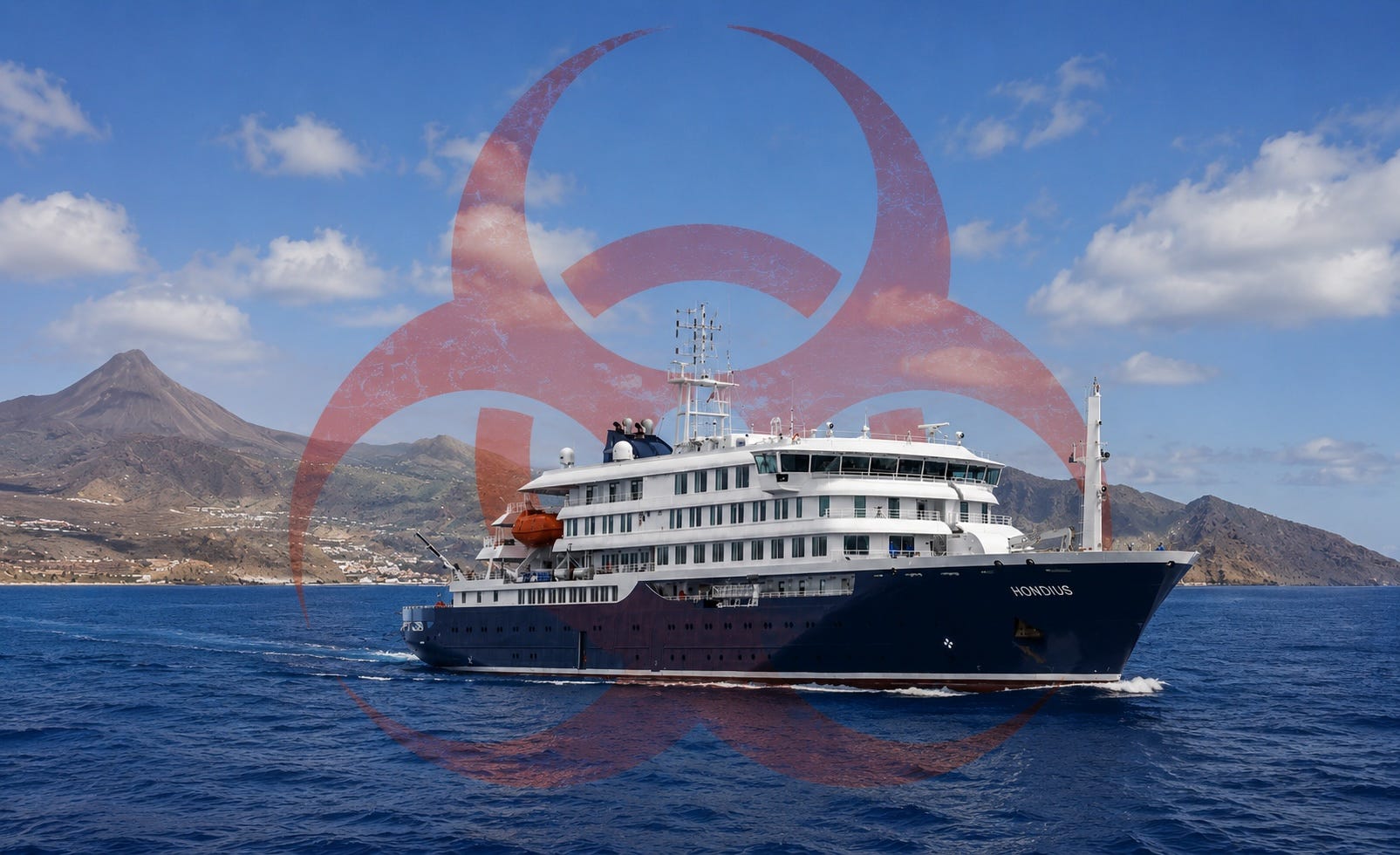
🦠 Panic over virus ship aimed at Spain
Plus: Ayuso goes to Mexico and an alternative to Eurovision.
Madrid | Issue #146
🇪🇸 The Bubble is Spain's #1 English-language, best-selling newsletter. We offer paid subscriptions, and we’d be thrilled to have your support!
🚨 Customize your subscription! You can personalize your Bubble experience so you only get the emails you want—and never the ones you don’t. Click here to learn how.
📺 Sponsorship opportunities. Want to get your brand in front of our engaged and influential audience of professionals, creatives, and government workers? We’re now offering a variety of ways to do so. Click here to find out how and book a spot.
Dear God, not again
⛴️ A cruise ship, a deadly virus… and Spain is right in the middle of it
The world has been glued to its screens for the past two days following the news unfolding in real time of a luxury expedition cruise ship drifting across the Atlantic with a deadly virus onboard — and now heading straight for Spain.
The MV Hondius is carrying around 150 passengers and crew. What started as a mysterious illness quickly escalated into something much more serious. Three people have died, and at least eight cases of hantavirus (a rodent-borne virus that can cause severe disease) have been confirmed or are under investigation.
The situation has snowballed into a multi-country health concern, and Spain is now at the center of it, because the ship is expected to dock in Tenerife on Saturday.
Quick recap. The cruise began in southern Argentina and made stops in extremely remote locations. Early on, a passenger fell ill and later died — but the cause wasn’t immediately identified.
The ship kept going. Passengers kept traveling. And crucially, dozens of people disembarked mid-journey and flew home before anyone realized what they might have been exposed to. At least one person who left the ship has already tested positive. Authorities are now trying to trace contacts across multiple countries
This isn’t The Last of Us. Hantavirus is not new (outbreaks in Argentina have been happening since, like, forever). It’s not easily transmissible (so please don’t say this is “just like COVID”).
It’s typically spread through contact with infected rodents, not casual human interaction. (Good). The Andes strain — the one detected here — can, however, lead to severe respiratory illness with mortality rates of up to 40% and can be transmitted from person to person if there’s very close, prolonged contact. (Bad).
There’s no vaccine, no specific treatment, and when symptoms worsen, things can deteriorate quickly.
Keep calm and carry on. On the ship, passengers are isolating, wearing masks, and limiting contact — but also reading, watching movies, and drinking tea. “Our days have been close to normal,” one passenger said. At least there’s that.
Now enter Spain. After being denied disembarkation in Cape Verde, the ship is heading to Tenerife following a request from the WHO, which has sparked… tension.
Why involve us? The Canary Islands government is openly questioning why passengers couldn’t be evacuated directly from Africa instead of bringing the situation to Spain.
You're not good at this. Regional president Fernando Clavijo has also complained about a lack of transparency and coordination from Madrid. On the ground, the reaction is simpler: people are nervous. (Remember COVID?.)
Full steam ahead. The central government, however, is sticking to the plan. Spain has activated EU emergency protocols and will handle the operation once the ship arrives.
Welcome to Spain. Passengers will be medically screened, foreigners repatriated, and the 14 Spanish nationals flown to Madrid for quarantine in a military hospital. Everything is being coordinated with European partners.
Please don’t panic. Health Minister Mónica García insists the risk to the general population is very low, while Fernando Simón, the Ministry’s Director of the Health Alerts and Emergencies Coordination Center, has gone out of his way to stress that this is “very, very different from COVID.”
What happens now? All eyes are now on Saturday, when the ship is expected in Tenerife. Passengers will remain onboard until evacuation flights are ready, and authorities will begin an operation to disperse them safely. Or maybe cause the end of civilization!
More news below. 👇👇
💬 Five things to discuss at dinner parties
1. 🇲🇽 Ayuso travels to Mexico and — surprise! — pisses off her hosts
Guess who’s in town. Madrid regional president Isabel Díaz Ayuso (PP) landed in Mexico on Sunday for what was supposed to be a 10-day official visit. Instead, it’s turned into a transatlantic controversy almost from day one — centered (surprise!) on history.
If you’re going to go controversial, go big. Things started to unravel when Ayuso backed a tribute to Hernán Cortés in Mexico City — you know, that Cortés. The one who overthrew the Aztec empire (with the help of other indigenous groups) and, in the process, massacred 3,000–6,000 unarmed people at Cholula, either to avoid an ambush or just because he wanted to.
Heck of a guy. Ayuso praised Cortés as “a key figure in the creation of modern Mexico,” argued Spain’s legacy is one of mestizaje (cultural/racial mixture) rather than something to apologize for, and warned against the “death of democracy under socialism,” naming both Spain and Mexico as examples. So: a light agenda.
Bad timing. Spain–Mexico relations have been shaky for years after former president López Obrador demanded an apology for colonial abuses, which Spain rejected. Recently, though, things were starting to thaw: King Felipe VI offered some conciliatory words, and Mexico’s president Claudia Sheinbaum lowered the temperature in a visit to Barcelona.
Then Ayuso shows up… and 💥.
Not amused — then amused. Sheinbaum fired back hard, saying anyone trying to reframe the conquest as something positive is “destined to fail.” But the next day, she walked it back, insisting Ayuso has “the right to speak” and this won’t derail bilateral relations.
Back in Spain. Digital Transformation Minister Óscar López called the trip “irresponsible” — no surprise, given that Sánchez is setting him up as the PSOE candidate to run against Ayuso in the next election.
Presidenta non grata? At a Mexican airport, a local woman confronted Ayuso directly, criticizing her conquest comments and pointedly reminding her that México is spelled with an “x,” not a “j” — something Ayuso loves to do because it provokes people. The video went viral almost instantly.
Wealthy Mexicans, who have been moving to Madrid in significant numbers, drawn for stability, lifestyle, and tax reasons, seem less stressed by Ayuso’s heroes, or her spelling.
Next stops? Monterrey and the Riviera Maya. We’re sure it’ll be calm. 🤣
2. 🇺🇸 Ceuta and Melilla are framed as ‘Moroccan’ in Washington

More surprises! Buried in a U.S. congressional budget document, a House committee has (for the first time) echoed Morocco’s long-standing claim over Spain’s Ceuta and Melilla.
The wording is doing a lot of heavy lifting. The two cities are described as being “in Moroccan territory” but “under Spanish administration”.
Um, like what “future”? The document encourages Secretary of State Marco Rubio (aka Mark Blondy) to help mediate their “future status.” (Translation: they are not quite Spanish, and are potentially negotiable). For the local government in these areas, this is a 🚩 (or a 🇲🇦, if you know what we mean).
Reality check. Ceuta and Melilla are not some ambiguous leftovers of the empire. They are Spanish cities, full stop, and have been for centuries.
Heap long time. Melilla has been Spanish since 1497. Ceuta since 1668. Their residents are Spanish citizens, they vote, they’re part of the EU, and Madrid treats them the same way it treats Barcelona or Seville. For Spain, they’re not colonies, not disputed territories, and definitely not up for negotiation.
Why this now? Because of who pushed it. The language was introduced by Republican congressman Mario Díaz-Balart, a close Rubio ally and member of the pro-Morocco caucus.
Freelance geography lessons. He’s been openly saying for weeks that Ceuta and Melilla are “in Morocco,” and that their status should be discussed “between allies.” That framing is exactly what Rabat has been arguing for years.
Not law (yet). This is all part of an explanatory report attached to a budget bill. It still needs to pass the full House, then the Senate. But politically, it matters.
Great timing, too. Spain and the U.S. are not in their best moment. There’s been friction over Spain not doing its NATO spending, telling the U.S. it can’t use Spanish bases to attack Iran, and fighting with U.S. BFF Israel.
Two great tastes that taste great together. At the same time, the U.S. has been doubling down on its alliance with Morocco (which signed a normalization agreement with Israel during Trump I).
Do not escalate. Foreign Minister José Manuel Albares brushed it off with a line that says everything: the Spanishness of Ceuta and Melilla is “as unquestionable as that of Santiago de Compostela.”
Don’t forget us! PP leader Alberto Núñez Feijóo is heading to Ceuta this Saturday to mark Europe Day there and use the visit to “reaffirm the Spanishness” of both cities (and push for stronger EU backing).