

Skip to content
Madrid

đŸ’„ 'Kolditchen': Spain’s corruption double feature

Also: A dispute over Guernica, more stuff about Iran and the taxman cometh.

Because Spain deserves its own Barbenheimer.

Madrid | Issue #142

đŸ‡Ș🇾 The Bubble is Spain's #1 English-language, best-selling newsletter. We offer paid subscriptions, and we’d be thrilled to have your support!

🚹 Customize your subscription! You can personalize your Bubble experience so you only get the emails you want—and never the ones you don’t. Click here to learn how.

đŸ“ș Sponsorship opportunities. Want to get your brand in front of our engaged and influential audience of professionals, creatives, and government workers? We’re now offering a variety of ways to do so. Click here to find out how and book a spot.

Become a paid or free subscriber


Grab the popcorn

⚖ Spain’s two biggest corruption cases hit court at the same time

It’s time for “Kolditchen”! That’s right, Spain’s peculiar judicial version of the 2023 double feature hit “Barbenheimer” just arrived in a theater courtroom near you, and we couldn’t be more thrilled.

  • Party x2. Both the Kitchen case (corruption in the PP!) and the Koldo case (corruption in the PSOE!) trials are starting in the same week by complete coincidence (or so we hear).

And really, how often do you get to watch Spain’s two main political parties get breaded in corruption and dunked in hot oil like the croquetas we wish they were?

  • It’s still early days in these trials. So we’re far from ready to put a bet prediction on Polymarket on who will go to jail. But a few things seem to be coming clear so far: everything politicians say is being recorded, pretty much nobody works in Spain, and women get the short end of the stick. So let’s get to it!

But first, a brief legal history lesson. Here's why each case is so relevant.

Caso Kitchen revolves around an alleged covert operation launched in 2013 by Spain’s Interior Ministry under PP PM Mariano Rajoy, which (allegedly) used police resources and secret state funds to spy on former PP party treasurer Luis Bárcenas. The goal? To obtain and potentially destroy documents linked to the party’s illegal financing.

  • Why the name? It’s called “Kitchen” because the operation referred to BĂĄrcenas' driver, who was allegedly recruited as an informant, as “the cook” (apparently he looked like a famous Spanish chef).

  • Best costume: One of the strangest episodes involved a man disguised as a priest who stormed BĂĄrcenas’ home at gunpoint in an apparent attempt to steal incriminating documents.

Caso Koldo revolves around an alleged corruption scheme during the pandemic, in which former Transport Minister JosĂ© Luis Ábalos (PSOE), his advisor Koldo GarcĂ­a, and businessman VĂ­ctor de Aldama are accused of taking commissions in exchange for awarding public contracts for medical masks. We’ve covered this case in excruciating depth.

  • Ye olde kickbacks. Prosecutors say they used privileged information and emergency procurement rules to steer contracts to companies linked to Aldama. They face charges including bribery, influence peddling, and embezzlement.

First, Koldo. You might think that a major trial about kickbacks on public contracts would focus on, well, kickbacks on public contracts. But you’d be wrong. The first two days of the Case Koldo dove deep into ex-Transport Minister Ábalos’s (extramarital) lovers, and how they were plugged into apartments and government jobs by Koldo and Aldama. đŸ€Š

  • Doesn’t anybody work around here? One former Ábalos lover, JĂ©sica RodrĂ­guez, who lived in a €2,700/month apartment paid for by an associate of Aldama, earned €44,000 from two public administrative assistant jobs she was given but never worked at. When asked why she didn’t work, she said she was waiting for Koldo or his brother to tell her what to do 😂.

  • Staring at a wall. Another Ábalos lady was former Miss Asturias Claudia Montes (no, he is not that attractive; it’s just that politics is Hollywood for ugly people). After being plugged into a state rail industry job, she was placed in an office corner facing the wall. Feeling that her services weren’t being used, she said she reported the situation to Ábalos and Koldo GarcĂ­a and, in the meantime, spent her work hours reading books in Oviedo’s library. Pressed by the presiding judge, she clarified that they were always “books about trains.”

  • Not nice. JĂ©sica definitely got it worse. Ábalos’s lawyer went on a smear campaign to suggest that she and the ex-transport minister had never been actual partners, asking her if she was a prostitute — a move that caused conternation in court and in the press room. Her (well played) answer? “No. I’m a registered dentist.”

Ooooh, we’re gonna watch this one! There’s clearly more fun to come.

And now the Kitchen. More than a decade after the alleged espionage took place, former Interior Minister Jorge Fernández Díaz, his deputy Francisco Martínez, and several senior police officials are finally set to face trial. That said, so far the trial’s big moments have been mostly procedural.

  • No more delays. Judges rejected attempts by the defense to annul the proceedings or move them out of Spain’s High Court, arguing that it was time to finally examine what happened.

  • Can we expand? Piling on, the PSOE asked the court to expand the investigation and bring back former PP secretary general MarĂ­a Dolores de Cospedal, arguing that new audio recordings suggest she may have played a more significant role than previously established.

  • Well, no. The court and the prosecution ruled that Cospedal had already been cleared during the investigation phase and that reopening that line of inquiry would only delay the trial further.

Expect to hear more about this. Did parts of the state apparatus act illegally to protect a political party from a corruption scandal? So far, this trial has been the less spicy of the two, but that could change.

More news below. 👇👇


🔔 But first, check out our sponsor — Bureaucracy.es

We’ve teamed up with our friends at Bureaucracy.es to bring you more resources about immigration and life in Spain. Check out our guides on how to get a Spanish Digital Nomad Visa or Non-Lucrative Visa.

  • If you’d like their help with the paperwork to apply for these visas, or need someone to guide you through the Spanish citizenship application process, you can hire them using this link (and, in the spirit of full transparency with our subscribers, The Bubble will receive a small commission).


💬 Five things to discuss at dinner parties

1. đŸ‡źđŸ‡· Spain: No to war, yes to NATO, Orange Man bad
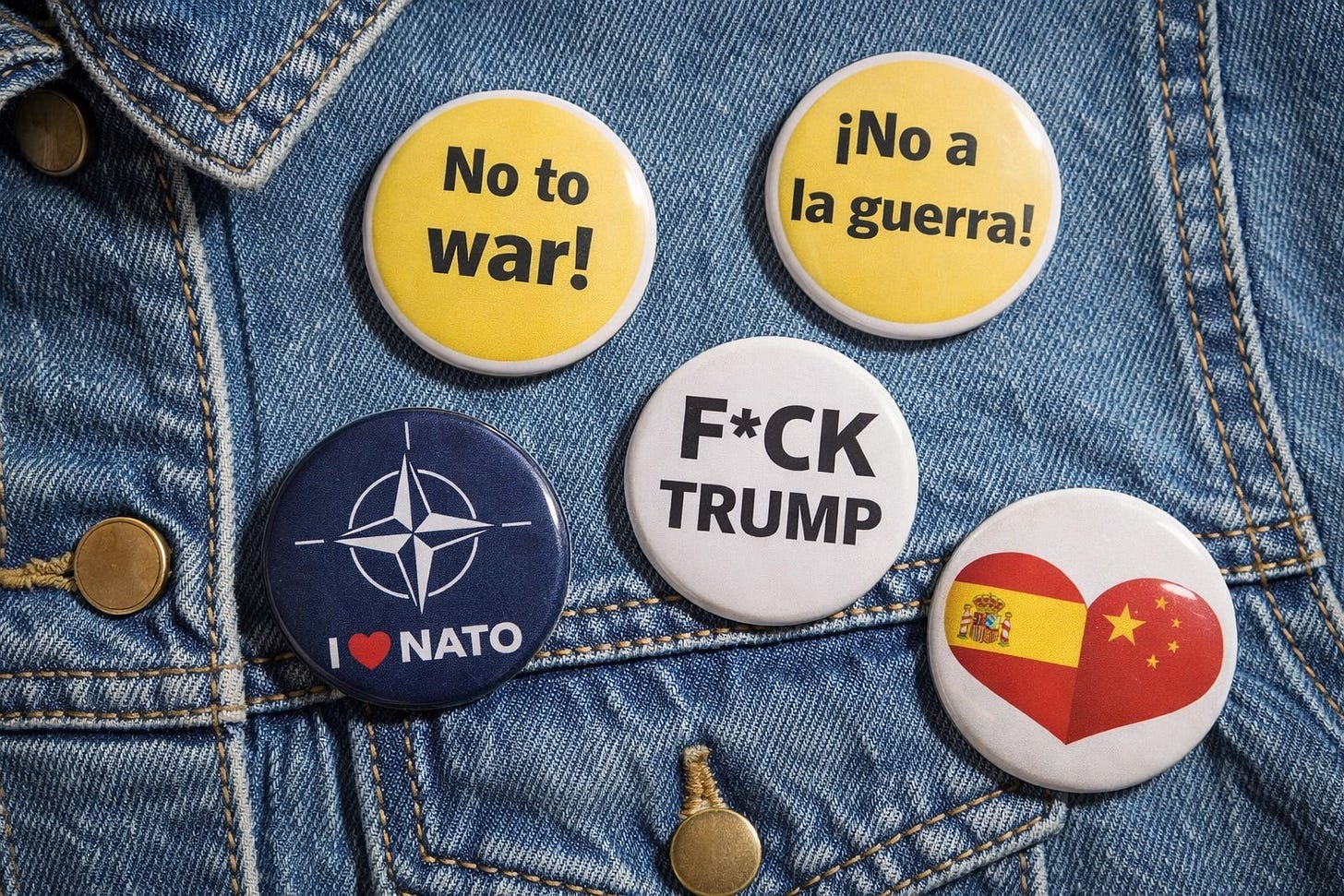
Now that WW3 has been postponed for two more weeks, here’s a roundup of Iran news as it relates to Spain (we'll leave the world press to tell you the rest). The tl; dr version? Whatever is happening in the Middle East, Spain doesn’t want to be dragged into it.

We’re busy, sorry. Foreign Minister JosĂ© Manuel Albares said this week that Spain turned down an invitation to join a high-level international meeting on the Strait of Hormuz, convened by the U.K. and attended by more than 30 countries.

  • For what? The meeting was meant to coordinate a response to the crisis and guarantee freedom of navigation in one of the world’s most strategic waterways.

  • No to war. According to Albares, Madrid refused to participate because it would not be part of “any discussion that could involve military intervention or escalate the war.”

Guess who’s applauding. China praised Spain’s position, with its ambassador in Madrid going as far as saying that Pedro Sánchez is seen as a “hero” in Chinese public discourse (maybe a bit much). Beijing has framed Spain as a responsible, peace-oriented actor, essentially saying Madrid is in line with its own stance. But don't get too excited about this; it's probably just another way for Beijing to troll Trump.

  • Not exactly neutral praise. At a time when the U.S. is pushing allies to do what it says and contribute to its war security efforts, Spain is taking a more ambiguous route: maintaining ties with Washington, but also strengthening its ties with China and positioning itself closer to what Beijing calls the “Global South.” (It is rather warm in Spain, after all.)

President non grata. A new 40dB./El PaĂ­s poll shows that Donald Trump is viewed by Spaniards as the biggest threat to global peace, slightly ahead of Vladimir Putin. The Orange Menace, always ready to collect a prize, will probably be happy about this.

  • Worry all around. Yes, El PaĂ­s is a left-leaning, pro-PSOE publication. But you should know that even conservative voters ranked Trump as a major risk, though they place Putin slightly higher. The only voters who are relatively comfortable with Trump (and Netanyahu) are those of Vox (shocker). And the only ones good with Putin? Podemos (also shocker).

  • But here’s a twist. Despite the anti-war mood and an ambiguous take on increasing defense spending, support for NATO remains strong across the board. Nearly two-thirds of Spaniards want to stay in the alliance (with only Podemos voters clearly backing an exit; again, shocker).

Official Iranian trolling. Remember how the PP was timid about criticizing Trump when he started bombing Iran? Well, it looks like Trump’s Easter message about destroying Iranian civilization may have been a bit too much, so PP boss Alberto NĂșñez FeijĂło took to X to call for “sensibility, not brutality”.

  • His tweet prompted the Iranian Embassy in Spain to reply somewhat cheekily “better late than never.” Iranian embassies around the world have launched a global trolling campaign against Trump — and people have noticed.

2.🎹 Spain is fighting over Guernica. Yes, the painting.

Put up your dukes! The Holy Week is over, so Spain can go back to its regular political drama. This time it’s not about housing or inflation, but a painting. Specifically, Pablo Picasso's iconic Guernica and whether it should leave Madrid.

  • Never simple. What started as a relatively predictable institutional request has turned into a political clash between the Basque government and Madrid, with regional presidents Imanol Pradales (from the Basque nationalist PNV) on one side and Isabel DĂ­az Ayuso (PP) on the other.

Art history lesson. Painted in 1937, Guernica is not just another famous artwork; It’s one of the world’s most powerful political paintings of the 20th century.

Enter the Basque Country. A couple of weeks ago, Pradales formally asked PM Sánchez to allow the painting to be temporarily moved to Bilbao. (Btw, this isn’t the first time they’ve asked.)

Computer says no. The response from Madrid was quick and (at least initially) quite technical.

Enter Madrid’s presi. Speaking on Monday, Díaz Ayuso dismissed the proposal as a “catetada,” (essentially calling it provincial nonsense), and argued that culture should not be treated as something to be divided territorially.

Please stop. At the Senate this Tuesday, Urtasun tried to shut the debate down for good, making it clear that the government would simply follow expert advice and leave the painting where it is.

Here we are again. In our political happy place.

3. đŸ€‘ The Tax Man is back — and he wants your đŸ’¶

It’s the most wonderful time of the year đŸ„ł! (Wait for it.) Tax season! But yes, all sarcasm aside, the filing season for Spain’s IRPF (income) taxes began yesterday. Because we love you, we thought we’d do as much as we could (in a few hundred words) to walk you through what to expect from Spain’s convoluted tax system this year.

What’s new this year? The headline change is a new deduction of up to €340 for lower earners, designed so workers on or around the 2025 minimum wage (€16,576) don’t lose the benefit of that pay rise to tax.

One thing that’s almost inevitable? You’ll pay more this year. Not because you did anything wrong, but because Spain has again not adjusted IRPF brackets for inflation. So as salaries rise nominally, more of your income gets pushed into higher tax bands even if your real purchasing power hasn’t actually improved. Economists call it bracket creep. We call it đŸ’©.

4. 🛬 Qatar Airways’ new big airport hub is in
Teruel?

Yeah, yeah, we know the joke: Teruel tambiĂ©n existe. That snide reference to the largely empty desert-ish Aragonese province — as in, it exists, but not much more. But don’t tell that to the Qataris or the Emiratis or pretty much anyone else in the no-fly zone that is the Persian Gulf these days. Because for them, Teruel does a lot more than exist — it serves as their new home.

Don’t think I’ve ever been there. There’s a reason: you haven’t. The Aeropuerto de Teruel, built in 2013 on the site of an old military aerodrome that was used in the civil war, doesn’t do passengers. It does something far more niche and increasingly lucrative: parking, maintaining, and recycling planes.

And it’s only getting bigger. The airport is on its fourth expansion, adding more hangars (including a blimp facility — because who doesn’t miss the Hindenburg). There’s a new aerospace engineering degree launching locally, and Spain’s Defense Ministry is adding a €42m training center. Keep on existing, Teruel!

5. ⚜ FIFA is investigating Spain for racist chants

Not every joke is funny. The world football body FIFA announced this week it was opening disciplinary proceedings against Spain over “Islamophobic and xenophobic” chants during a friendly national team game between Spain and Egypt. Which, when you’re preparing to host a World Cup in partnership with Morocco (checks notes — a Muslim country), is not a great look.

The Spanish football federation condemned the chants. So did Egypt’s, calling them “loathsome.” And Spain coach Luis de la Fuente weighed in, voicing his “total and absolute disgust.”

Not a first for Spain. The incident is part of a history of racist behavior in European football. Spain has struggled with fan chants targeting players for their race. Example? In May 2023, Real Madrid star VinĂ­cius Jr. faced racist insults from Valencia fans during a La Liga match.

The issue this time? It wasn’t a nationality or a team nickname. It was race or religion. Which is, um, less than cool. Or, really, just ugly.


🙏 Once again, please remember to share this newsletter with your friends on social media. The more we grow, the more information we’ll be able to offer each week.

Share

Read the original on Substack